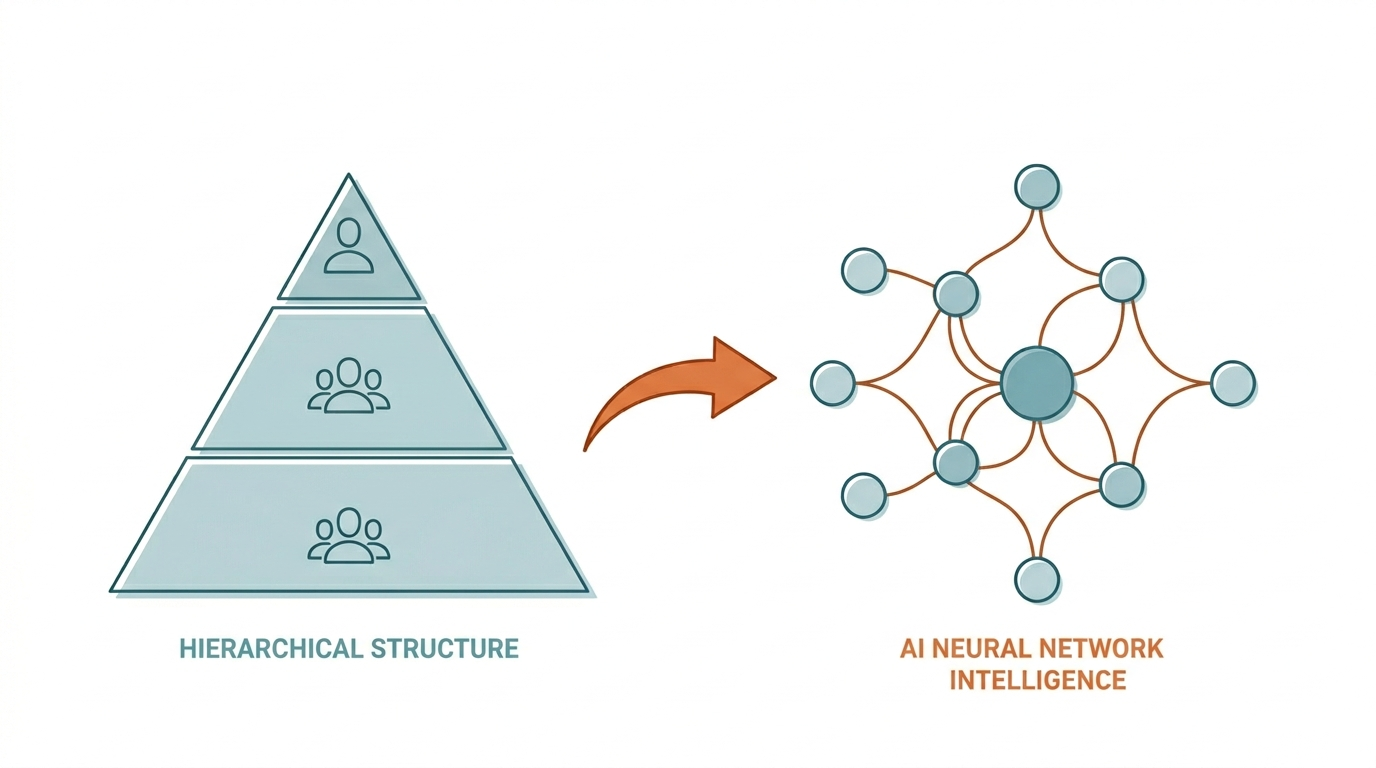
TL;DR: From Roman legions to Silicon Valley, the core architecture of human organizations hasn't fundamentally changed in two millennia. Block proposes a four-layer AI framework that replaces middle management's information coordination function — not its decision-making role.
Your Company Still Runs on a Roman Blueprint
A Roman legion had a precise organizational design: 8 soldiers per tent, 10 tents per century, 60 centuries per legion — roughly 5,000 people. The entire structure was dictated by a single cognitive constraint: span of control. One person can effectively manage 3 to 8 direct reports. That's it.
This number is essentially a human cognitive constant. The Prussian army invented the staff officer system in the 19th century — the prototype of modern middle management — to compensate for commanders' limited bandwidth. In the 1850s, American railroad companies transplanted this logic into business, drawing the first organizational charts in history.
Since then, every company has been answering the same question: how many people can one manager handle? When the answer is "not enough," add another layer. More layers mean slower information flow and sluggish decisions. But there was no better alternative.
Until now.
 Figure 1: From Roman Legions to Modern Corporations — 2,000 Years of Organizational Hierarchy
Block's Four-Layer "Intelligence"
Jack Dorsey and Sequoia Capital's Roelof Botha proposed a framework in early 2026 that uses AI to replace middle management's core function — not decision-making, but information coordination. The stuff that consumes 80% of a middle manager's time: alignment meetings, status updates, progress tracking.
The architecture has four layers:
Capabilities (bottom layer): Every business function decomposed into atomic modules — payments, lending, card issuance, payroll. Each module has defined reliability, compliance, and performance specs, but no user interface of its own.
World Model (the critical layer): Split into two halves — a Company Model (real-time tracking of team status, resource allocation, task progress) and a Customer Model (built from Cash App and Square's bilateral transaction data to construct a real-time profile of every customer).
Intelligence: Automatically assembles the optimal service package based on a customer's real-time state. Detects that a coffee shop's cash flow tightens every autumn? It pre-assembles a matching short-term loan before the owner even notices.
Interface (top layer): Square, Cash App, Afterpay — these are just delivery channels. The real value lives in layers two and three.
 Figure 2: Block's Four-Layer Company-as-Intelligence Architecture
Why Every Previous Attempt Failed
"Flatten the hierarchy" is not a new idea. At least four major experiments in the past two decades:
Spotify launched its "Squad Model" in 2012 — small cross-functional squads replacing departments. It worked beautifully until the company hit 3,000 employees and quietly reintroduced traditional coordination layers. Zappos adopted Holacracy in 2013: 18% of employees quit immediately, annual turnover hit 30%, and everyone spent 5 extra hours per week just figuring out the new system. Valve's flat structure worked under 300 people but spawned invisible power hierarchies at scale — no titles didn't mean no power imbalance.
Haier's "RenDanHeYi" is the only partial success: 4,000+ micro-enterprises, 7+ years of gradual transformation. But it's deeply rooted in Chinese manufacturing culture and has never been successfully replicated elsewhere.
The common failure: all four tried to replace hierarchy's coordination function with culture, process, or rules — none offered a genuine technological alternative. Block's bet is that an AI World Model can.
 Figure 3: Four Flat-Organization Experiments Compared — Spotify, Zappos, Valve, Haier
The Critical Prerequisite: Can Your World Be Modeled?
Block has an advantage most companies can't replicate: it simultaneously owns Cash App (consumer side) and Square (merchant side) transaction data. Money flow is the most honest signal — a single transaction tells you what the consumer bought, what the merchant sold, when, where, and how often.
This bilateral data density is globally rare.
For most companies, reality is far messier. In hospitals, critical decisions happen at the bedside — most signals never get digitized. In retail, a customer's facial expression, tone, hesitation — all invisible to AI. In labs, a researcher's gut feeling that "these cells don't look right" is tacit knowledge that can't be modeled.
Block's framework isn't a universal solution. It's an experiment with prerequisites: if your business generates sufficient digital record density, and that density compounds daily, AI can create a flywheel advantage. If not, AI is just a cost-cutting tool.
The Takeaway
Block's experiment has just begun, and they openly acknowledge some designs may fail. But it poses a question worth serious consideration:
How much of the "management" in your organization is actually "information logistics"? If AI can handle the logistics, what should the remaining humans focus on?
Perhaps the answer is: return to where human judgment truly matters — creation, decision-making, and building trust.
A 2,000-year bottleneck won't break overnight. But the cracks are showing.
References
- Fox Hsiao (2026). 公司即智能體:Block 提出管理史上最激進的組織架構. Anduril.
- Dorsey J, Botha R. (2026). Company as Intelligence. Block Inc. / Sequoia Capital.
- Bernstein E, et al. (2016). Beyond the holacracy hype. Harvard Business Review. hbr.org
- Mankins M, Garton E. (2017). Time, Talent, Energy: Overcome Organizational Drag and Unleash Your Team's Productive Power. Harvard Business Review Press.
- Hamel G, Zanini M. (2018). The end of bureaucracy. Harvard Business Review. hbr.org