Your cells don't age gradually. They collapse at specific thresholds.
Why Does Aging Research Feel So Fragmented?
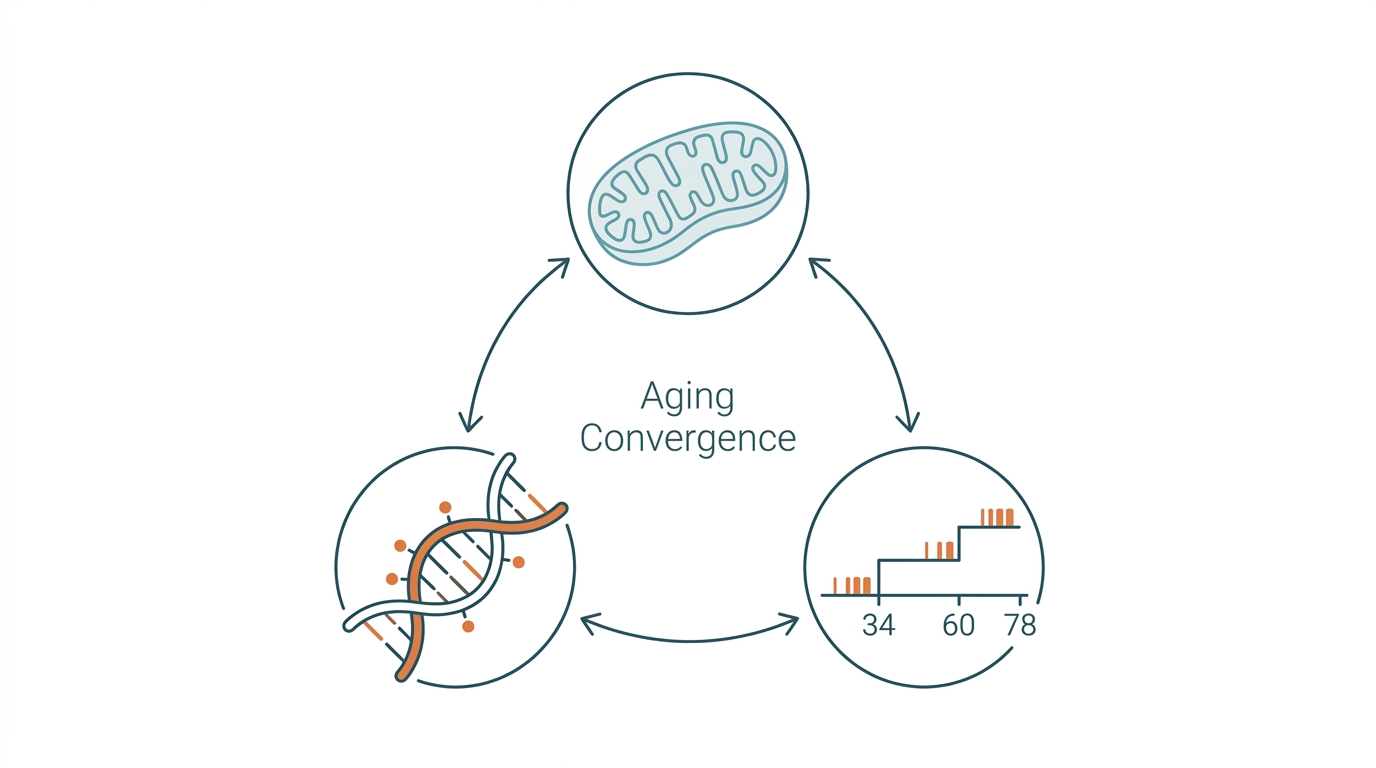
Every aging research subfield tells its own story in its own language. But multiple studies from 2025-2026 are breaking down these walls, converging on a single unified framework: mitochondria handle real-time regulation, epigenetics manages long-term memory, and aging accelerates through three irreversible transition windows.
Telomere shortening, senescent cell accumulation, proteostasis breakdown — you've probably heard all of these. The problem is that each mechanism stands alone, lacking a thread to weave them together.
Step back far enough, and the thread appears. We can reframe what aging actually breaks by examining how three subsystems interact.
Mitochondria: Not Just Batteries, But Commanders
Mitochondria do far more than produce energy. They simultaneously serve as signaling hubs, quality controllers, and cell fate arbiters — a distributed command network inside every cell.
Textbooks call mitochondria "the powerhouse of the cell," but that metaphor drastically undersells them. Recent research shows mitochondria juggle four responsibilities at once:
- Energy regulation: dynamically adjusting ATP output to match demand
- Signal relay: sending "status reports" to the nucleus via ROS, Ca2+, and metabolic intermediates
- Quality control: eliminating damaged units through mitophagy
- Fate decisions: triggering apoptosis through cytochrome c release
Each cell contains hundreds to thousands of mitochondria, constantly reshaping their network topology through fission and fusion dynamics in response to environmental stress. Think of them as independent sentries that merge and split to redistribute resources. Once this network ages and the sentries slow down, the entire cell loses its ability to respond in real time.
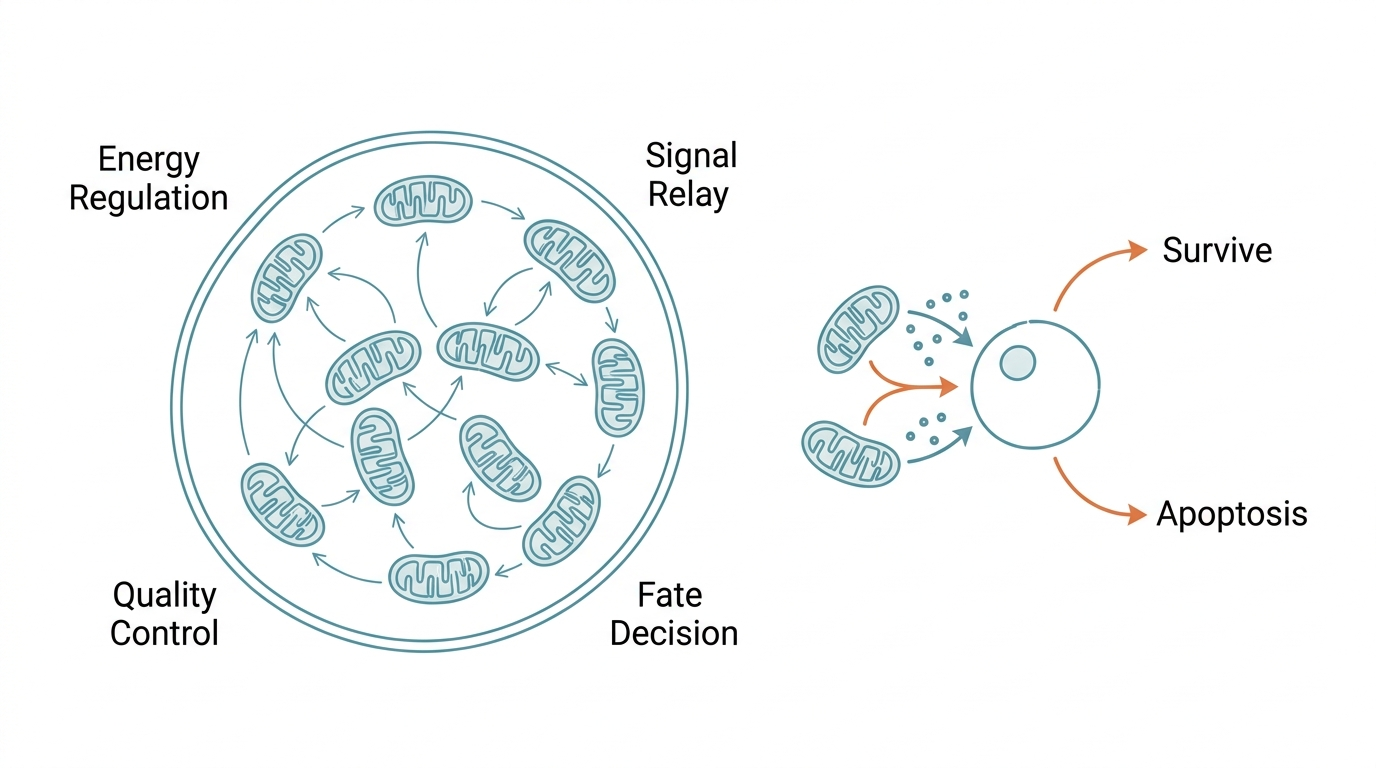 Figure 1. The mitochondrial network functions as a distributed orchestrator within the cell, coordinating energy, signaling, quality control, and fate decisions.
Epigenetics: The Cell's Long-Term Memory
Epigenetic marks determine which genes are read and at what intensity. During aging, these marks gradually blur, and cells slowly "forget" their identity.
If DNA is the hard drive, epigenetics is the operating system's registry. Over time, the registry settings drift. Like a document photocopied over and over, each copy slightly fuzzier than the last. Liver cells start expressing genes from other tissue types. Differentiation boundaries dissolve.
Yamanaka factors can partially reset this memory system, allowing cells to "remember" their youthful gene expression patterns. But here's the catch: reset too much, and the cell loses its identity entirely, reverting to a stem cell state. Reset too little, and the effect is negligible. That "just right" window is extremely narrow — and the hardest part of current research.
It's worth noting that Yamanaka factor reprogramming remains in animal model stages as of 2026. The "rejuvenation effects" observed in mice cannot be directly extrapolated to humans. Excessive reprogramming carries tumor risk — a safety concern that must be resolved before clinical translation.
Transition Windows: Aging Isn't Linear
A 2019 study by Lehallier et al. in Nature Medicine tracked plasma proteome profiles across 4,263 participants and found that aging doesn't accumulate at a constant rate. Instead, it accelerates through three sharp nonlinear jumps at approximately ages 34, 60, and 78.
You might assume aging is a smooth downhill slope. It isn't. It looks more like a staircase with three steep drops, where the proteome, metabolome, and immune parameters all shift dramatically at once.
This yields three practical implications:
- Timing matters more than method. Deploying protective measures before a transition window delivers far greater returns than remedial action afterward
- "Anti-aging" isn't doing the same thing every day — it's doing the right thing at the right time
- Biological age measurement should include "how far from the next transition point" as a dimension
But honesty demands acknowledging a limitation: this study's participants were predominantly white Europeans and Americans. Whether the 34/60/78 thresholds apply to Asian populations lacks direct evidence. Genetic background, dietary patterns, and environmental factors could all shift these window positions.
Exercise: The Best Tool for Crossing Windows
Moderate-intensity exercise simultaneously activates three molecular pathways — BDNF for brain plasticity, IGF-1 for mitochondrial biogenesis, and AMPK for autophagy — making it the most evidence-backed cross-system anti-aging intervention available.
Why does exercise slow aging? "Improving cardiovascular fitness" is only the surface-level answer. The molecular mechanisms are well established:
BDNF (brain-derived neurotrophic factor): rises sharply after moderate aerobic exercise, promoting hippocampal neurogenesis and synaptic plasticity. This doesn't "make you smarter" — it preserves the brain's structural remodeling capacity, which is precisely what deteriorates earliest during aging.
IGF-1 (insulin-like growth factor 1): stimulated by resistance training, it promotes whole-body tissue repair and mitochondrial biogenesis. More newborn mitochondria means a stronger energy network and more precise quality control.
AMPK activation: exercise simulates energy scarcity, triggering autophagy to clear damaged proteins and dysfunctional mitochondria. Your body has a built-in recycling system — exercise is the button that turns it on.
Think of it this way: exercise is to cells what stress testing is to software. Moderate stress surfaces weak points, triggers repair mechanisms, and ultimately builds greater resilience.
The Tea Extraction Metaphor: Everything Has an Optimal Window
Tea catechin extraction has a precise window: 3-5 minutes at 80 degrees C. Too brief and extraction is incomplete. Too long and excess tannins make it bitter.
This chemical phenomenon maps directly onto the philosophy of aging intervention. Yamanaka factor reprogramming has a window. Exercise intensity has a sweet spot. Fasting-induced autophagy has a threshold. The central challenge of biology isn't "what to do" but "when and how much."
It's easy to get drawn in by "breakthrough research" headlines and overlook dosage and timing. Next time you read any anti-aging news, try asking three questions: Which subsystem does it target? At which transition window? Does it account for cascading effects across the other two?
If you can answer those three questions, you're already seeing past most anti-aging marketing.
Frequently Asked Questions
Q: At what ages do the three transition windows occur? A: According to Lehallier et al. (2019), plasma proteome profiles show nonlinear shifts around ages 34, 60, and 78, with biological markers changing far more rapidly at these thresholds than at other ages.
Q: Can exercise actually reverse aging? A: Exercise cannot reverse aging, but it slows decline across all three subsystems: BDNF promotes neural plasticity, IGF-1 drives mitochondrial biogenesis, and AMPK activates autophagy. Effectiveness depends on timing and intensity.
Q: Can Yamanaka factor reprogramming be used in humans yet? A: As of 2026, partial reprogramming remains in animal model stages. The main bottleneck is dose control: excessive reprogramming can cause dedifferentiation and tumor risk.
References
- Lehallier, B. et al. (2019). Undulating changes in human plasma proteome profiles across the lifespan. Nature Medicine, 25, 1843-1850.
- Lopez-Otin, C. et al. (2023). Hallmarks of Aging: An Expanding Universe. Cell, 186(2), 243-278.
- Mitochondrial Information Processing theory (2025).
- Cotman, C.W. & Berchtold, N.C. (2002). Exercise: a behavioral intervention to enhance brain health and plasticity. Trends in Neurosciences, 25(6), 295-301.