
TL;DR
Edit Banana is one of the more ambitious attempts to turn static diagrams back into editable assets. That matters a lot for research figures, teaching materials, and workflow charts. The catch is that the stack is heavy.
Why it stands out
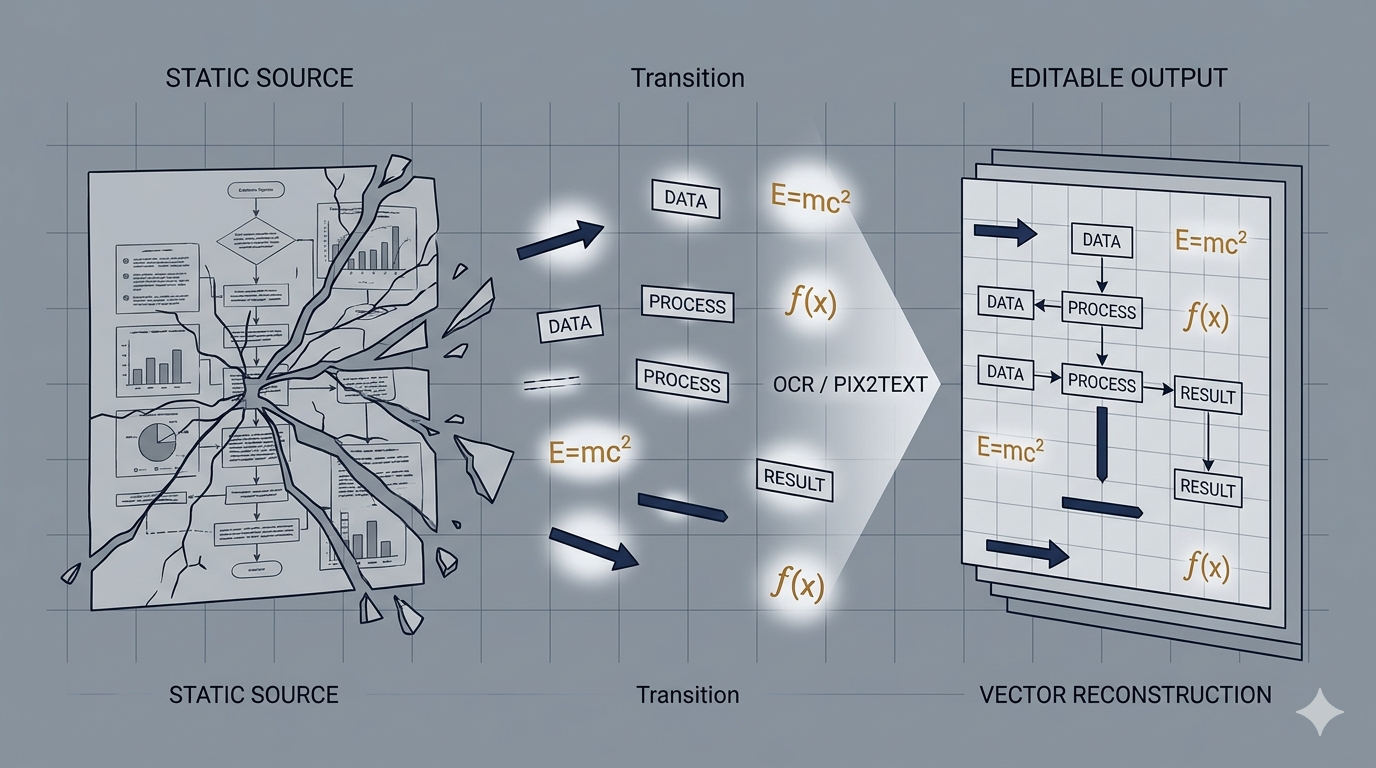
This is not just OCR. Edit Banana tries to reconstruct structure: shapes, arrows, layout, text, and even formulas. The research note describes a pipeline built from SAM3 segmentation, multimodal understanding, Tesseract OCR, and Pix2Text for formula recognition.
That is why the output story is compelling. Instead of extracting text alone, the project targets DrawIO XML, SVG, and PPTX. For people who regularly rebuild diagrams by hand, that is a meaningful promise.
Where the cost appears
The deployment story is much less lightweight. The project expects Python 3.10+, benefits from CUDA GPU, and depends on multiple components and model downloads. In other words, the usefulness is real, but so is the setup burden.
The license also matters: the project is AGPL-3.0, which should be treated as a practical consideration, not a footnote.
Who should care
- Researchers working with paper figures
- Educators updating teaching diagrams
- Teams with repeated, high-value diagram conversion needs
Who probably should not
- Casual users with occasional one-off needs
- Anyone expecting a simple local install
- Users without the patience or hardware for a heavier ML stack
Verdict
Edit Banana is worth watching because the problem it targets is real and the technical approach is stronger than a typical OCR utility. But until setup becomes easier, this remains a watch tool: impressive, useful in the right context, and too heavy to recommend broadly.