
If you only watch the stock chart, this looks like market mood. If you step back and read the technical claim, the question gets harder: is AI's most painful memory bill finally starting to loosen?
Lead: After Google Research published TurboQuant on March 25, 2026, the conversation was no longer just about a clever algorithm. It was about whether the cost curve behind AI infrastructure had to be redrawn.
Why would one paper bother Wall Street?
To investors, TurboQuant matters because cheaper KV cache could force a rewrite of AI infrastructure cost assumptions.
Around March 25-26, 2026, market coverage quickly linked TurboQuant to weakness in memory names. Investing.com reported Samsung down 4.8%, SK Hynix down 5.9%, and U.S. peers such as Micron, SanDisk, Western Digital, and Seagate off 3% to 6%. That does not prove a single paper "crashed" the market. It does show how sensitive investors are to any sign that AI may need less memory per workload than previously assumed.
Why is KV cache such a sensitive bottleneck?
KV cache is like an AI system's running notebook: as context grows, it often fills GPU memory before users notice anything else.
A model is not only answering your prompt. It is also trying to remember what came before. That memory behaves like a desk covered with sticky notes: before the conversation is done, the desk is already full. So when a product wants longer sessions, longer documents, or more concurrent users, the first limit is often memory, not raw compute.
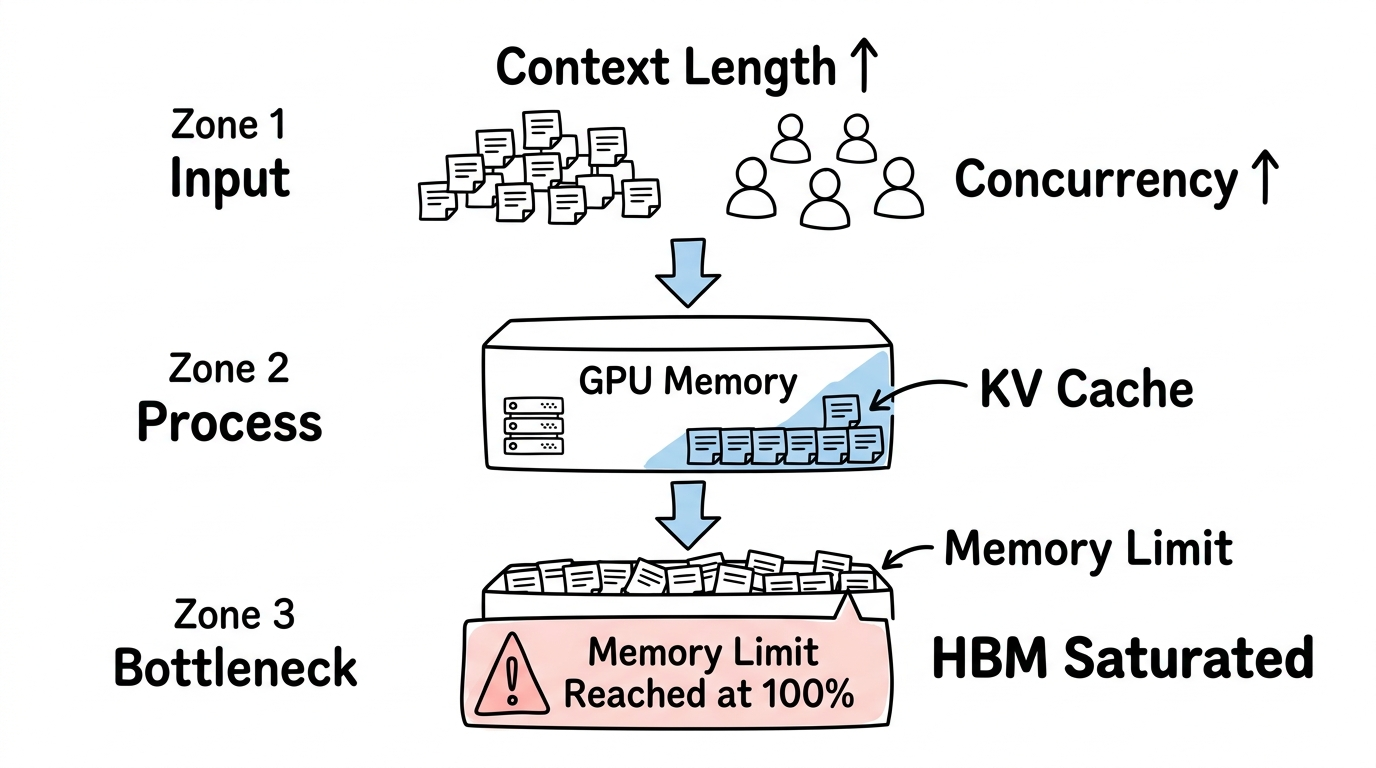
Figure 1. As context windows and concurrency rise, KV cache behaves like an increasingly crowded work desk: memory pressure arrives first.
What does TurboQuant actually do?
TurboQuant uses PolarQuant to reshape the data distribution and QJL to correct the residual error, aiming to compress KV cache down to 3-bit without retraining.
Google Research's public write-up makes the core claim clearly: KV cache memory can drop by at least 6x, and 4-bit TurboQuant can deliver up to an 8x speedup for attention-logit computation on H100 GPUs. What makes that interesting is not the headline number alone. It is the target. TurboQuant goes after the fast memory layer that has been especially expensive to scale. Still, these results come from public long-context benchmarks on Gemma and Mistral. They should not be read as proof that every production stack will see the same gain immediately.
What is the market actually afraid of?
The market is not afraid of a formula. It is afraid that the old line of "more AI growth equals more memory demand" may no longer stay straight.
For the past two years, much of the memory narrative has rested on one simple chain: bigger models, longer context, more users, therefore more high-bandwidth memory. TurboQuant disrupts that chain because it suggests the storage geometry itself can change. But this is also where caution matters. Inventory cycles, capex, macro conditions, and sentiment all move share prices too. Any claim that explains the entire move with one paper is overstated.
Why cheaper memory does not guarantee lower demand
When inference gets cheaper, companies often do not slow down. They use the savings to buy longer context, higher concurrency, and more agents.
That is the AI version of the Jevons paradox. Lowering the unit cost does not remove ambition. It removes friction. Once the barrier drops, teams try things that were previously too expensive: longer conversations, denser monitoring, larger systems, and more simultaneous sessions. The real question is not whether memory demand disappears, but how that demand gets reorganized.
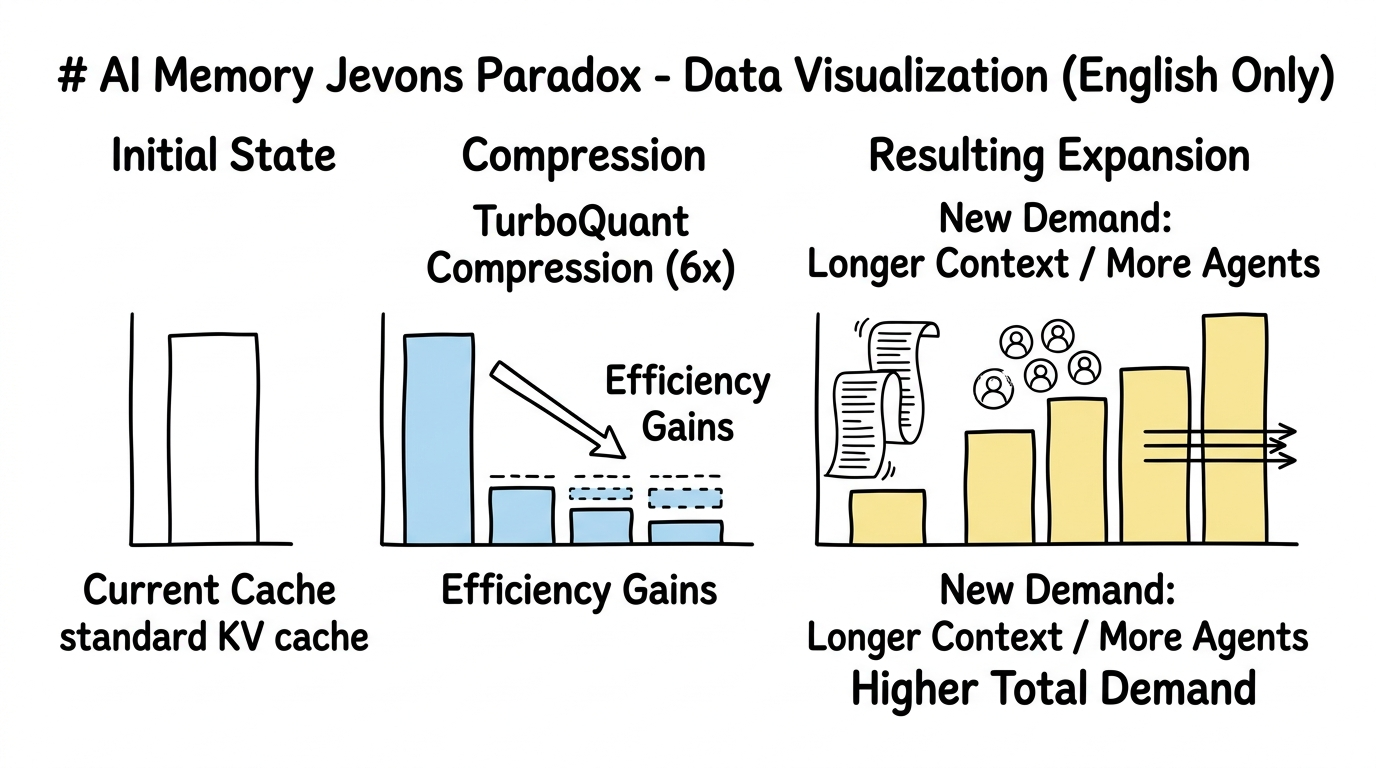
Figure 2. Better compression lowers unit cost first, but companies often spend the freed capacity on longer context, more agents, and higher concurrency.
Why should you care?
For ordinary readers, TurboQuant matters because it could make AI better at reading long documents, sustaining long conversations, and reaching viable product economics sooner.
What you are likely to feel is not the math but the product shift: AI that forgets less, handles larger reports, and stays steadier under shared usage. If TurboQuant-like methods land in production, the next bottlenecks will move toward power, latency, model quality, and product design. The thing being rewritten is not just cost. It is the roadmap.
References
- Zandieh, A. et al. (2026). TURBOQUANT: Online Vector Quantization with Near-Optimal Distortion Rate. ICLR 2026. https://openreview.net/forum?id=tO3ASKZlok
- Google Research. (2026-03-25). TurboQuant: Redefining AI efficiency with extreme compression. https://research.google/blog/turboquant-redefining-ai-efficiency-with-extreme-compression/
- Investing.com. (2026-03-25). Samsung, SK Hynix slide as Google touts AI memory compression tech ‘TurboQuant’. https://www.investing.com/news/stock-market-news/samsung-sk-hynix-slide-as-google-touts-ai-memory-compression-tech-turboquant-4581363