Half a century ago, a philosopher riding a motorcycle across America asked a question that nobody could fully answer: What is quality? In 2026, as AI writes research papers, generates illustrations, and builds slide decks on demand, that question has become more urgent than at any point in history.
The question isn't abstract anymore. It's practical. It sits at the center of every creative decision you make.
The Stuck Screw
Robert Pirsig, in Zen and the Art of Motorcycle Maintenance, describes a moment during a repair when a screw won't turn. Every tool has been tried. Nothing works.
In that instant, Pirsig observes, that screw becomes worth the entire price of the motorcycle — because without it loosening, nothing else can be fixed.
His insight: when you give a single screw your full and undivided attention — treating it not as an interchangeable object but as a specific, singular thing — your perception expands. You notice the texture of the metal, the pattern of the rust, the geometry of the slot, the angle of force. You begin to see it, not just look at it.
That expansion of perception is the doorway to quality.
Quality Is Not a Property — It's an Event
Pirsig spent an entire book (and the cost of a nervous breakdown and electroconvulsive therapy) trying to define quality. His eventual conclusion: quality cannot be defined, but everyone recognizes it.
Quality is not an attribute of an object ("this is a high-quality article"). Quality is an event — something that happens in the moment a subject and an object meet, before analysis has time to intervene.
You read a piece of writing. Before you've consciously assessed its structure, logic, or precision, you've already felt it: this is good. Or: something is wrong here. That pre-analytical perception — the gut-level recognition before any rational framework kicks in — that is quality.
Why does this matter for AI? Because AI-generated content is frequently correct without being alive. Flawless structure. Precise vocabulary. Coherent logic. But you finish it and feel nothing. What it lacks isn't capability. It lacks quality in Pirsig's sense.
Classical and Romantic: AI Has Only Half the Picture
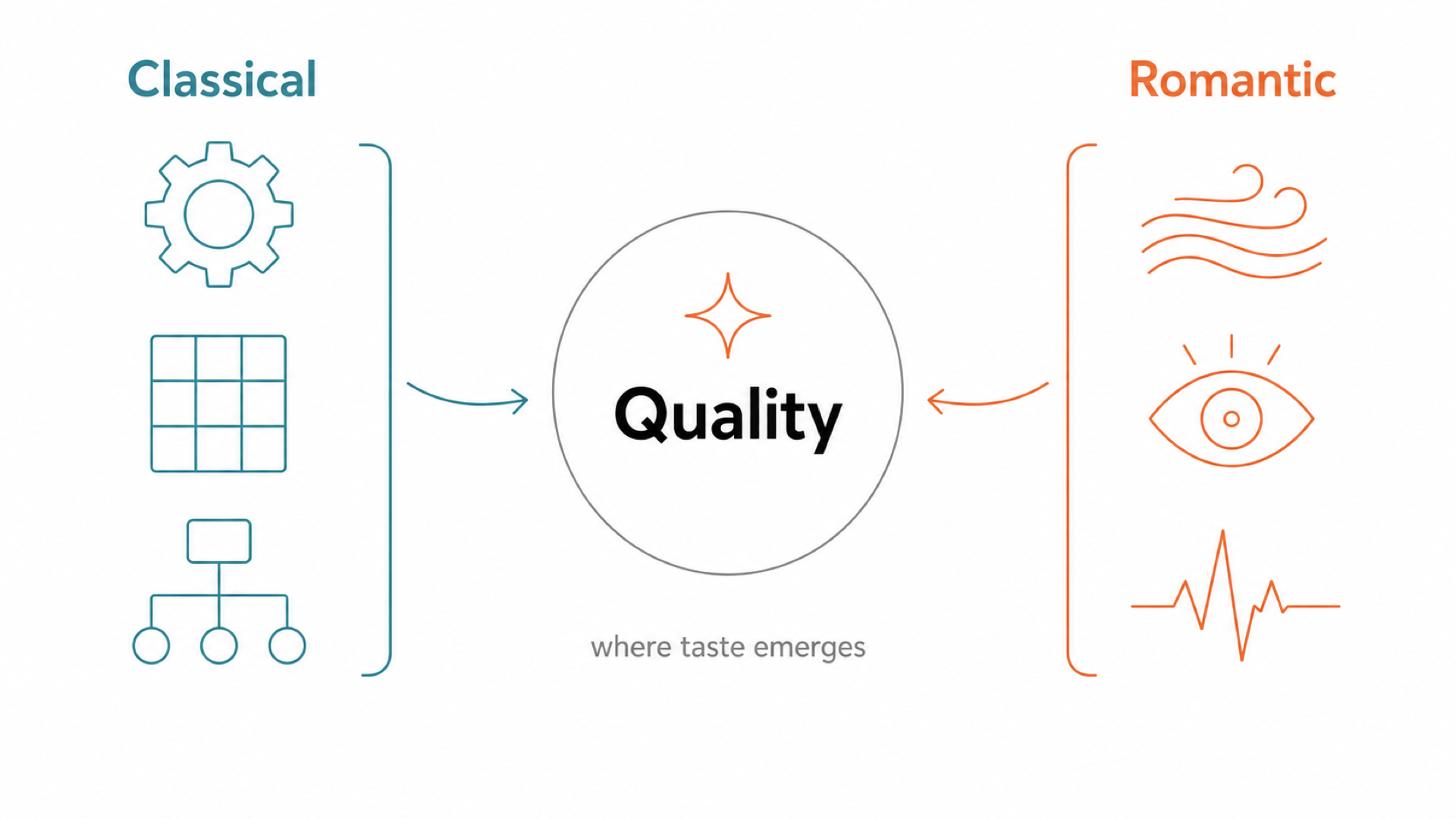
Pirsig divides human cognition into two modes:
Classical understanding — analysis, decomposition, categorization, structural reasoning. You look at a motorcycle and think: engine, transmission, circuitry, the function of each part.
Romantic understanding — direct perception, holistic grasp, immediate presence. You look at a motorcycle and feel: wind, freedom, the vibration of the engine, the smell of the road.
AI is a perfect classical understanding machine. It can analyze the structure of anything and decompose any problem into its components. But it has no romantic understanding — that direct, pre-analytical perception.
The problem is that quality occurs precisely at the intersection of these two modes. Classical without romantic gives you correct but soulless output. Romantic without classical gives you moving but incoherent expression. The best science papers have both. The best product designs have both. The best teaching has both.
Care: The Engine That Makes Quality Possible
If quality can't be defined, what generates it? Pirsig's answer: care.
A hurried mechanic and an attentive mechanic use the same tools, consult the same manual. The difference is that the attentive one cares about the motorcycle — not abstractly about "quality," but concretely about this specific bike, this specific screw, this specific problem.
AI can simulate the surface language of care ("I take your question seriously," "let me look at this carefully"). But it doesn't possess care's substance. It won't lose sleep over a problem it didn't solve well. It won't feel satisfied when a piece of writing comes together.
This isn't a flaw in AI. It's its nature.
Taste = Trained Quality Perception
So what is taste, exactly? In Pirsig's framework, taste is quality perception that has been trained.
Taste isn't innate. It comes from repeated exposure to good and bad work, gradually calibrating your perceptual sensitivity. After reading a thousand papers, you know which ones are good without needing to analyze them. After looking at a hundred product designs, you instinctively know which one is right.
In the age of AI, the value of taste has exploded. The reason is simple: when generation costs approach zero, curation becomes the primary cost.
Previously, writing one article took three days. Taste expressed itself continuously throughout the creative process. Now AI produces ten versions in three minutes. The value of taste has migrated entirely to selection — which one deserves to be published? Which needs revision? Which should be discarded?
A caveat: taste itself has blind spots. Your taste is shaped by what you've been exposed to — if you've only read papers from one field, your curation standards carry that bias. Pirsig acknowledged that quality perception varies between individuals; there is no absolute objective scale. Some argue that AI, through RLHF (Reinforcement Learning from Human Feedback), is already learning an approximation of taste. That's a fair point — but what it learns is statistical taste: what most people consider good, not what you consider good. The gap between the two is precisely where your irreplaceability lives.
Aretē: Excellence Is Not Efficiency
Pirsig traces the concept back to the ancient Greek aretē (excellence, virtue). Aretē is not "doing things faster." It is "bringing something to the highest state it is capable of reaching."
This distinction is critical in the AI era. Companies instinctively reach for AI as an efficiency tool — faster, more, cheaper. But aretē-mode AI use is something else entirely: use the time AI saves you to invest more deeply in the parts that require care.
Use AI to generate a first draft, then spend three times as long refining it. Use AI to surface all relevant literature, then spend the time to truly understand the three most important papers. Use AI to generate ten options, then apply your taste to identify the one worth pursuing.
Efficiency serves quality. It does not replace it.
Closing
Pirsig's stuck screw is still stuck.
AI can search every possible solution, list every torque specification, even simulate force vectors. But the thing that finally loosens the screw is the moment when you give it your complete, undivided attention.
That moment is quality. The capacity for it is taste.
In the age when everything can be generated, this is your most valuable possession.
References
- Robert M. Pirsig, Zen and the Art of Motorcycle Maintenance — Quality as event, Classical vs. Romantic understanding, Care as quality's engine
- "你正在維修的那台摩托車" — Pirsig's quality philosophy reinterpreted for the AI era
- Ancient Greek aretē — the distinction between excellence and efficiency
- Quality as pre-analytical perception — Pirsig's paradox applied to AI-generated content evaluation