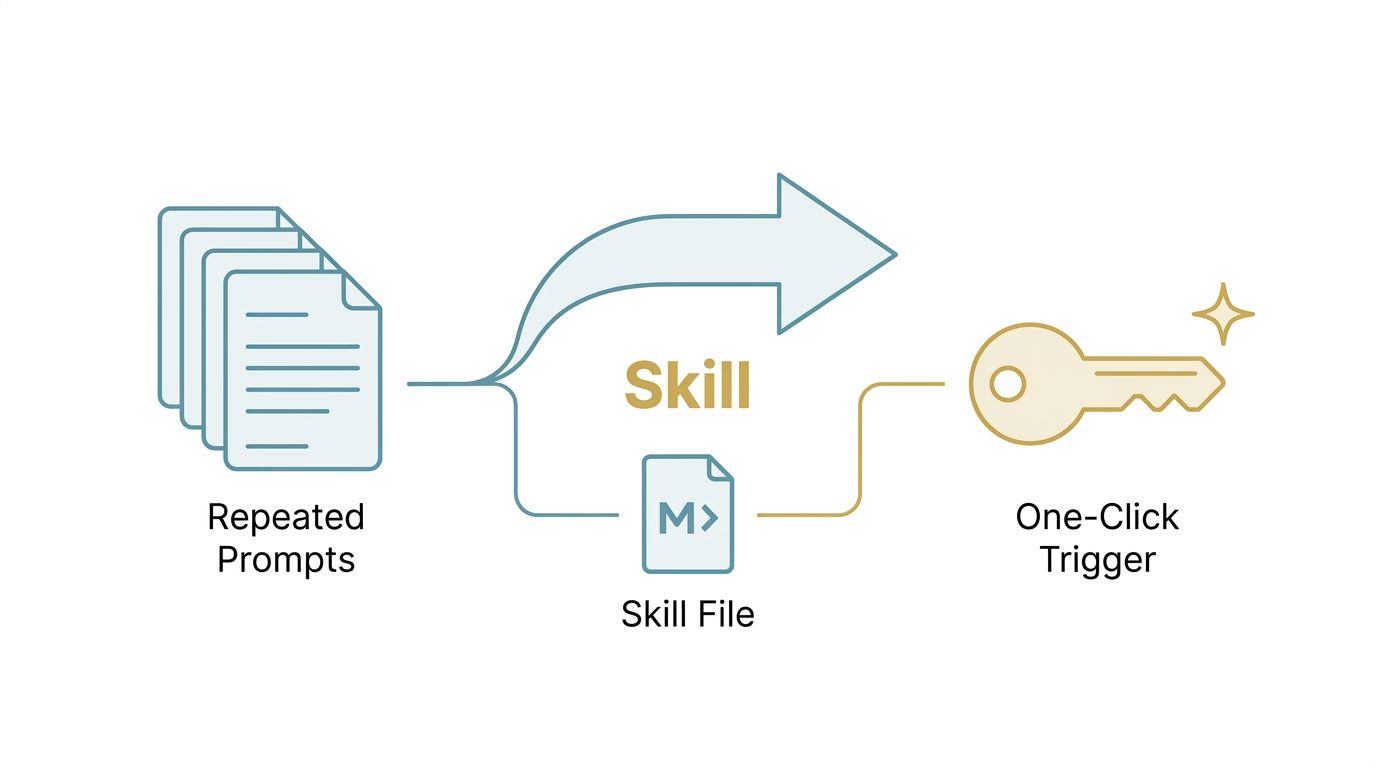
Here's a tax you probably pay every day without noticing.
You need to translate an article. You open your AI tool and start typing the prompt you've written a dozen times before: analyze the terminology first, then translate paragraph by paragraph, prioritize naturalness over literalism, avoid mechanical phrasing… Or you need meeting notes processed: extract action items, tag owners, rank by priority, export as Markdown…
The AI does it well. You're satisfied. You close the conversation.
Next week, you do it again. From scratch.
The problem isn't that the AI can't do the work. The problem is that every conversation ends in total amnesia. That carefully calibrated prompt you spent weeks refining? Gone. The AI has no memory of what worked, what didn't, what your standards are.
This is where Skills come in.
What a Skill Actually Is
A Skill is a persistent, reusable workflow definition — essentially a standard operating procedure written for an AI to follow.
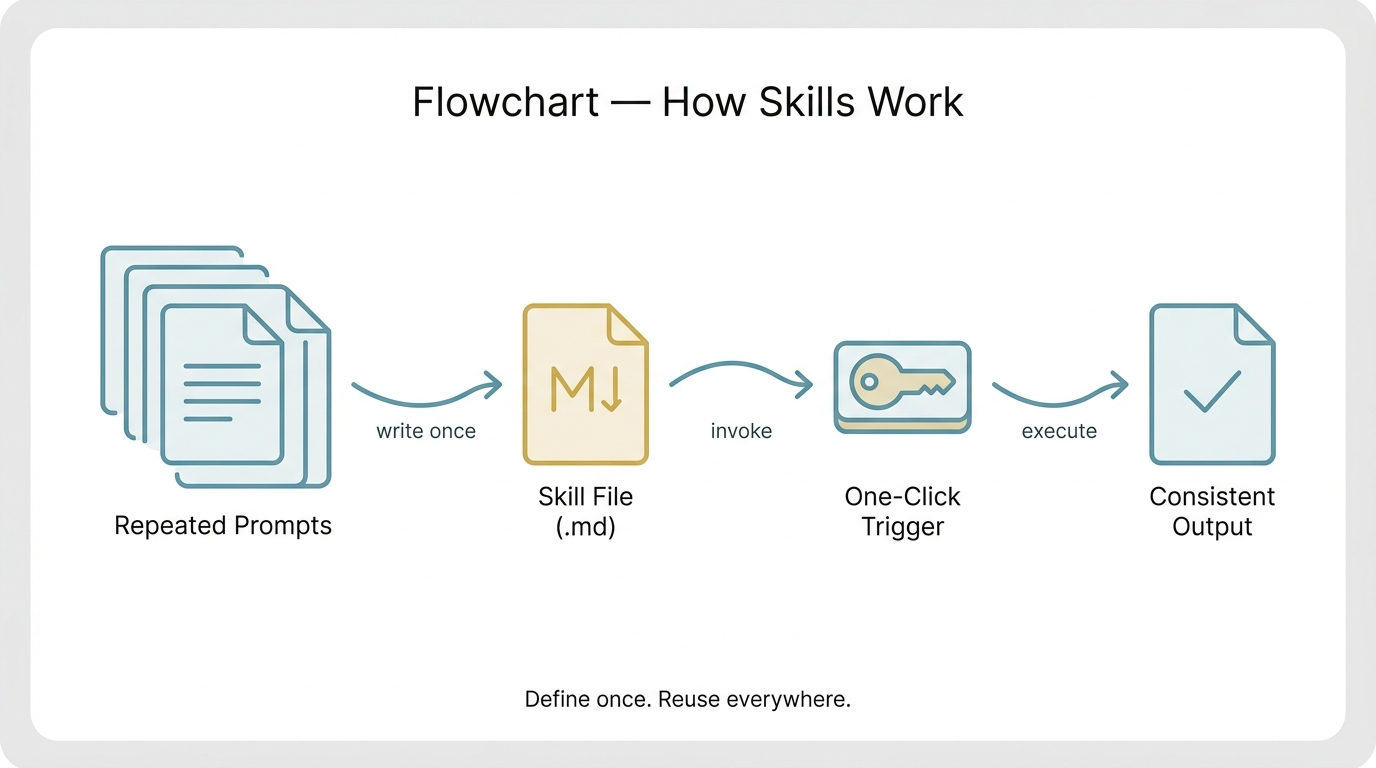
Structurally, it's a Markdown file containing a few core elements: a name, a trigger condition, the required inputs, a sequence of steps, and a defined output format. That's it. No code, no infrastructure, no technical setup.
What this means practically: instead of retyping your full translation protocol every time, you invoke the Skill once. The AI reads the file, follows the procedure step by step, and produces consistent results. It doesn't skip steps. It doesn't forget your quality standards. It doesn't produce wildly variable output depending on how carefully you phrased the prompt that day.
The parallel to organizational processes is intentional. SOPs exist because institutional knowledge shouldn't live only in one person's head. Skills exist for the same reason — except the knowledge being encoded isn't human expertise, it's your expertise about how to work effectively with AI.
Two Ways to Build a Skill
The retrospective method. Run through the complete workflow manually with the AI first. Merge three drafts, translate a long document, produce a report — whatever the task. When you're satisfied with the result, ask the AI to formalize what you just did into a Skill document.
This approach has a real advantage: you have direct evidence that the workflow produces good output, and the AI has concrete experience of the actual execution — including which steps matter most and where errors tend to occur. Skills built from real runs tend to be more accurate than Skills written from memory or specification alone.
The forward-specification method. If you already have a clear mental model of the workflow, describe it directly: "Build me a Skill that does X, Y, Z in that order." The AI generates a complete Skill document from your description.
Both approaches compose well. Build an initial version via the retrospective method, run it a few times, identify what could improve, then refine via direct specification. The Skill evolves with your understanding of the task.
Three Design Principles Worth Internalizing
Synthesis over assembly. A well-designed content-merging Skill doesn't just concatenate multiple drafts. It selects the strongest overall structure, extracts unique insights and missing information from other versions, integrates them organically, then polishes the whole. The output should read like it was written by one person with access to everything — not like a patchwork.
Skills can reference other Skills. A translation Skill can invoke a writing style Skill to ensure the output automatically conforms to your established voice. A reporting Skill can reference a formatting Skill to guarantee consistent layout. This modularity means you define shared rules once and inherit them everywhere, rather than duplicating them across every Skill that needs them.
Persist all intermediate artifacts. Every meaningful step in the workflow — the terminology analysis, the translation instructions, the first draft, the review notes — should be saved as a file. This makes individual steps independently debuggable and rerunnable. If one section of a translation is weak, you can rerun just that section without reprocessing everything. If you want to inspect whether the AI's translation strategy was sound, you can read the instruction file it generated.
The Decision Rule
One heuristic covers most cases: if you find yourself copy-pasting a prompt you've used before, it's time to make a Skill.
Translation with consistent formatting? Skill. Meeting notes with a standard structure? Skill. Weekly digest from multiple sources? Skill. Pre-publication checklist? Skill. One-time analysis of a specific dataset? Just prompt it directly.
Repetition is the signal. It means the task has enough structure and regularity to justify investment. It means you've already done the hard work of figuring out what good output looks like. The only question is whether you want to keep paying the tax manually, or capture that knowledge once and stop paying it entirely.
The Compounding Effect
The most underappreciated property of Skills isn't time savings — it's knowledge externalization.
How you prompt, what process you follow, what quality standards you care about: all of that currently exists only in your head. Once it's encoded in a Skill file, it becomes transferable. Other team members can execute to your standard without needing to understand your reasoning. New collaborators don't spend months learning "how we do things here" — they read the Skill file.
One person's investment compounds across an entire team's output. That's not efficiency. That's leverage.