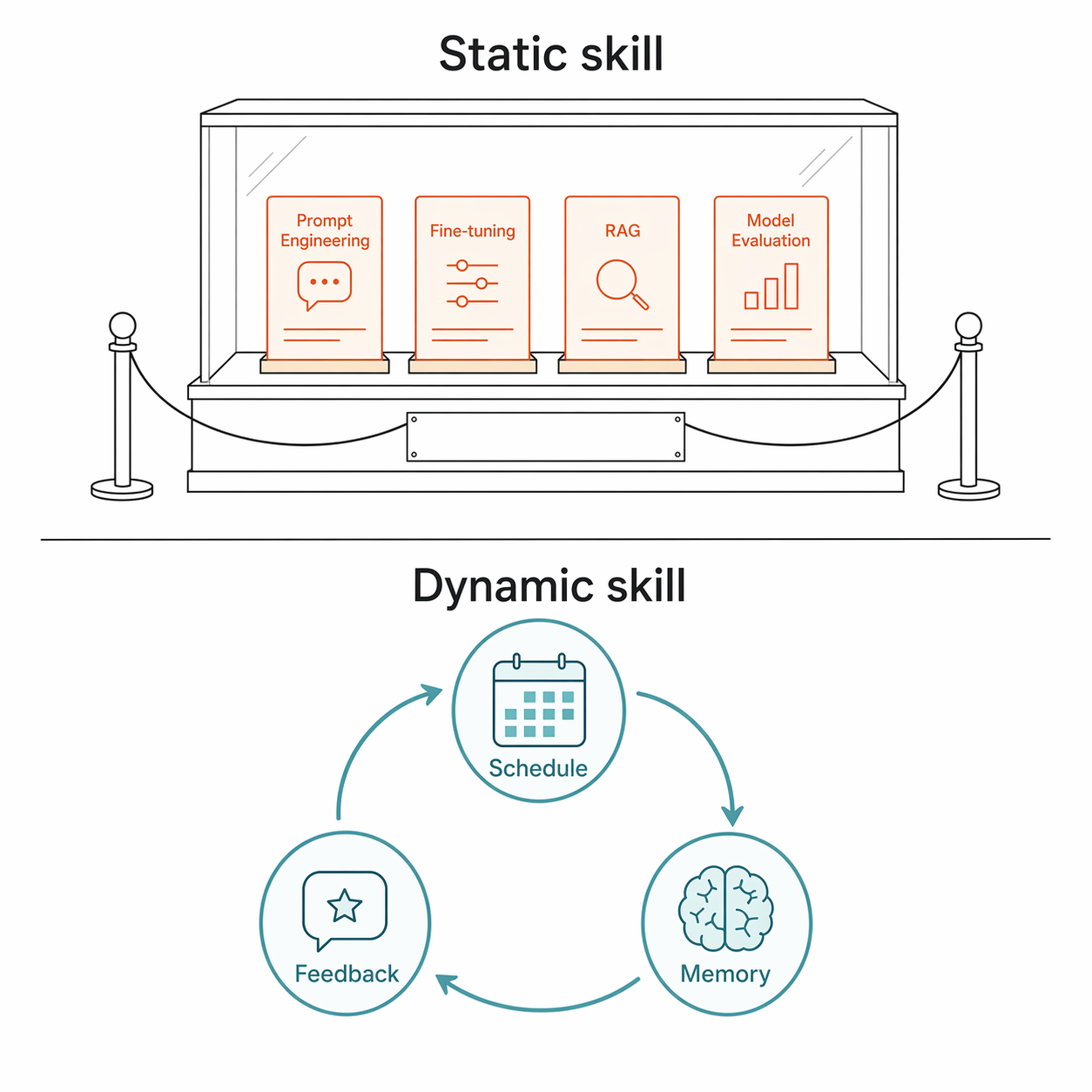
Maybe you have seen this already: your sidebar is full of Skills, yet when real work starts you still stop and ask, "Which one am I supposed to call now?" In that moment, the library feels less like a team and more like a storage room with excellent labels.
The issue is not quantity. It is design. Most people treat a Skill like a noun: a template, a card, a block of instructions waiting to be selected. The systems that pull ahead treat a Skill like a verb: something that notices context, steps in, hands work off, and improves after each run. What you need is not a display case. You need a production line.
Is Your Skill Library a Museum or a Factory?
A noun-style Skill architecture usually turns into a museum. You have many exhibits. They are tidy. They are documented. But each one still needs you to walk over, read the label, and activate it by hand. The collection grows. The flow does not.
A verb-style architecture feels more like a factory. You do not need to remember where every part lives. You put a job on the line, and the system decides who should pick it up next. That is the core argument from Random Labs: Skills should not be static instructions. They should be context-triggered behaviors.
The difference sounds cosmetic. It is not. It is the difference between driving stick and driving automatic. One keeps asking for human intervention. The other hides repetition inside the machinery.
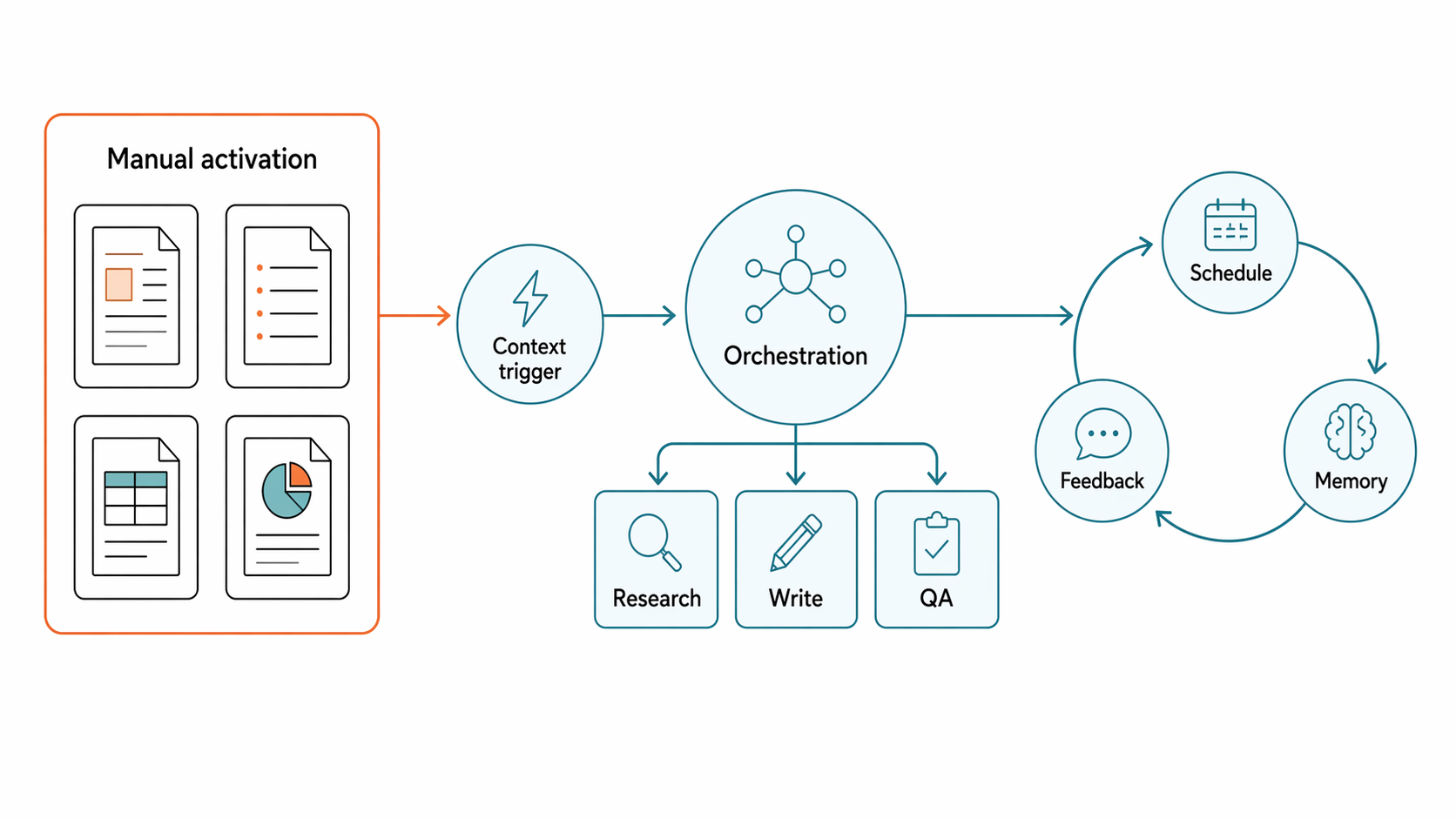
From Manual Activation to Context Triggering
The old workflow is easy to recognize. You tell the AI, "Use the writing Skill to turn this research into an article." It complies. Next time, you repeat the same ceremony. It is functional, but it never becomes fluid.
Dynamic Skills behave differently. If the description field is written precisely enough, the AI can recognize a relevant situation and activate the Skill automatically. You do not have to say, "Use the writing Skill." You can say, "Turn this research finding into a public-facing article," and the system infers which Skills belong in that job.
Why does that matter? Because the expensive part of tooling is often not execution. It is selection. If every task begins with, "Which Skill do I call?" the library becomes sticky. Context triggering removes that layer of friction.
Skill Chaining: Turning Isolated Skills into a Workflow
A single Skill can do useful work. It cannot build momentum alone. The real jump comes from Skill chaining: linking multiple Skills into a pipeline so one handoff leads to the next.
A common content pipeline might look like this: a research Skill gathers material, an analysis Skill extracts the argument, a writing Skill drafts, a QA Skill challenges weak spots, and a formatting Skill packages the final output. You trigger once. The rest should move like falling dominos.
This is where orchestration matters. Anthropic and other agent teams keep coming back to the same point: someone has to conduct the timing. Without orchestration, Skill chaining becomes a row of freelancers who never talk to each other. With orchestration, each output arrives in a form the next Skill can actually use.
That is also why context forking matters. Each Skill needs its own workbench. Let it do its job, then return a compressed result to the orchestration layer. Otherwise the shared context turns into a desk so cluttered you cannot find the mug anymore.
The Three-Loop System: Skills That Evolve Themselves
If chaining solves handoff, the three-loop model solves growth. Vox's proposal is simple, but it maps closely to how people learn.
Loop 1: scheduling. High-frequency work should not depend on someone remembering to click a button every time. Daily research curation, weekly FAQ refreshes, recurring content transforms: these are good candidates for automatic triggering.
Loop 2: memory. Every run leaves a record. The next run reads that record back in. That makes the Skill behave less like a brilliant amnesiac and more like a colleague who takes notes.
Loop 3: feedback. The gap between AI output and human edits is not just cleanup. It is training material. If the system can extract rules from that gap and feed them back into the Skill, every revision becomes a lesson.
Once those three loops work together, a Skill stops being merely executable and starts becoming mature. Moving from v1.0 to v1.3 is not mainly about writing more prompts. It is about feeding the system scheduling, memory, and feedback until it develops better habits.
Not Everything Should Be Automated
This is the part people often skip. If dynamic Skills are better, should everything become auto-triggered? No. Low-frequency, high-risk, ambiguous tasks can become worse when automated too aggressively. External communications, destructive actions, and decisions with unclear criteria still need a human in the loop.
So the best design is layered. Let the system automate the high-frequency, low-risk, rule-heavy work. Keep judgment-heavy, responsibility-heavy decisions with people. Automation should create room for judgment, not pretend to replace it.
Do You Have Capabilities, or Just Documentation?
The next time you audit your Skill library, do not start by counting how many you have. Ask the more uncomfortable question instead: if you walked away for an hour, how many of those Skills would still know when to act, how to hand work off, and how to improve?
If the answer is still 0, you probably do not own a capability yet. You own a very tidy manual. That is not nothing. But it is not the same thing as a system that keeps work moving after you stop touching it.
References
- Random Labs (2026). Skill chaining and why skills should be actions. Slate Blog.
- Vox (2026). I Stopped Collecting Agent Skills. Started Wiring Them Into Loops. Blog.
- Anthropic (2026). Claude Code Skills and Orchestration. docs.anthropic.com.