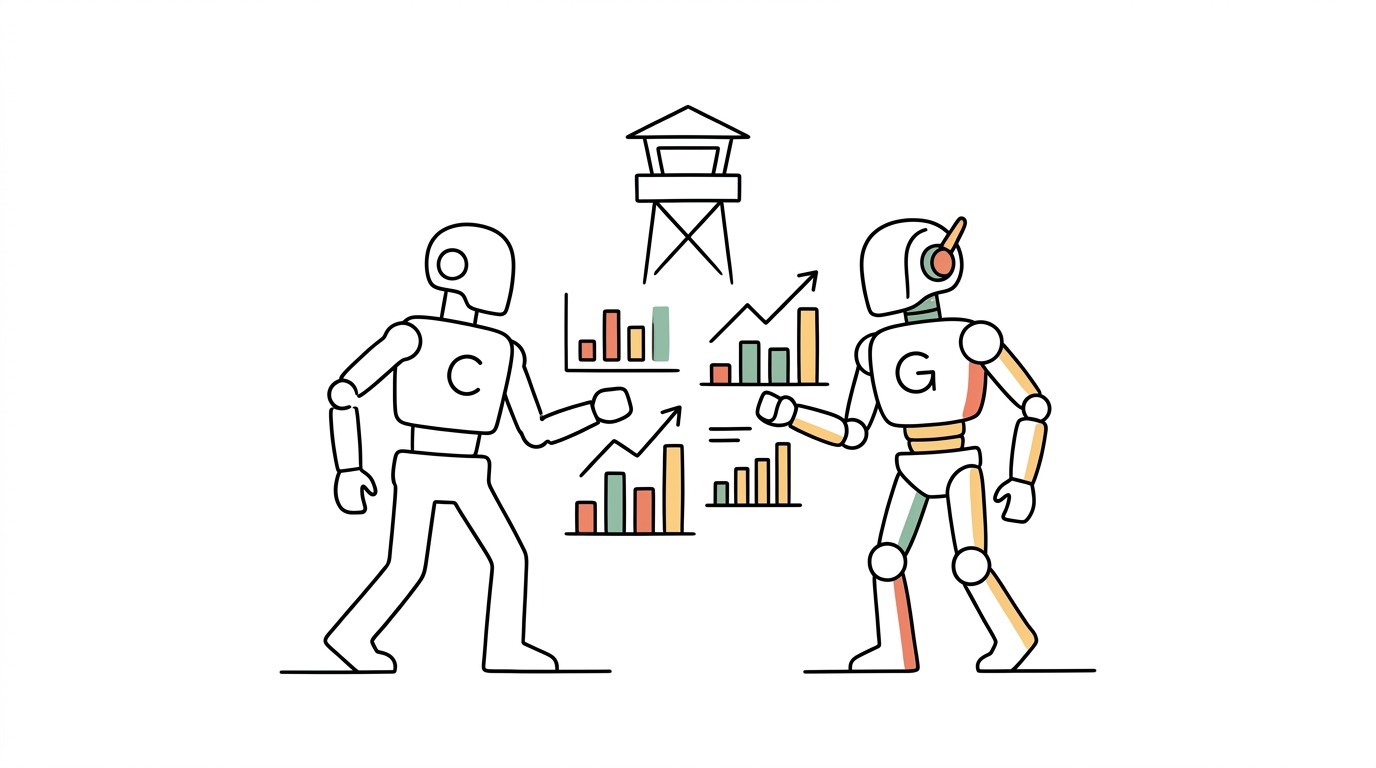
Key insight: The AI competition has shifted from "whose model is smarter" to "who can ship vertical applications and control hardware costs." The data points to some surprising winners.
Signal 1: Vertical SaaS Isn't Going Anywhere
Last year, the consensus was that general-purpose AI would swallow every industry-specific tool whole. BIM software for construction? Dead. Legal document platforms? Toast.
The data says otherwise.
a16z's latest numbers show that Vertical SaaS sales cycles are actually improving. Quota attainment is climbing, and demand for deep, industry-specific solutions remains rock solid.
The reason is straightforward: domain knowledge can't be replaced by a general model. Sure, you can feed GPT-4 an entire real estate workflow. But a purpose-built agent with real estate logic baked into its bones will outperform it every time — because context isn't just data, it's judgment.
Takeaway: The next 10x company won't be "AI for everything." It'll be "AI plus deep industry expertise."
Signal 2: Retention Rates That Break the Rules
ChatGPT's retention curve defies every pattern we know from traditional software.
Normal apps follow a decay curve: 100% in week one, 80% in week two, 40% by week four, then a slow bleed to oblivion.
ChatGPT shows a "smile curve." Usage dips slightly at first, then starts climbing back up around week 10. By week 23, it's actually higher than week 4.
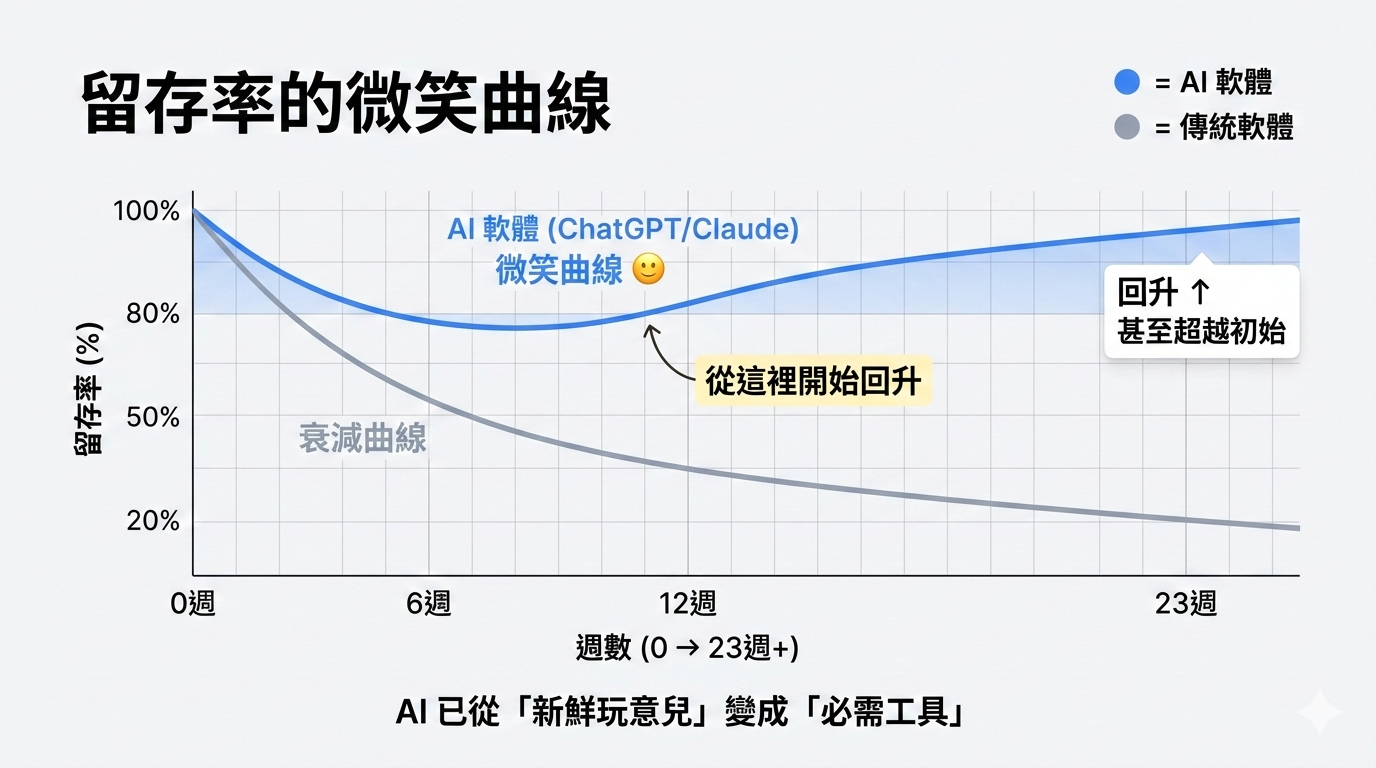
This isn't novelty. This is dependency. AI has crossed the line from "cool toy" to "can't work without it." Daily session times for Claude and DeepSeek users now average over 20 minutes — that's Spotify-tier stickiness.
Takeaway: The land-grab phase is over. Now it's a retention war. The winner won't be whoever signs up the most users — it'll be whoever they can't quit.
Signal 3: Open-Source Models Are Striking Back
OpenAI's frontier models still lead on benchmarks. But open-source is closing the gap at an alarming pace.
MiniMax, Qwen, GLM-5, and DeepSeek now account for roughly 45% of token consumption on OpenRouter. Four months ago, that figure was 10%.
The cost difference? Open-source models run at 1/10 to 1/5 the price of Claude.
Takeaway: You still need top-tier models for the hardest problems. But for the bulk of daily tasks, cheaper open-source models will do the job. Multi-model architectures aren't a nice-to-have anymore — they're table stakes.
Signal 4: Hardware Is the New Battleground
Apple barely shows up in LLM conversations, yet the data reveals it as the stealth winner of the AI era.
Why? Local AI is taking off. Tools like OpenClaw have driven a surge in demand for machines that can run models on-device. Used Mac mini prices are up 15%. Raspberry Pi 8GB boards have jumped 50%.
This points to a truth the industry has been slow to acknowledge: on-device compute matters. When users start running AI on their own hardware instead of relying entirely on the cloud, the bottleneck shifts to chips, thermals, and power efficiency.
Takeaway: The next wave of AI startups won't just stack apps on top of GPT APIs. They'll figure out how to put powerful models in people's hands — literally.
Signal 5: Big Companies Build, Small Companies Buy
This split runs deep.
Public companies — under quarterly earnings pressure — are building their own AI systems. They're training lightweight models on their own servers to cut operating costs, bypassing OpenAI entirely.
Private companies — free from that pressure — are buying AI services aggressively. The Carlyle IT Service Spend Index shows private company IT spending growing over 33% year-over-year, triple the rate from two years ago.
Takeaway: If you're an early-stage startup, don't build your own model. Use the best API available (Claude or Gemini), validate your business model fast, and only consider self-hosting once you've hit $10M in annual revenue.
Claude vs. Gemini: Which One Should You Pick?
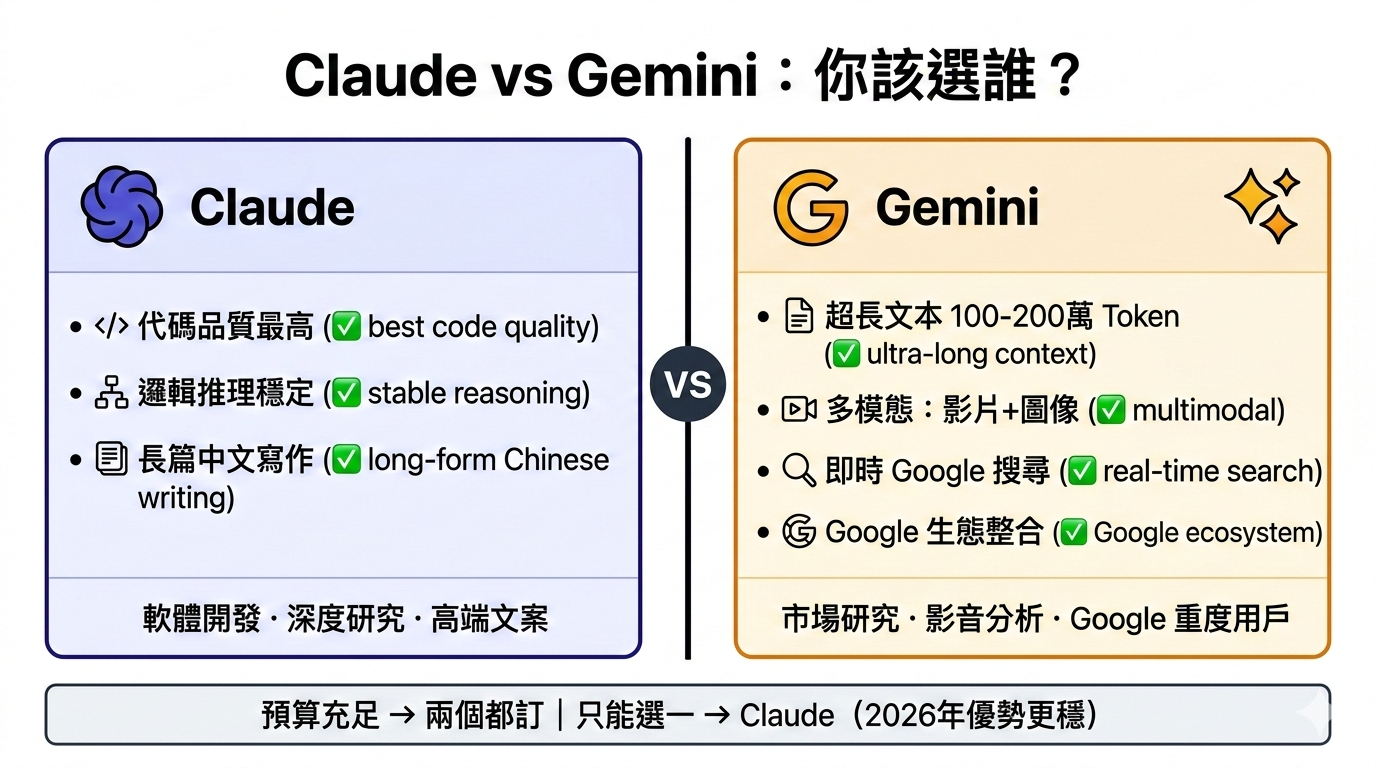
Claude excels at:
- Code quality — outputs that follow engineering best practices out of the box.
- Logical reasoning — more stable on complex, multi-step chains of thought.
- Long-form writing — natural prose with less "AI smell."
Best for: software development, deep research, high-end copywriting.
Gemini excels at:
- Ultra-long context — 1-2 million tokens means you can feed it an entire codebase.
- Multimodal understanding — strongest at interpreting video and images.
- Live search — integrated Google Search for real-time information.
- Ecosystem integration — seamless with Gmail, Docs, and Drive.
Best for: market research, media analysis, Google-heavy workflows.
The practical advice: If budget allows, subscribe to both (~$20/month each). Use Claude for core work, Gemini for research and exploration. If you can only pick one, go with Claude — its advantage in reasoning and code is more durable over the next 12 months.
Survival Guide
- Investment: Skip general AI plays. Look for vertical applications in real estate, legal, healthcare.
- Architecture: Multi-model beats single-model. Route tasks to the right model at the right cost.
- Cost control: Frontier models for hard problems, open-source for everything else.
- Hardware: If you're building an AI product, offer a local-run option. Cloud-only is a liability.
The Bottom Line
Short-term, Claude and Gemini will coexist. Medium-term (2-3 years), the platform with the strongest retention and deepest ecosystem integration wins. Long-term (5+ years), whoever puts real AI power into local hardware — so that ordinary people can run it — takes everything.
The finish line isn't in the cloud. It's on your Mac mini.
Which AI tool are you using day-to-day? What do you wish it could do better? Drop a comment — let's talk.
Source: a16z Charts of the Week, 2026