Every team has that person—the one who can explain in three seconds exactly why your idea won't work. Over time, everyone learns the lesson: don't share ideas. The problem usually isn't that the ideas are bad; it's that we've confused the ability to find flaws with actual competence.
The Fundamental Asymmetry
Proposing an idea requires imagination, courage, and the willingness to be publicly wrong. Dismissing an idea requires exactly one sentence: "We tried this before," "The budget won't allow it," or simply "This will never work."
Proposing is a constructive act—it requires building capacity, synthesizing information, and accepting vulnerability. Dismissing is a destructive act—it only requires finding one flaw. Since every early-stage idea is full of flaws, spotting them requires no special talent.
Our brains make this worse. Psychologists call it "negativity bias": our ancestors survived because they were faster at spotting predators than berries. This wiring makes fault-finding cognitively easier than benefit-finding, leading us to mistake "seeing problems" for "having capability."
Preventing Flaws vs. Creating Value
A team that only plays defense might avoid disaster, but it will never win. Criticism has one legitimate function: preventing obvious errors. What it cannot do is generate new products, new processes, or new strategies.
Evaluating an embryonic idea against mature-stage criteria is like judging a caterpillar by butterfly standards. You'll correctly conclude that it can't fly, and you'll be completely right—and you'll have accomplished nothing useful. That "correctness" is the price of mediocrity.
The deeper damage is psychological. When ideas are repeatedly "killed" on the spot, rational team members perform a silent cost-benefit calculation: the emotional cost of proposal exceeds the expected value of adoption. Soon, meetings become silent graveyards of untapped intelligence.
The Fix: Separate Optimism and Critique
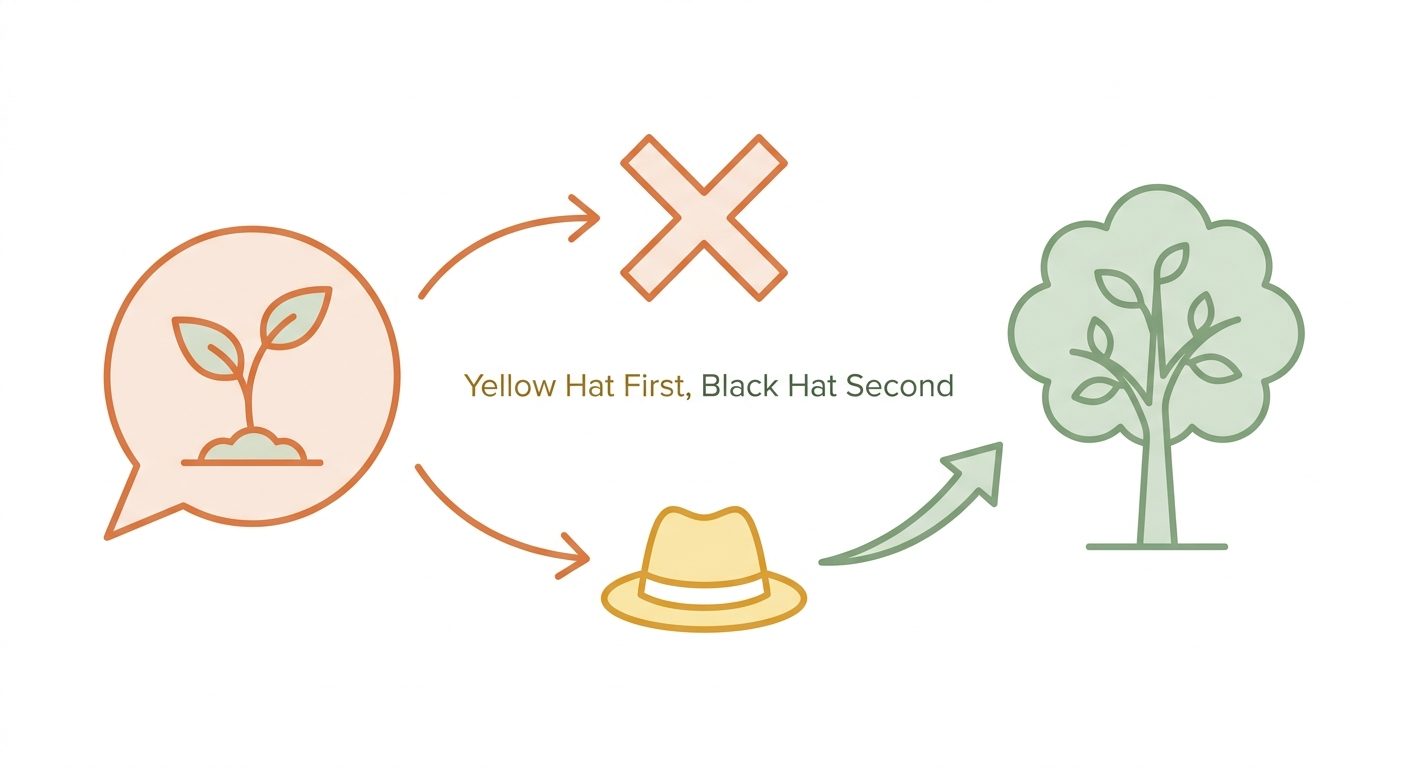
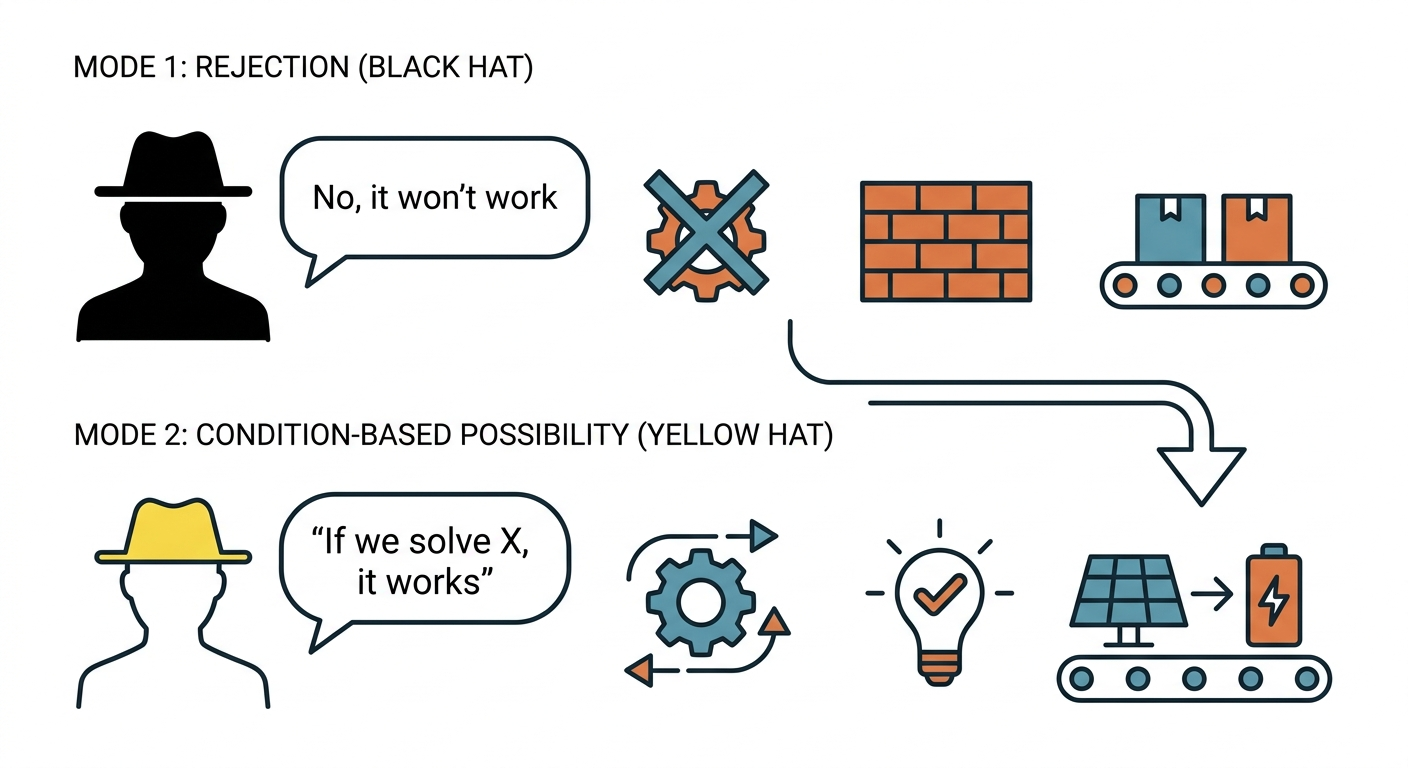
The solution isn't to ban criticism, but to time it correctly. Edward de Bono's "Six Thinking Hats" framework provides a simple rule: separate the Yellow Hat (optimism/benefits) from the Black Hat (critique/risks).
The key rule: Yellow Hat always comes first, and both hats must receive equal weight.
You can implement this with one powerful rule: every concern must be reframed as a "conditional," never as a "verdict."
- Instead of: "This won't work because we don't have the budget."
- Use: "If we could solve the budget constraint, this could work."
One word changes the entire dynamic. "No" closes the door; "If" opens a path for collective problem-solving.
Innovation in the AI Age
In an era where AI can generate hundreds of concepts in seconds, human value shifted from "generating" ideas to "identifying and developing" them. If your culture immediately kills anything that isn't fully formed, AI just gives you more ammunition for the idea graveyard.
Innovation doesn't require a lone genius with a lightning bolt. It requires a group of people willing to let fragile ideas survive their first five minutes. Killing an idea takes a second; raising one takes a team.
References
- Shooting Down Ideas Is Not a Skill. (2026). English blog.
- @dotey. Thread: Chinese translation and analysis. 2026.
- de Bono, E. (1985). Six Thinking Hats. Little, Brown and Company.