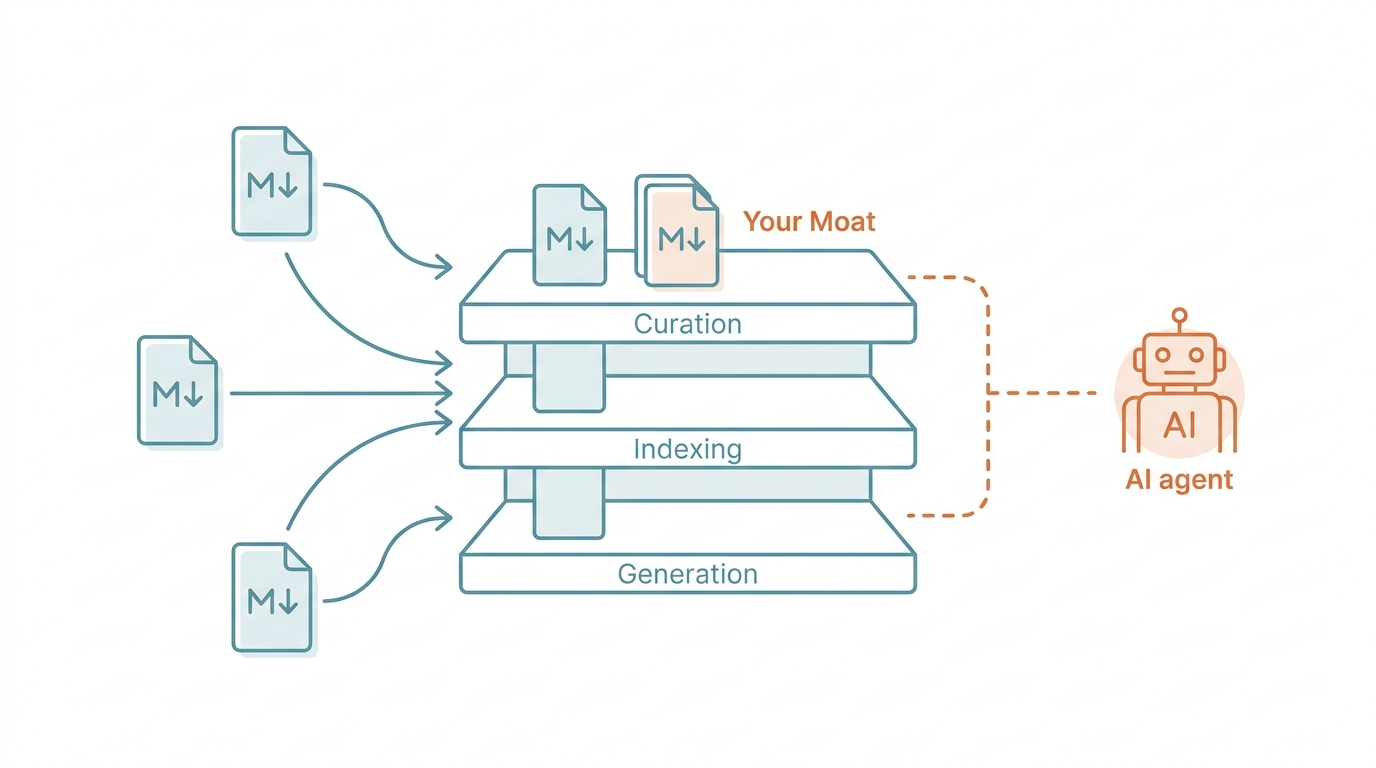
When everyone runs the same AI model, what separates your output from everyone else's? The answer isn't the model — it's what you feed it. A personal knowledge base is fast becoming the decisive differentiator in AI Agent systems.
Same Model, Radically Different Results
Two researchers. Same AI model. Same paper. Researcher A gets a generic summary. Researcher B gets a precise insight mapped against three years of their own prior work.
The difference isn't prompt-writing skill. Researcher B's AI is connected to a personal knowledge base — hundreds of carefully curated papers, annotated key findings, and cross-referenced concepts built up over time.
This is the new moat in the AI era: the deeper your knowledge base, the sharper your AI's output. Model capability is a public commodity. A knowledge base is private infrastructure.
The Three-Layer Architecture
AI researcher Elvis (@omarsar0) laid out a practical framework built on three layers.
Layer 1: Curation. A tuned Skill runs daily, scanning new papers and surfacing the ones that actually matter. After months of iteration, this Skill has learned to find "the best of the best" — not collect everything, but capture what's genuinely relevant.
Layer 2: Indexing. Every paper is stored as a Markdown file with structured metadata, searchable by semantic query. No traditional database, no vector store overhead. Markdown's readability and portability make it the right tool for this job. Each entry carries standardized tags, key concepts, and cross-references to related work.
Layer 3: Generation. The knowledge base becomes a dynamic source of interactive artifacts — visualizations, research maps, trend analyses. You query it in natural language: "cluster the last six months of NAD+ papers by research direction," "switch to timeline view," "show only clinical-stage results." The system responds.
Why Markdown Beats Every Flashy Tool
Here's the counterintuitive part: in a world of Notion, Obsidian, and countless AI-native note apps, the most effective knowledge management approach is plain Markdown. Why?
Three reasons. First, native AI Agent compatibility: nearly every Agent framework reads Markdown directly, no API layer or conversion needed. Your knowledge base is zero-friction for AI.
Second, version control: Markdown is plain text, which means Git. Every addition, edit, and deletion has a full audit trail. The evolution of your knowledge base is itself valuable data.
Third, portability: no platform lock-in. Manage it in Obsidian today, VS Code tomorrow, plug it into a new Agent next year — the knowledge base survives every transition intact.
The Knowledge Base as External Memory
Vox's experience adds another dimension: a knowledge base isn't just passive storage. It's the Agent's external memory.
In his three-loop architecture, every task the Agent completes gets written back to the knowledge base. Next time the Agent runs, it reads the previous output as context before starting fresh analysis. The Agent's quality isn't fixed — it compounds with every run.
A paper curation Agent that's been running for three months versus one that launched yesterday, using the exact same model and Skill, can produce output that's orders of magnitude apart. The gap lives in the accumulated judgment history stored in the knowledge base.
This is exactly why the moat metaphor holds: you can copy someone's Skill in minutes. You cannot copy three months of their curation history.
From "Finding" to "Generating"
Traditional knowledge management ends at retrieval — you know where a paper lives and you open it. AI-era knowledge management ends at generation — you ask a question, the system cross-references hundreds of documents, and returns a structured answer with citations and confidence scores.
Elvis pushes this further: the output isn't static text, it's an interactive visualization. Researchers can rotate the view with natural language, exploring the same dataset from different angles. Not a search engine — something closer to a research library that talks back.
What This Means for You
Model capabilities are converging. The gap between frontier models is shrinking. As that happens, the variable that determines AI output quality is shifting from "which model" to "what context quality."
Your personal knowledge base is the ultimate source of that context quality. It converts everything you've ever read, thought, and judged into structured assets the AI can use — so every AI interaction builds on everything that came before.
Starting your knowledge base today is never too late. Starting tomorrow means you're already one day of curation history behind.
References
- @omarsar0 (2026). Thread on personal knowledge bases for agent systems. X/Twitter.
- Vox (2026). I Stopped Collecting Agent Skills. Started Wiring Them Into Loops. Blog.
- Matuschak A. & Nielsen M. (2019). How can we develop transformative tools for thought? numinous.productions.
- Anthropic (2026). Claude Code Documentation — CLAUDE.md and Project Context. docs.anthropic.com.