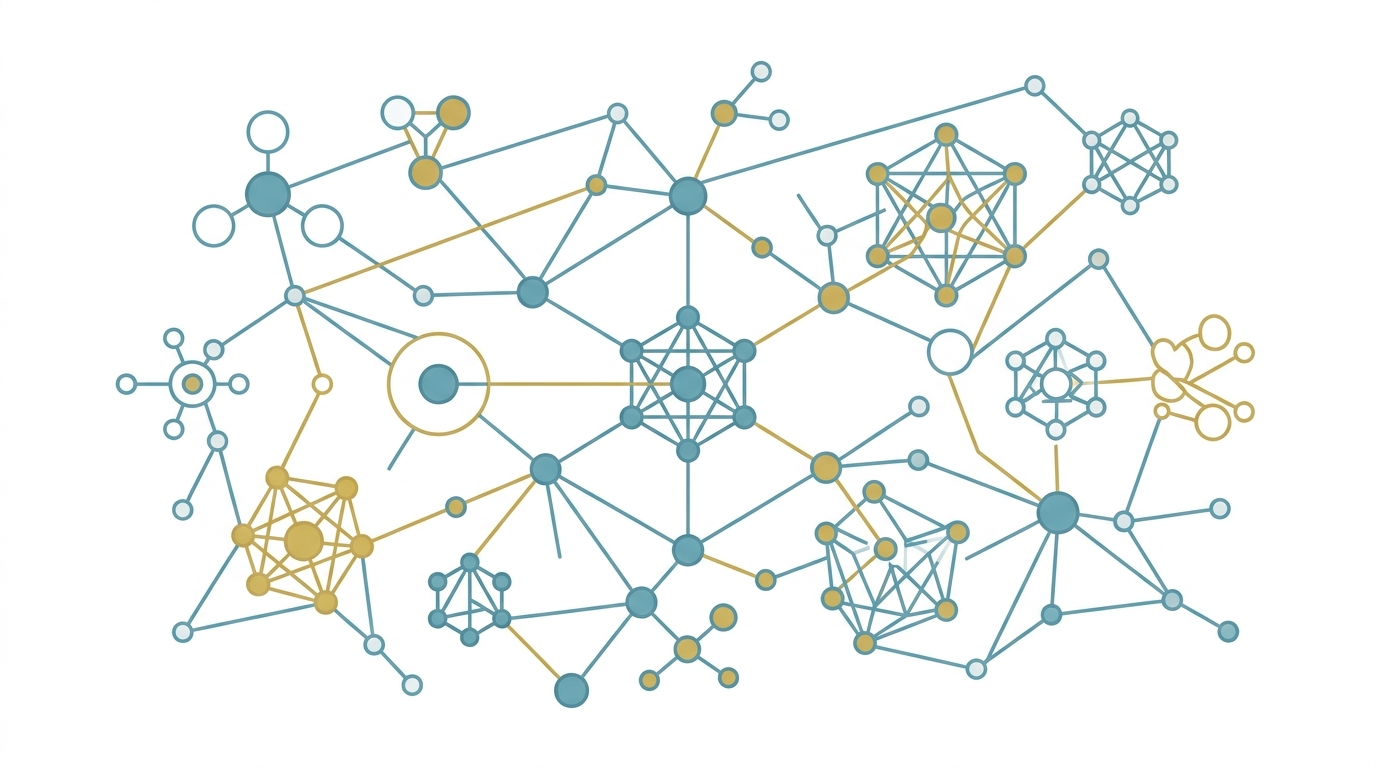
Here's a question most people get wrong: when you put multiple AI agents together, does the system automatically become smarter? The answer is no — and often, it becomes slower, more expensive, and harder to debug. The real differentiator isn't how many agents you have. It's how they collaborate.
Anthropic recently documented five distinct multi-agent collaboration patterns. Think of them as five different ways to organize a team. Pick the wrong one, and even the most capable agents will trip over each other.
Why Collaboration Patterns Matter
Imagine running a company with ten departments. If every manager reports directly to you, you'll burn out. If there's no hierarchy at all, projects fall into chaos. The organization structure — not the talent alone — determines whether the company thrives.
Multi-agent AI systems work the same way. Single agents handle simple tasks fine. But when multiple agents need to tackle complex, multi-step work, the collaboration architecture becomes the deciding factor between success and expensive failure.
Pattern 1: Generator-Verifier (Editor-Writer)
The core idea: One agent generates content; another verifies quality.
This is the most intuitive pattern. A fast Generator produces output — code, text, data extractions — while a focused Verifier checks it for accuracy, safety, or compliance. The Verifier doesn't produce anything; it just judges. If the output fails review, it goes back for revision.
Best for: Code generation with security review, content creation with fact-checking, automated data extraction with accuracy validation.
Watch out for: Infinite loops if the verifier is never satisfied. Also unsuitable for tasks requiring creative collaboration between agents.
Pattern 2: Orchestrator-Subagent
The core idea: A primary orchestrator agent breaks down tasks and delegates to specialized subagents.
Think of this as a project manager who never actually does the work. The orchestrator analyzes a large task, decides who should do what, and dispatches specialized agents — a copywriter agent for headlines, a data agent for analytics, an API agent for integration. Each subagent executes its piece; the orchestrator coordinates the whole.
Best for: Complex business processes (customer analysis → marketing copy → sales outreach), product development pipelines, multi-step research projects.
Watch out for: The orchestrator itself needs to be highly capable to route tasks correctly. Communication overhead increases as task complexity grows.
Pattern 3: Agent Teams
The core idea: Multiple peer-level agents work in parallel on different dimensions of the same problem.
No hierarchy here — just colleagues. Like a soccer team where every player knows their position and role, agents coordinate through shared goals and shared rules rather than command-and-control. A market analysis task might simultaneously involve an economics agent studying macroeconomic data, a competitive intelligence agent mapping rivals, and a user research agent analyzing customer psychology — all working in parallel, results integrated at the end.
Best for: Multi-dimensional analysis, parallel audits, comprehensive brainstorming where diverse perspectives matter.
Watch out for: High coordination costs, potential for duplicated work, and results that need significant integration effort.
Pattern 4: Message Bus
The core idea: Loosely coupled agents communicate through a shared messaging system — like a public bulletin board.
Agents don't talk directly to each other. Instead, Agent A posts a message ("data cleaning complete"), and other agents subscribe to relevant events and decide whether to act. No one specifies who works with whom — the system self-organizes around published events.
Best for: Event-driven systems (file upload triggers virus scan + format conversion + metadata extraction), monitoring and alerting pipelines, collaborative editing environments.
Watch out for: High complexity and difficult debugging (message flow is non-obvious). Requires well-defined message schemas to prevent chaos.
Pattern 5: Shared State
The core idea: Multiple agents collaborate to build and update a common knowledge base or state record.
Imagine a shared Google Doc where every team member is simultaneously taking notes and adding insights. Each agent can read the full state and contribute new information. This shared state becomes the foundation through which agents coordinate without direct communication.
Best for: Knowledge accumulation (agents continuously update a knowledge graph), multi-step decision records, long-running virtual assistants that need to maintain full user context.
Watch out for: State management complexity (who can write what? how do conflicts resolve?). Requires careful concurrency handling.
The Selection Framework: Start Simple
Anthropic's practical advice cuts through the noise: don't over-engineer.
Here's a practical decision tree:
- Default to the simplest pattern first. If generator-verifier solves it, don't build an orchestrator-subagent system.
- Let bottlenecks drive upgrades. When a simpler pattern starts underperforming, that's your signal to add complexity — not before.
- Match the pattern to the problem structure. Hierarchical tasks? Use orchestrator. Multi-dimensional parallel tasks? Use agent teams.
- Account for context overhead. Each additional agent adds conversation history to manage. Message bus and shared state patterns carry real context costs.
The trap many builders fall into: seeing five sophisticated patterns and wanting to use all five. Reality check — 90% of business problems are solved cleanly by the orchestrator-subagent pattern. The remaining 10% of genuinely complex problems are where the more elaborate architectures earn their keep.
A Concrete Example: Investment Research Assistant
Say you're building an AI investment research tool. Here's how the five patterns map to it:
- Generator-Verifier: One agent drafts the research report; another checks facts and logic. Simple, but report quality is constrained.
- Orchestrator-Subagent: Master agent delegates — financial report analysis to Agent A, industry trends to Agent B, risk evaluation to Agent C. Better quality, cleaner organization.
- Agent Teams: Finance, market, and technical agents work simultaneously, each contributing their perspective. Most comprehensive, but synthesis requires extra work.
- Message Bus: A "research topic" channel triggers automated responses from news-monitoring, data-crawling, and network-intelligence agents. Ideal for continuous monitoring.
- Shared State: All analysis writes into a shared "investment model" that other agents use for predictions and decisions. Most flexible, most complex to manage.
The Bottom Line
The future of AI isn't smarter individual models — it's smarter AI teams. Choosing the right collaboration architecture is like giving a talented group the right organizational structure. Don't over-design it; don't under-invest in it.
Anthropic's golden rule: the best architecture is the simplest one that solves the problem.
References
- Anthropic. (2025). "Building Effective Agents: Five Collaboration Patterns." Anthropic Multi-Agent Systems Blog.
- OpenAI. (2024). "GPT-4 with Vision: Orchestrating Complex Tasks." Developer Documentation.
- DeepMind. (2024). "Multi-Agent Reinforcement Learning and Scalability." Research Papers.
- Chen, K., & Zhang, Y. (2024). "Context Window Management in Large Language Models." NeurIPS 2024.
- Enterprise AI Architecture Patterns. (2025). O'Reilly Media.