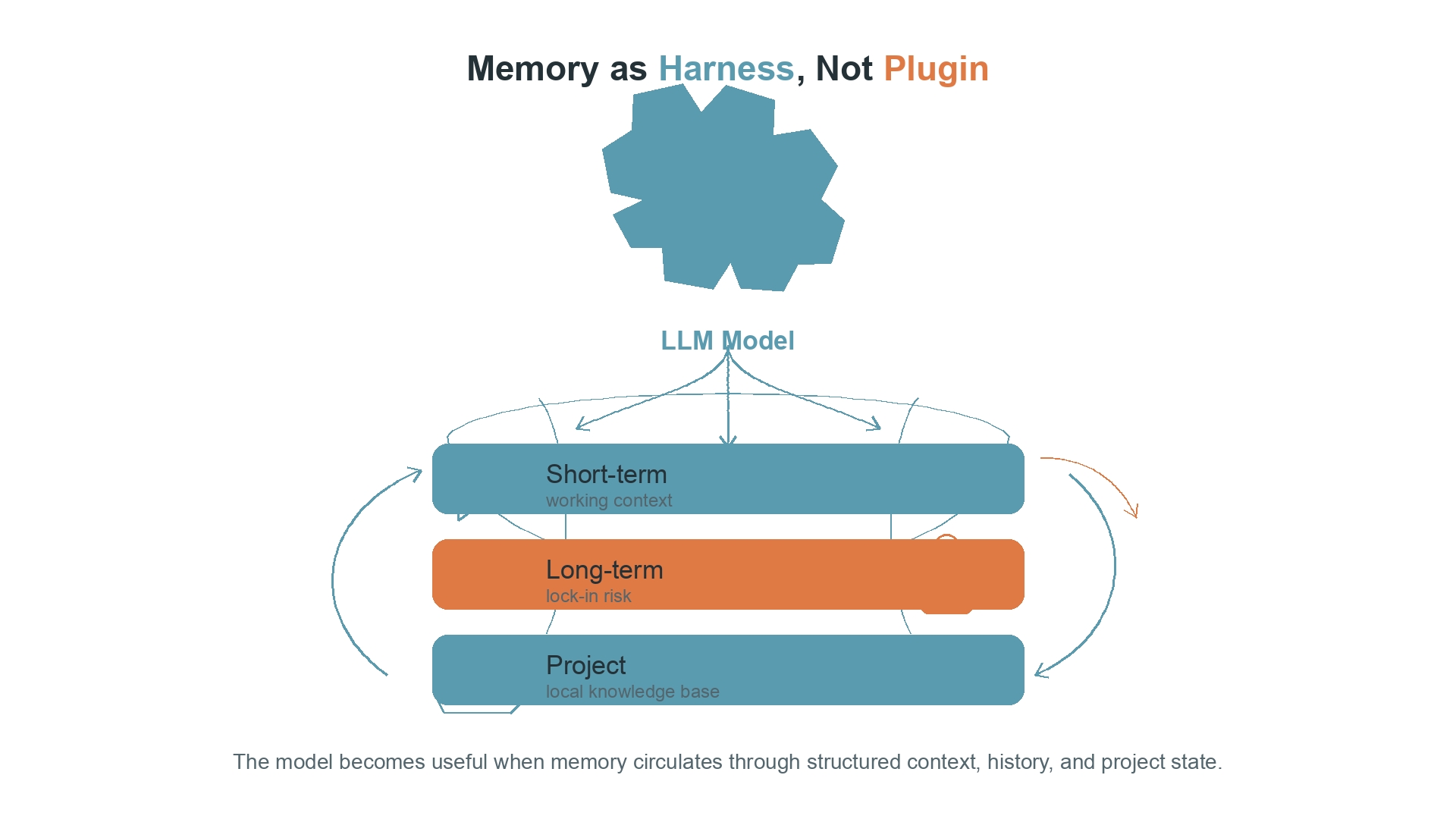
 The model needs the body. A brain without a harness is just floating.
Imagine a superintelligent brain floating in a nutrient tank. It can reason, write poetry, solve differential equations. But it cannot see, cannot hear, and cannot remember. Every time you speak to it, it treats you like a stranger.
That's not a hypothetical. That's the actual condition of a large language model without a Harness.
What Is a Harness?
Harness — literally, a set of straps for guiding and directing — in AI refers to the complete system wrapped around a model: perception, memory, tool calls, feedback loops, error-handling mechanisms. It is the brain's body.
The AI community has landed on a counterintuitive finding: the same model inside different Harnesses can perform 5 to 10 times differently. Not a new model. Not more parameters. Just a different Harness. That reframes the whole question of what it means to "improve" an AI system.
Memory Is Not RAG
When most people hear "AI memory," they think of RAG (Retrieval-Augmented Generation): store knowledge in a vector database, retrieve relevant chunks, inject them into the prompt. It sounds reasonable. For many use cases, it works fine.
But memory is far more than this.
A real memory system needs to answer questions like: How does the system prompt get loaded? Which Skills are visible and when? Can the agent modify its own instructions? How is conversation history compressed? Where are interaction logs stored? How is metadata surfaced? What portion of the filesystem is exposed?
All of these decisions happen at the Harness level, not the RAG level. RAG handles retrieval — one small piece of a much larger puzzle. Some practitioners have gone so far as to say that for true retrieval, even grep is hard to beat. The rest of memory? That's an architectural question, not a plugin you install.
Three-Layer Memory Architecture
A mature Agent Harness implements three distinct memory layers:
Short-term memory (Context Window) — the current conversation context. The model can only see this. Even the largest context windows have limits; beyond them, forgetting begins. You can throw more tokens at it, but you cannot eliminate the ceiling.
Long-term memory (Persistent Knowledge) — knowledge written to databases or filesystems. The agent needs to autonomously judge what's worth remembering. Not every conversation should be stored, and not everything stored should be recalled.
Project-level memory (Task-Specific State) — the intermediate steps, decisions, and results of a specific task. Critically, this should not bleed into the next task. Your literature search agent doesn't need to remember the birthday card it helped you write yesterday.
Different products have taken different approaches. Claude Code relies almost entirely on context windows — session ends, memory resets. Hermes uses a self-managed 2,200-word MEMORY.md file: simple but elegant. Letta Code takes the opposite extreme, building a git-backed filesystem with dedicated memory subagents running concurrently. All three work. The difference is context — and none of them is wrong for the right situation.
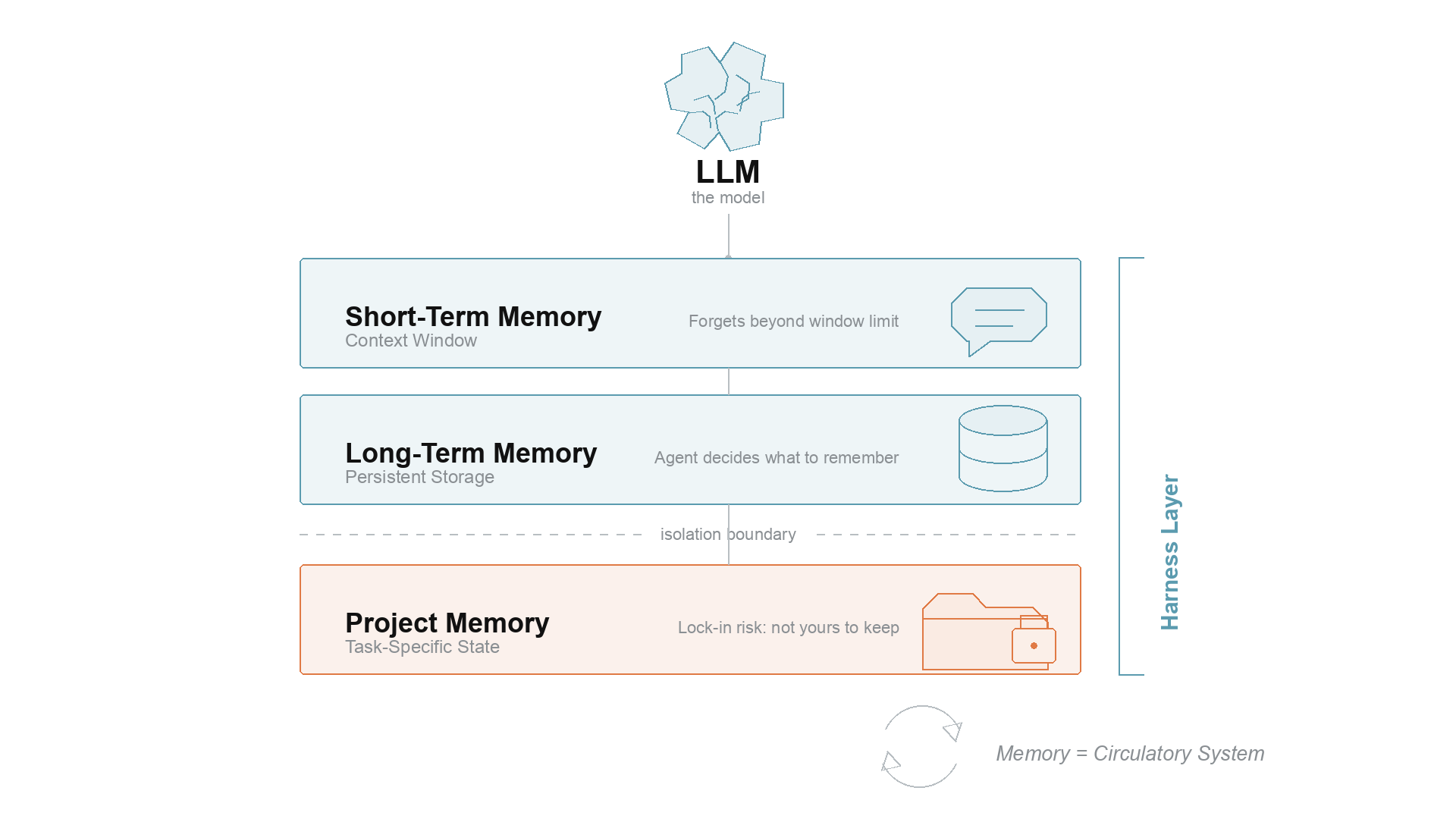 Short-term context, long-term persistent storage, and project-scoped state — the three layers of a mature agent Harness, with isolation boundaries that prevent task bleed.
Memory Lock-In: What You Don't Own, You'll Eventually Lose
Here's a risk most people overlook: if you're using a closed Harness, your memory doesn't belong to you.
One developer shared an illustrative story. He used an email assistant for several months. The agent gradually learned his writing style, preferred tone, and the communication preferences of his key contacts. One day, the data was accidentally deleted. Starting over, he described the experience as "completely different — all the accumulated tacit knowledge gone overnight."
This isn't an isolated case. Memory lock-in operates at three levels:
Level 1: State lives on the provider's servers. You cannot switch models without losing memory.
Level 2: The Harness itself is proprietary. Even if you can export the data, the format isn't portable to other systems.
Level 3: Fully API-driven Harness where you can't even inspect what memories exist or what they contain.
Gary Marcus's analysis revealed something striking: Claude Code's core is a 3,167-line symbolic logic engine with 486 branch points. This isn't purely neural — it's a hybrid of neural networks and symbolic AI. The Harness itself is symbolic AI. Whoever controls the Harness controls the agent's actual capability ceiling.
A fair counterpoint: for many users, closed Harnesses are fine. If you're using an AI assistant for low-stakes tasks and don't plan to switch platforms, lock-in may never matter. The risk compounds when AI is embedded in core workflows — customer communication, institutional knowledge, long-running research. That's when portability stops being theoretical.
Anthropic's New Answer
In April 2026, Anthropic launched Managed Agents. The core premise: turn Harness from a DIY engineering project into a cloud service.
Developers define tasks, tools, and safety boundaries. Anthropic handles sandboxing, session state management, multi-agent coordination, and execution tracing. Pricing shifts from per-token to per-session-active-hour ($0.08/hr).
Early results: a 10% improvement in success rate on structured tasks, with the largest gains on the hardest problems. Rakuten deployed a working agent across four departments, each taking about one week.
This signals that Harness is evolving from "architectural choice" to "infrastructure service" — much like how you no longer need to run your own servers. You may not need to build your own Harness in the future, either. But here's the thing: you'll still need to understand it well enough to ask the right questions of whoever builds it for you.
Three Practical Recommendations
Design the memory architecture before choosing a model. What are the boundaries between short-term, long-term, and project-level memory? What's the compression strategy? What should be remembered, and what should deliberately be forgotten? These answers shape the agent's long-term behavior more than model selection ever will.
Ensure memory portability. Use git-backed filesystems, standard-format knowledge bases, and exportable conversation history. Avoid locking your core memory into a single closed platform. If you can't answer "where does my agent's memory live?", that's the answer.
Test end-to-end, not components in isolation. RAG recall rate in a vacuum is meaningless. What actually matters: can the agent correctly remember, correctly forget, and correctly apply past experience across a complete workflow? That test is harder to run — and much more informative.
Closing
The model is the brain. The Harness is the body. Memory is the circulatory system — not a question of whether to install it, but of how it flows.
Next time your AI assistant forgets what you told it, don't blame the brain. Look at the body's design.
That's where the real problem lives.
FAQ
Q: What's the actual difference between RAG and a real memory system? RAG handles retrieval — fetching relevant chunks from a vector database and injecting them into the prompt. A real memory system also handles system prompt loading, Skill visibility, conversation compression, metadata surfacing, and filesystem access. RAG is one piece. The rest is Harness.
Q: What is memory lock-in, and when does it actually matter? Memory lock-in is when your agent's accumulated knowledge — writing style, contact preferences, domain expertise — lives on a platform you don't control. For casual use, it rarely matters. For core workflows (customer communication, institutional knowledge, long research projects), it's a compounding liability. The longer you use a closed system, the more it costs to leave.
Q: How do I check if my memory is portable? Ask yourself: Can I export my agent's memories in a standard format? Can I open and read them without the platform's tools? Can I import them into a different system? If the answer to any of these is "no" or "I'm not sure," you have lock-in.
References
- "Why memory isn't a plugin (it's the harness)" — memory as architectural component, RAG limitations
- "Your harness, your memory" — lock-in economics, memory ownership, Claude Code harness analysis
- @GaryMarcus — Claude Code neurosymbolic architecture analysis: 3,167-line symbolic kernel with 486 branch points
- Anthropic Managed Agents release — session-hour pricing ($0.08/hr), 10% success rate improvement
- Letta Code — git-backed filesystem with concurrent memory subagents
- Hermes MEMORY.md — 2,200-word self-managed memory file design