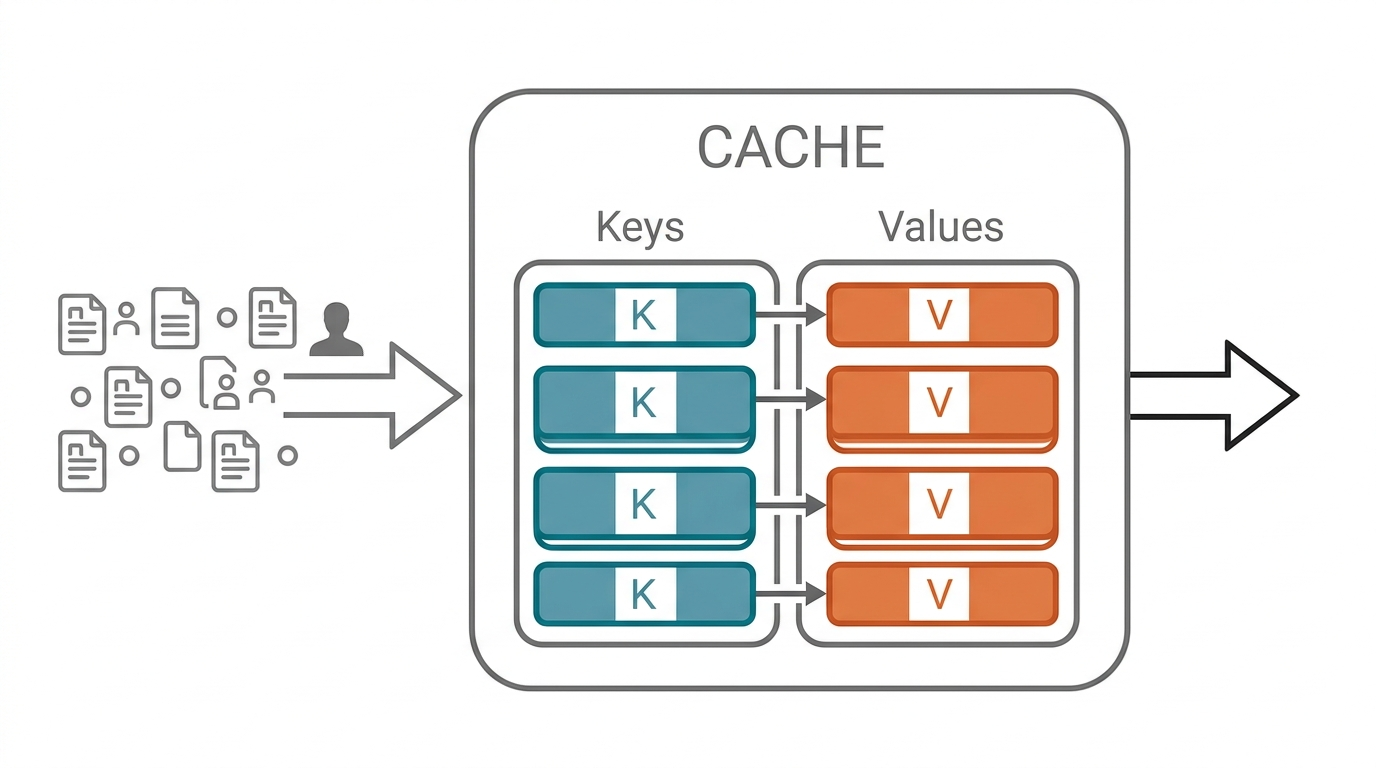
Here's a question worth thinking about: why does having a ten-message conversation with an AI cost significantly less than sending those same ten messages as separate conversations?
The answer lives in a mechanism called the KV Cache — a piece of infrastructure so fundamental to how language models work that understanding it changes how you should think about every dollar you spend on AI.
The Forgetful Waiter Problem
Picture a coffee shop where the barista has no memory. Every single time you walk in, they ask your name, your order, whether you take milk, and whether you prefer paper or ceramic. It takes two minutes just to establish who you are before anything useful happens.
An intelligent barista learns your preferences. Your first visit is slow; every subsequent visit takes seconds.
Without KV Cache, AI models are the forgetful barista. When you send a message, the model runs its attention mechanism across every previous message to understand the full context. Message one took a little work. Message ten requires re-processing everything from messages one through nine, plus the new message. The computational cost compounds with every exchange.
KV Cache makes the model into the intelligent barista. It stores the computed Key and Value vectors from the attention mechanism — the internal representation of what was said before. On your next message, those vectors are retrieved rather than recomputed. The math only happens once.
One computation. Permanent cache.
The Numbers
Abstract savings become concrete quickly when you run the math.
Assume a ten-round conversation where each round adds 100 tokens of input:
Without KV Cache:
- Round 1: compute 100 tokens
- Round 2: recompute 100 previous + 100 new = 200 tokens
- Round 5: recompute 400 previous + 100 new = 500 tokens
- Round 10: recompute 900 previous + 100 new = 1,000 tokens
- Total: 5,500 tokens
With KV Cache:
- Round 1: compute 100 tokens, cache the result
- Rounds 2–10: retrieve cache, compute only 100 new tokens each
- Total: 1,000 tokens
That's a 76% reduction. And this is a conservative example. Longer conversations with longer messages show even more dramatic savings — the percentage improvement grows with conversation length.
How Claude Code Structures Its Cache
Real-world cache architecture isn't just "store everything." Claude Code uses a four-block prompt structure that illustrates how sophisticated systems think about cache efficiency:
Block 1: Global instructions — Anthropic's deep safety rules and core behavioral guidelines. This never changes across any conversation.
Block 2: Static system prompt — Your application's specific rules, brand voice, and fixed instructions. Changes infrequently.
Block 3: Dynamic context — Current files, recent code, tool outputs, and session-specific information. Changes as the conversation progresses.
Block 4: User message — What you're actually saying right now. Changes every turn.
The first three blocks are cached independently. As long as they're unchanged, the cache is valid. The optimization insight: push as much configuration as possible into the earlier, more stable blocks, and keep the later blocks as lean as possible.
Cache Invalidation: The Hidden Cost
Here's the rule that catches most people off-guard: KV Cache operates on prefix matching. The cached vectors are only valid if the beginning of the conversation is exactly identical to when the cache was built.
Change anything in an earlier block, and every subsequent block's cache is invalidated.
This means:
- Edit your system prompt → cache clears
- Add a new context file → cache clears
- Switch to a different model → cache clears
- Edit a message that's already been sent → cache for every message after it clears
The coffee analogy: it's as if the barista's notebook only helps if your order hasn't changed since your last visit. Modify your order, and they start from scratch.
This is why "cleaning up" a conversation by editing earlier messages is often counterproductive from a cost perspective. You feel like you're being organized; you're actually triggering full recomputation.
Cache Expiration: Time Matters
KV Cache doesn't live forever. The cached vectors expire:
- Standard users: 5 minutes by default
- Claude Pro and Max subscribers: extended to 1 hour
The practical implication: if you close a conversation and reopen it within the expiration window, you're still benefiting from the cache. If you're working on a complex project and step away for lunch, returning within an hour means you're resuming where you left off — computationally as well as contextually.
This makes usage pattern optimization possible. Clustering related work into single sessions, staying within the expiration window, batching questions rather than fragmenting them across separate conversations — these habits compound into meaningful cost differences over time.
Five Habits That Maximize Cache Value
1. Lock your system prompt. Before you start any substantive work, finalize your system prompt. Every modification after that point invalidates all cached context. Time spent perfecting the system prompt before the first message is among the highest-ROI investments you can make.
2. Batch work into single conversations. Ten questions in one conversation costs roughly 1,000 tokens. Ten separate conversations asking the same questions costs over 5,000. The work is identical; the price isn't.
3. Don't switch models mid-project. Different models have separate cache pools. Switching models mid-conversation is economically equivalent to starting from scratch. Pick a model for a project and stay with it.
4. Use the expiration window intentionally. For Pro users, a one-hour window is substantial. Morning analysis, midday review, afternoon refinement — all within the same session — can leverage the same cache throughout the day.
5. Understand subagent cache isolation. Claude Code's subagents maintain their own independent cache space. Work delegated to a subagent doesn't pollute the main conversation's cache, and vice versa. This is a feature, not a limitation — it keeps different workstreams clean.
Why This Matters More Than Most Optimizations
KV Cache optimization is unusual among cost-reduction strategies because it requires no engineering effort, no infrastructure changes, and no quality tradeoffs. The savings are purely behavioral.
Consolidating ten fragmented conversations into one: 76% savings. Keeping related work within the cache expiration window: additional 60–80% on top of that. Stabilizing the system prompt and locking it: potential 90% reduction in cumulative project costs.
These aren't theoretical numbers. They're what well-structured usage patterns actually deliver.
The deeper point: most people think of AI cost as "model price per token." KV Cache reveals that it's actually "model price per token, multiplied by how many times you make the model compute the same thing." Eliminate redundant computation and the effective cost per useful output plummets.
The Bottom Line
You're not just paying for model intelligence. You're negotiating with the cache.
Understand the mechanics of prefix matching, respect expiration windows, and build the habit of batching related work into coherent sessions. The savings are immediate, compounding, and require no technical expertise beyond what you've just read.
The barista who remembers your order takes five seconds. So does your AI. The question is whether you're giving it a chance to remember.
References
- Anthropic. (2025). Claude Code Architecture: Block-Based Prompt Structure and Cache Invalidation Patterns. Anthropic Developer Documentation.
- Transformer Attention Mechanism & KV Cache fundamentals. Common patterns in LLM inference optimization. (2024–2025).
- Token Economics: Cost analysis across single vs. multiple conversation contexts. (2024–2025).
- Cache TTL & Subscription Benefits: Default 5-minute retention, extended periods for Pro/Max users. Anthropic documentation. (2025).