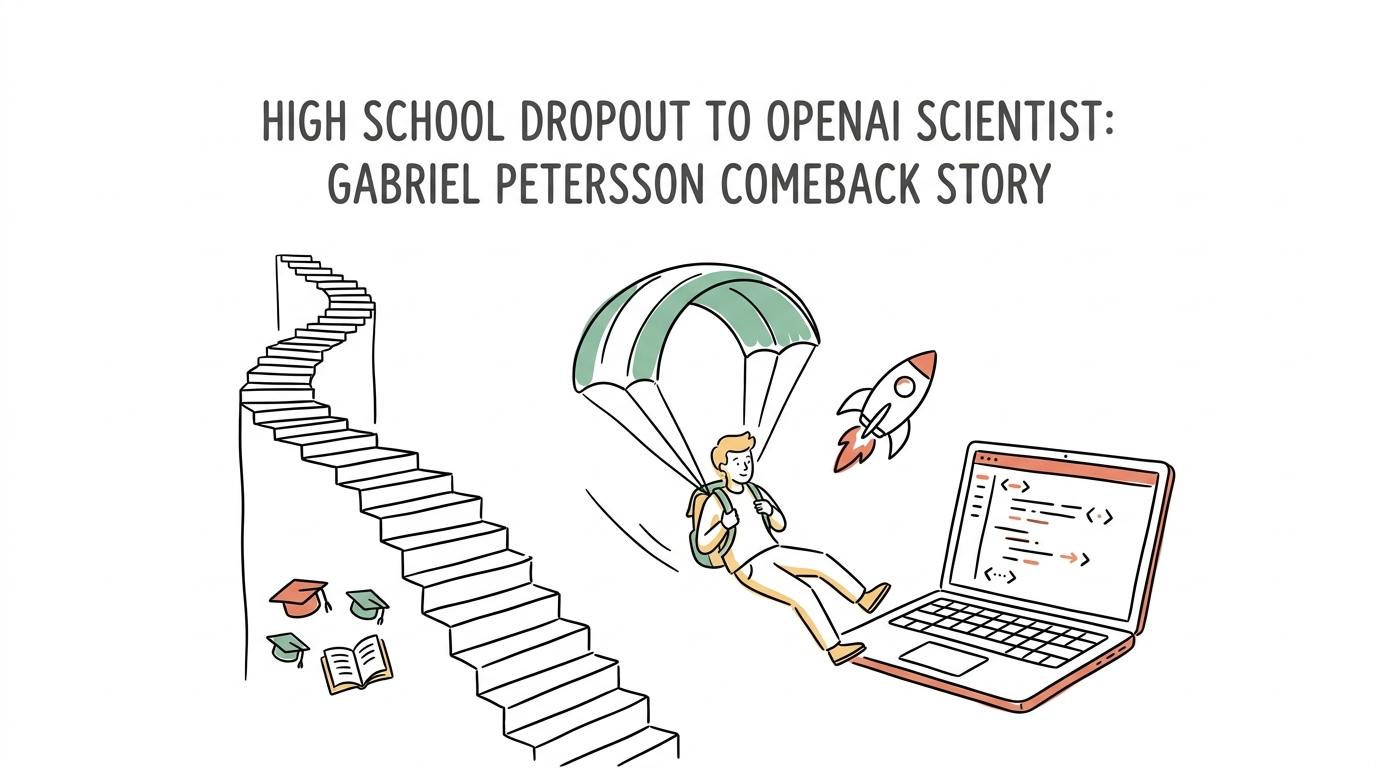
TL;DR: No college degree. Not even a high school diploma. Yet Gabriel Petersson became a research scientist on OpenAI's Sora team. Here's how he pulled it off.
No Time for School? Go Solve Real Problems Instead
Picture this: you're 17, about to head to a weekend party. Then your cousin calls and says, "Get on a bus to Stockholm. Right now. We're starting a company."
What would you do?
Gabriel Petersson chose the bus. He never went back to high school.
He joined Depict.ai, a scrappy startup where a bunch of teenagers had to build a product that could actually make money. There was no time for leisurely coursework. Gabriel needed to figure out web crawlers, data pipelines, and A/B testing -- immediately.
Forget the Staircase. Try the Parachute: Three Levels of Learning Evolution
1. Ditch the Traditional Path: Start With the Problem
The conventional way to learn programming is like building a house from the foundation up. Four years of math first -- calculus, linear algebra -- and maybe after six years you finally get to touch a real Machine Learning model. That's Bottom-Up learning.
Gabriel took a different route: Top-Down.
Hit a problem? Jump straight in. Break it into pieces. When you hit a wall, look it up on forums or ask someone who knows. Once ChatGPT arrived, this approach went into overdrive.

2. The Core Mechanism: Recursive Gap-Filling
He learned Diffusion Models in three days. The method is beautifully blunt:
First, ask AI to explain the absolute basics. Then, have AI write a complete working script -- even if you can't follow it yet, just get it running. Finally, interrogate every line you don't understand. Why does the gradient break here? What exactly is this Residual Connection doing?
Your brain absorbs fastest under real pressure. It's the deep-end-of-the-pool effect: when you have to swim, you learn to swim.
3. The Advanced Insight: No "Vibe Coding" Allowed
Today, Gabriel works on OpenAI's Sora team, developing cutting-edge video generation models. His daily work is hands-on: staring at generated footage, catching physics-defying glitches, tweaking parameters and architectures, then retraining.
He asks AI over a hundred questions a day. He has it review his code and summarize papers. But he draws a hard line: "I never blindly trust AI."
This is not vibe coding. He knows the logic behind every single line. AI saves him the time it takes to find the path -- it doesn't walk the path for him.
By the numbers: Traditional academic training takes roughly six or more years before you work with production-grade models. Gabriel, using AI-assisted recursive learning, grasped the intuitive core of Diffusion Models in three days. (Source: Extraordinary Podcast, 2024)
The Demo Breakthrough: How a Nobody Earns a Seat at the Table
So how does someone with zero credentials convince OpenAI or Midjourney to take a chance on them?
Gabriel's answer is simple: Build a demo so good it shuts people up.
A great demo does exactly two things:
- In 3 seconds, the viewer understands what you built.
- In 3 seconds, they believe you actually know what you're doing.
Companies exist to make money. If you can prove you solve real technical problems, nobody cares whether you graduated from MIT or never graduated at all.
His advice: skip the resume-screening HR pipeline entirely. Send your demo straight to the technical decision-maker. Offer to work for free for one week. For a startup, that's a zero-risk deal -- and for you, it's an entry ticket.
Gabriel even leveraged his high-reputation Stack Overflow answers to convince U.S. immigration authorities he qualified for an O-1 visa -- the one reserved for individuals with "extraordinary ability."
Proof that skills are the universal currency.

If you could drop your rigid study plan right now and just build something, what problem would you tackle? Drop a comment.
Closing Thought: Escape the Permanent Mild Pain
Gabriel noticed something about most people: they live in a state of "permanent mild pain."
Too afraid to make a decision. Too comfortable to change. They'd rather cling to a lukewarm status quo than step into the unknown. It's also why some in academia feel threatened by self-taught outsiders like him -- because his existence cracks the fortress of credentialed hierarchy.
His prescription? Become a great problem solver first. Then throw yourself into a room full of people who are just as hungry as you are.
If you're willing to learn actively and build with your own hands, you're already ahead of most of the world.
Author: TheVoidWeaver | Updated: 2026-03-12 Source: Extraordinary Podcast, 2024