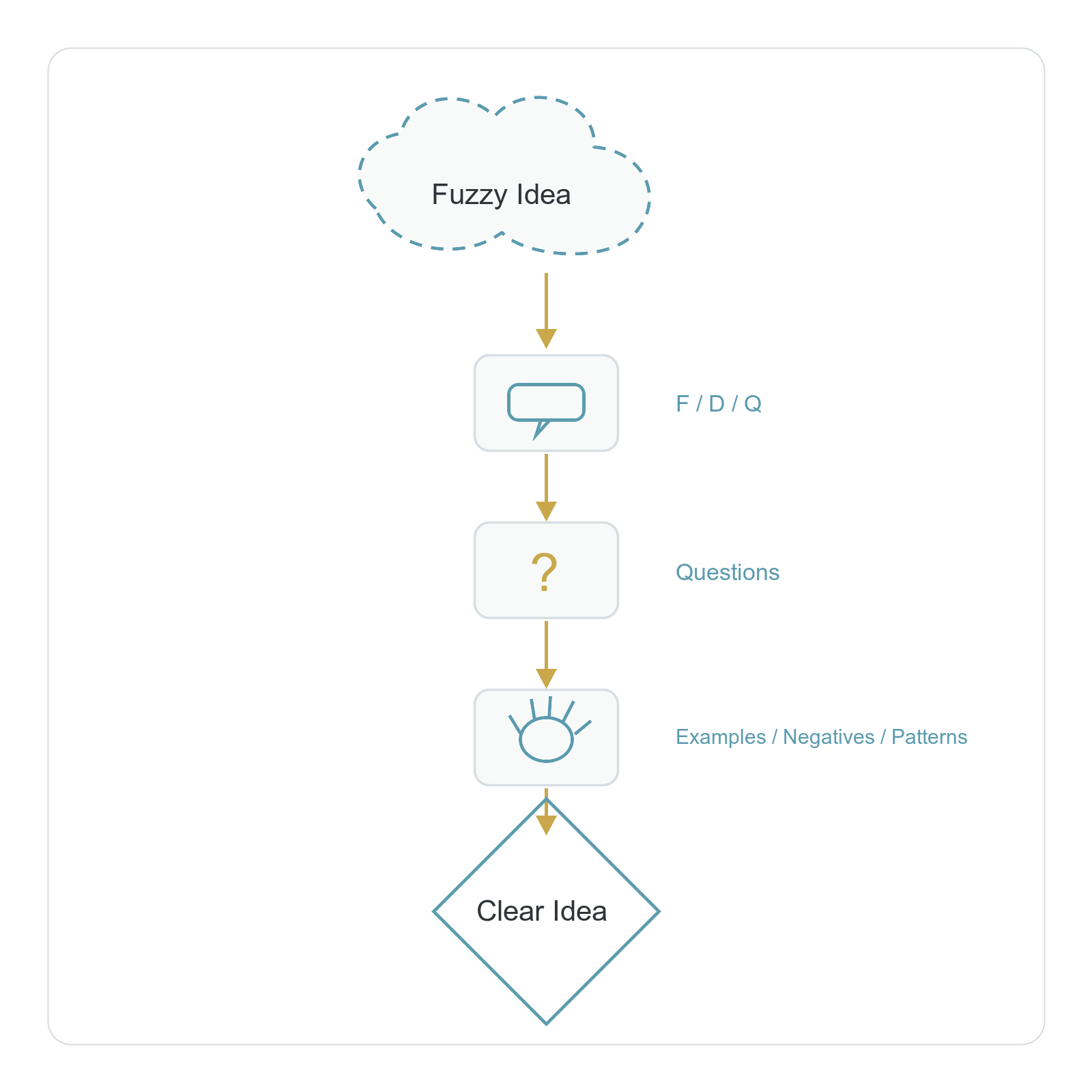
You have a great idea in your head. You open your mouth to explain it — and something gets lost in translation. The idea that felt so clear a moment ago comes out muddled, incomplete, wrong. Sound familiar?
Here's the uncomfortable truth: the problem usually isn't your articulation. The problem is that the idea wasn't actually clear to begin with.
The Boundary Problem
Wittgenstein put it bluntly: "The limits of my language are the limits of my world." In plain terms — if you can't say it clearly, you probably haven't thought it clearly.
This shows up everywhere in professional life. Someone says "this direction doesn't feel right" in a meeting, but when pressed on what specifically is wrong or how it should change, they go quiet. A requirements document says "the feature needs to be user-friendly," but what does that actually mean? What's the standard? The question hangs in the air.
This isn't a vocabulary problem. It's a precision-of-thinking problem. And precision requires tools.
Tool 1: Wittgenstein's Decomposition — Scan What You're Actually Saying
The first move isn't to question — it's to sort. Take the fog in your mind and distribute it across three buckets:
- F (Facts): What you know for certain
- D (Desires): What outcome you want
- Q (Questions): What you're uncertain about
Take the statement "our team's AI tool adoption is poor." Decomposed: F — only 30% of colleagues actively used AI tools last month (verifiable). D — want adoption at 80% (quantifiable). Q — unclear whether the barrier is lack of skill, lack of motivation, or perceived uselessness (investigable).
One step, and a vague complaint transforms into three actionable directions. Facts get verified. Desires get measured. Questions get researched.
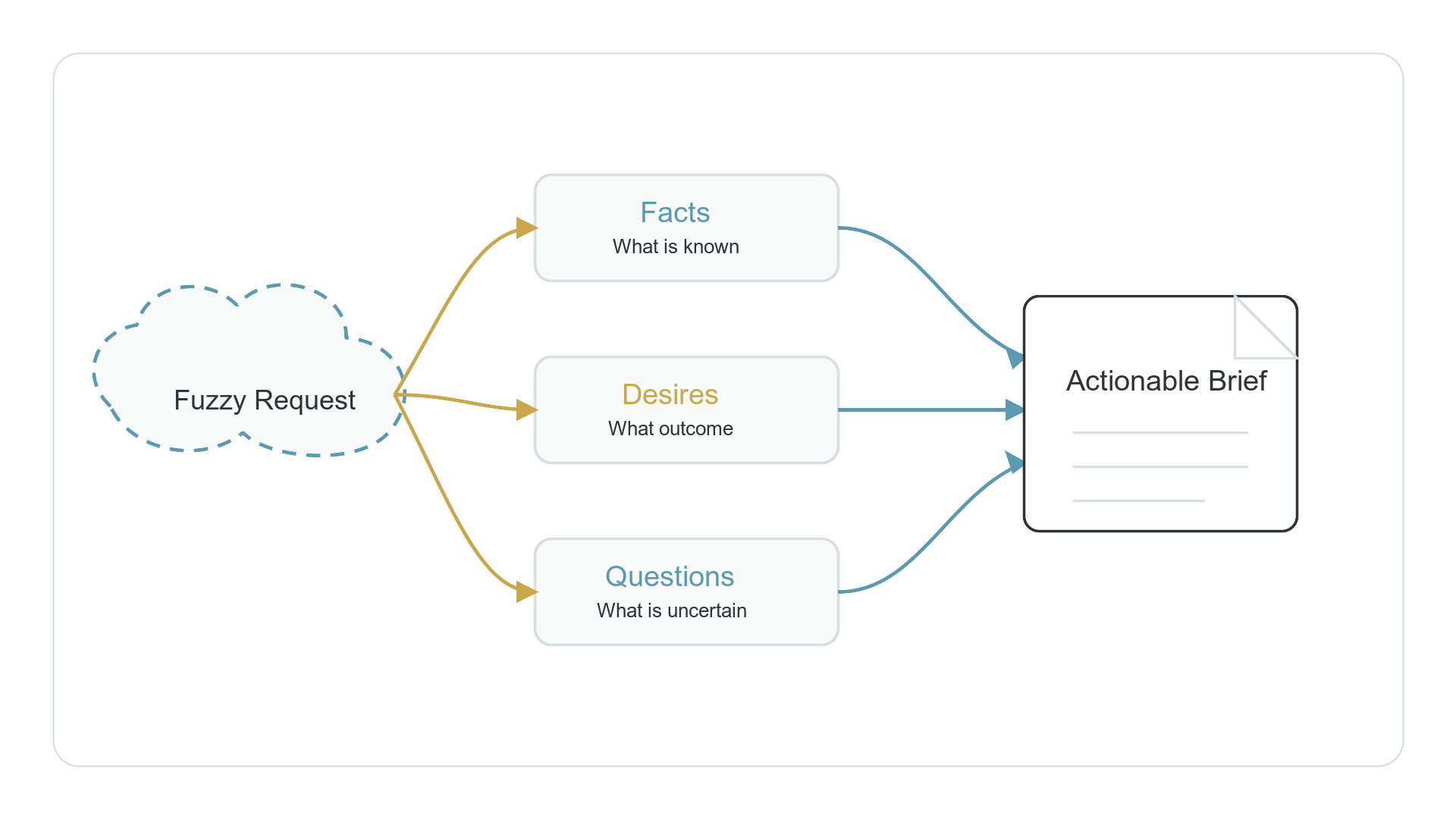 Figure 1: F/D/Q decomposition turns a fuzzy request into facts, desires, and questions.
Tool 2: Socratic Questioning — The Problem Isn't Missing Knowledge, It's Missing Questions
Socrates never taught answers. He only asked questions. Why? Because most of the time, you already know the answer — you just haven't been asked the right question to surface it.
Building on the F/D/Q decomposition, you turn Socratic pressure onto each Q. "You said you're not sure why they don't use the tools — what alternatives have you observed them using instead?" "If adoption actually hit 80%, what specific changes would you expect to see?" "Which team have you seen successfully adopt AI tools? What did they do differently?"
Each round of questioning makes the Q bucket smaller and the F and D buckets larger. You're not extracting new information — you're excavating what was already there.
Tool 3: Polanyi's Safety Net — Some Knowledge Can't Be Said, But Can Be Shown
Even after Wittgenstein and Socrates have done their work, something usually remains: the stuff you simply cannot put into words. You know what a good research report "feels like," but you can't produce a checklist. This is what Polanyi called tacit knowledge — you know it, but language can't fully encode it.
Polanyi's solution isn't to force tacit knowledge into words. It's to capture it indirectly, through three strategies:
Give examples. Rather than describing what a good report looks like, hand over an actual report and say "this — this feeling." The example carries the information that language cannot.
Describe the negative. When you can't articulate what you want, you can usually articulate what you don't want: "Not too academic. Not more than 5 pages. No passive voice." Constraints are a form of specification.
Extract patterns from past behavior. Review documents you've written, revised, approved, or rejected. The pattern across those decisions reveals your implicit preferences more accurately than any description you could produce on demand.
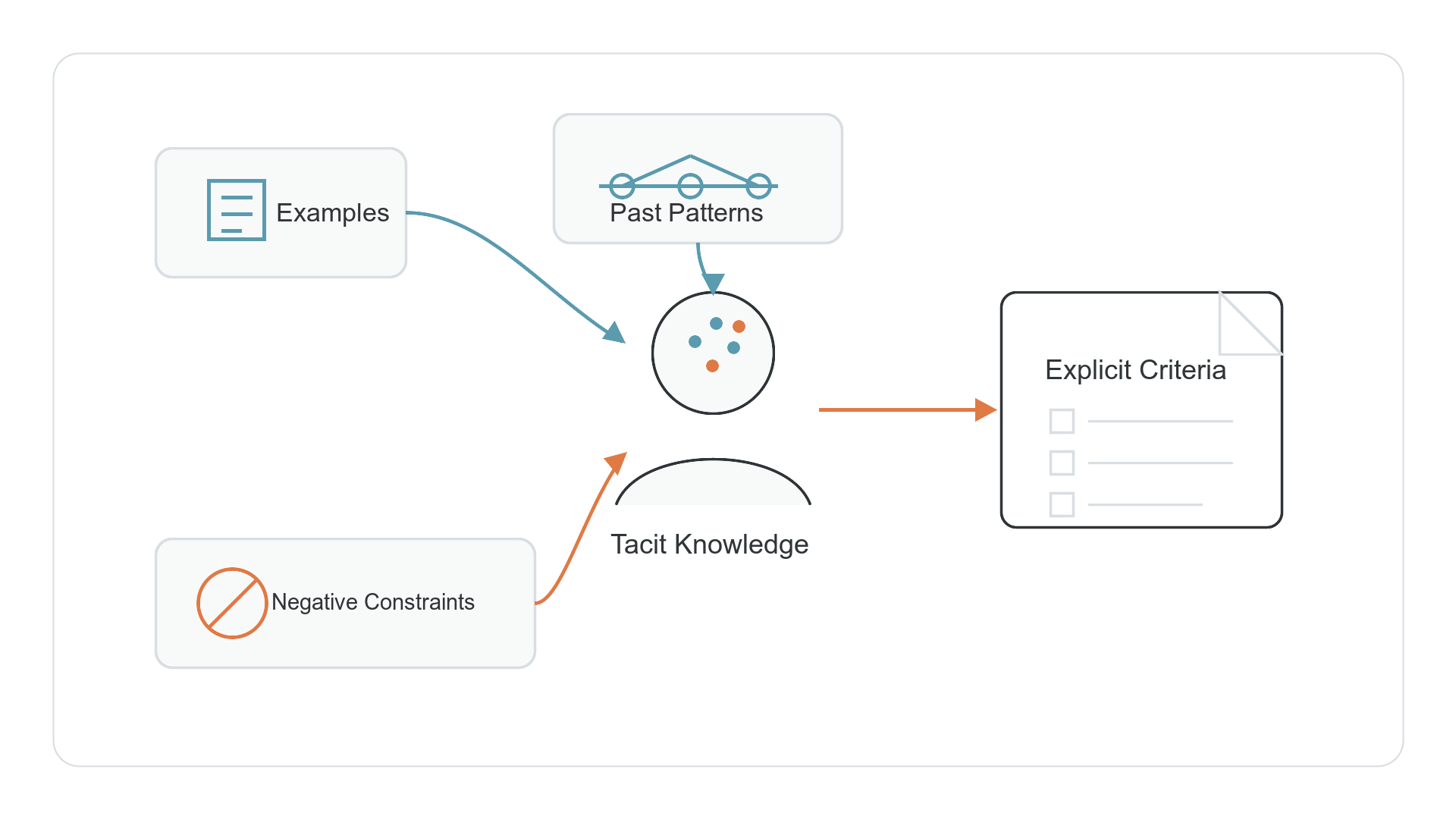 Figure 2: Examples, negative constraints, and past patterns capture tacit knowledge.
The Complete Three-Layer Flow
Vague idea → Wittgenstein (Scan): decompose into F/D/Q → Socrates (Refine): question each Q → Polanyi (Capture): use examples, negatives, and past behavior to catch what words miss → Precise, actionable idea.
Two contexts where this pays off immediately:
AI collaboration. The more precise your instruction, the better the output. Running this framework before you prompt an AI is the highest-leverage pre-work you can do. The difference between a vague prompt and a precise one isn't incremental — it's categorical.
Team requirements clarification. Spending 10 minutes on F/D/Q before a meeting consistently beats 2 hours of circular discussion. The buckets give people a shared structure to contribute to rather than a blank space to fill with whatever comes to mind.
There is a limit, though. This toolkit clarifies ideas, requirements, and AI instructions; it does not replace judgment or evidence. If the facts are wrong or the desired outcome is empty, questioning only makes the error look better organized.
Scan first. Ask next. Use examples for what words still miss.
The fog in your head isn't a sign that your ideas are bad. It's a sign that you haven't yet applied the right tools.
References
- Author unknown (2026). Socratic Questioning, Wittgenstein Decomposition, and Polanyi as Safety Net — My System Upgraded Again. Personal blog.
- Wittgenstein, L. (1922). Tractatus Logico-Philosophicus.
- Polanyi, M. (1966). The Tacit Dimension.