The early days of mainstream AI use had a particular competitive currency: prompt quality. Who could write the most precise, most creative, most effective instruction? The best prompt writers got noticeably better results. It felt like a skill worth cultivating.
It still is. But it's increasingly the wrong thing to optimize for.
Three distinct paradigm shifts have reshaped how sophisticated AI users actually work — and each one has moved the competitive advantage further away from the prompt itself, and further toward the system surrounding it.
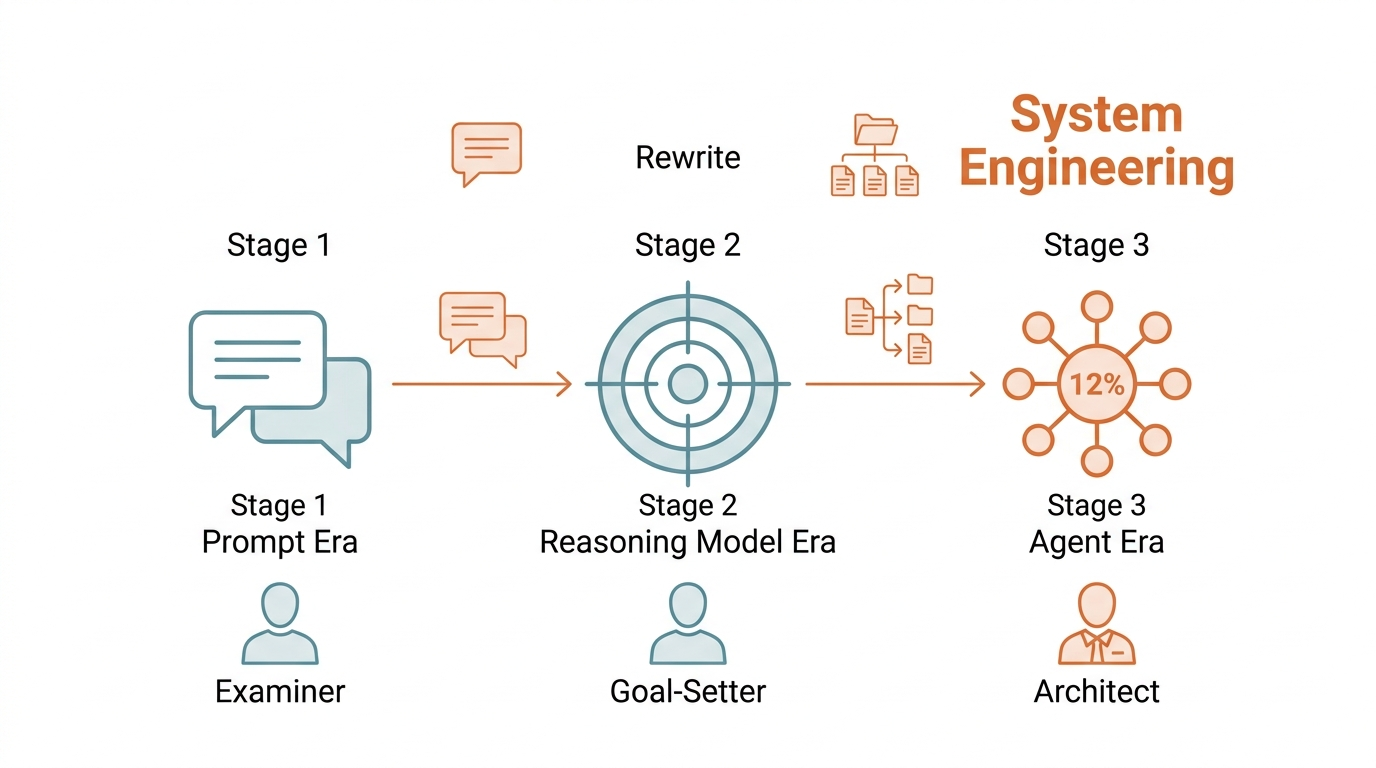
Act One: The Prompt Era — Everything Through Words
The first paradigm was intuitive. You type an instruction; the AI returns a result. Dissatisfied? Revise the prompt. Add a persona, add constraints, add examples, add output specifications. A prompt grew longer as it grew more effective. The craft was in knowing exactly which words to include and in what order.
This approach produced real results. Many people achieved genuinely useful outputs in the prompt era and still do. But the ceiling was visible: everything had to fit in a single exchange. Long inputs caused quality to degrade. Every session started from zero. The prompt writer's skill was artisanal — it didn't scale.
The translation example makes this concrete. A prompt-era translation instruction might read: First, produce a literal sentence-by-sentence translation. Then read through and revise into natural Chinese. Preserve the author's tone. Two explicit steps, manually specified. The prompter does the architectural thinking.
Act Two: The Reasoning Model Era — AI Learns to Think
Reasoning models changed the dynamic in a specific way: they shifted cognitive work from the user to the model.
The same translation task, in the reasoning model era, collapses into a single word: rewrite. Not "translate" — rewrite in the target language. This sounds like a minor semantic distinction. The results are not minor.
"Translate" anchors the model to the source text word by word. It produces accurate text that reads like translation. "Rewrite" gives the model permission to understand the source's intent, restructure sentences, handle idioms culturally rather than literally, and produce something that reads like it was originally written in the target language. Same source. Fundamentally different output. One word changed.
This is the reasoning model's core contribution: you describe the destination, not the road. The model figures out the road.
But a more powerful model is still a single-conversation model. Process a document too long to fit in context and quality degrades. Tasks requiring multiple dependent steps hit structural limits. The paradigm still assumes one prompt in, one result out. For genuinely complex, multi-stage work, something else was needed.
Act Three: The Agent Era — AI as Colleague
The Agent era isn't primarily about smarter models. It's about a different relationship between AI and action.
An Agent doesn't just respond — it executes. It reads files. It runs code. It calls external tools. It breaks a task into sub-tasks, spins up parallel workers for each, persists intermediate results to disk, and assembles the final output from components. It has hands, not just a brain.
The translation workflow in the Agent era looks nothing like the previous two acts. Step one: analyze the source document, extract terminology, identify cultural references and structural patterns, save as an analysis report file. Step two: generate a translation strategy document based on the analysis. Step three: if the document is long, segment it by logical structure. Step four: dispatch multiple sub-agents, each working from the same strategy document, translating their assigned segments in parallel. Step five: merge and perform final consistency review.
Every intermediate artifact is a file. Every step is independently inspectable and rerunnable. The translation strategy isn't implicit in a prompt — it's an explicit document you can read, critique, and revise. If one segment is weak, you rerun that segment, not the whole document.
The critical conceptual shift: in the prompt era, the context window was the entire workspace. In the Agent era, the file system is the primary memory; the context window is just a workbench.
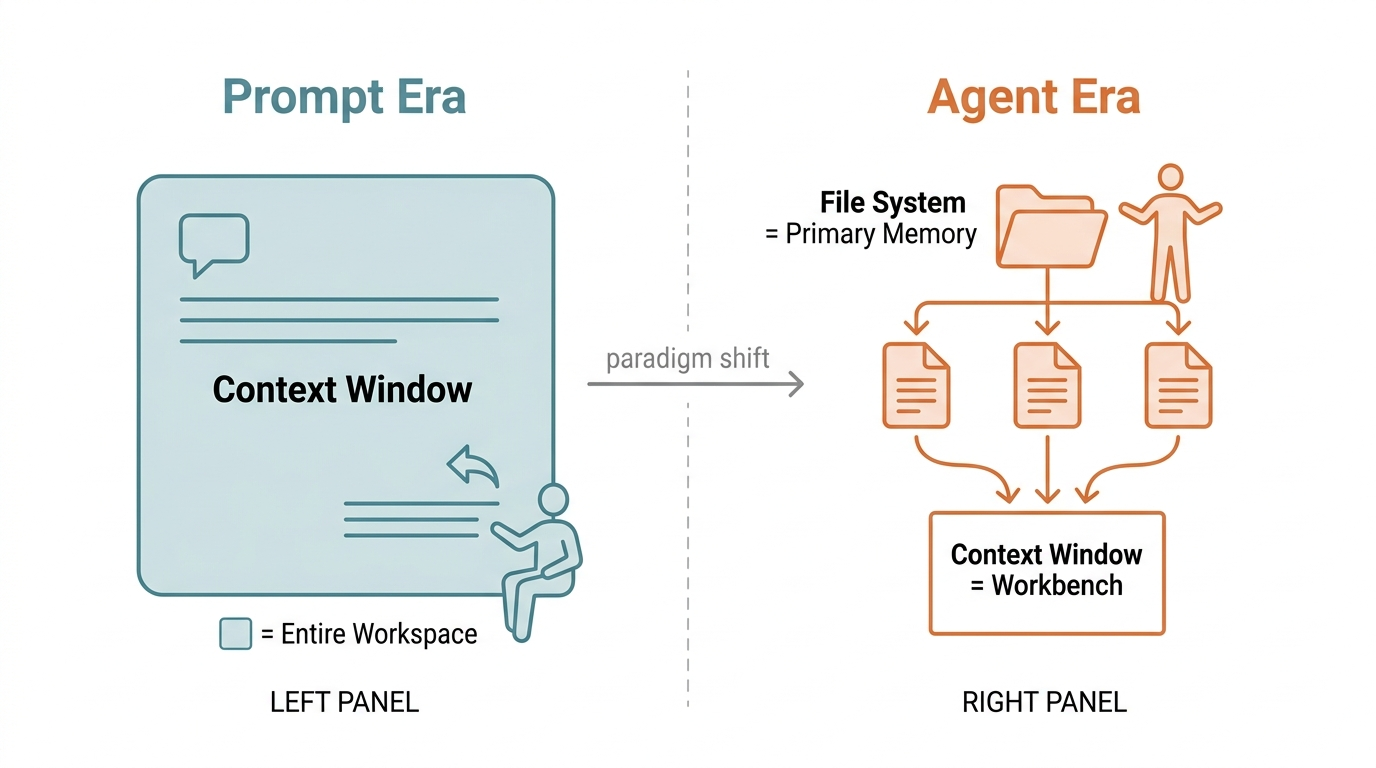
The Real Paradigm Shift: From Phrase to Architecture
The three eras map to three different user identities.
In the prompt era, you're an examiner — crafting questions clever enough to elicit good answers. In the reasoning model era, you're a goal-setter — stating what outcome you want and trusting the model to determine the path. In the Agent era, you're an architect — designing the workflow, defining quality standards at each stage, building the memory system, and letting the Agent execute.
This is what practitioners mean when they say that the Agent era rewards system engineering over prompt engineering. The return on investment has shifted. An hour spent designing a reusable workflow, encoding your standards, and building proper context architecture compounds over hundreds of future executions. An hour spent polishing a prompt is amortized over one.
Systems get smarter over time in a way that prompts don't. Every mistake that gets encoded into a rule file won't be repeated. Every repeated workflow that becomes a Skill runs faster and more consistently next time. The system evolves. The prompt doesn't.
You Don't Need to Jump All the Way
This isn't an argument for abandoning prompts. The three paradigms coexist, and matching the approach to the task complexity is itself a form of system thinking.
Simple questions warrant simple prompts. Single-pass high-quality outputs are often best served by reasoning models given clear goals. Multi-stage, multi-file, iterative tasks are where Agent workflows earn their complexity overhead.
One principle is worth applying regardless of where you currently operate: if you find yourself copying and pasting a prompt you've used before, that's your signal to move to the next paradigm.
Repetition means structure. Structure means the task can be systematized. The only remaining question is whether you want to keep doing it manually — or build something that does it for you, and gets better each time.