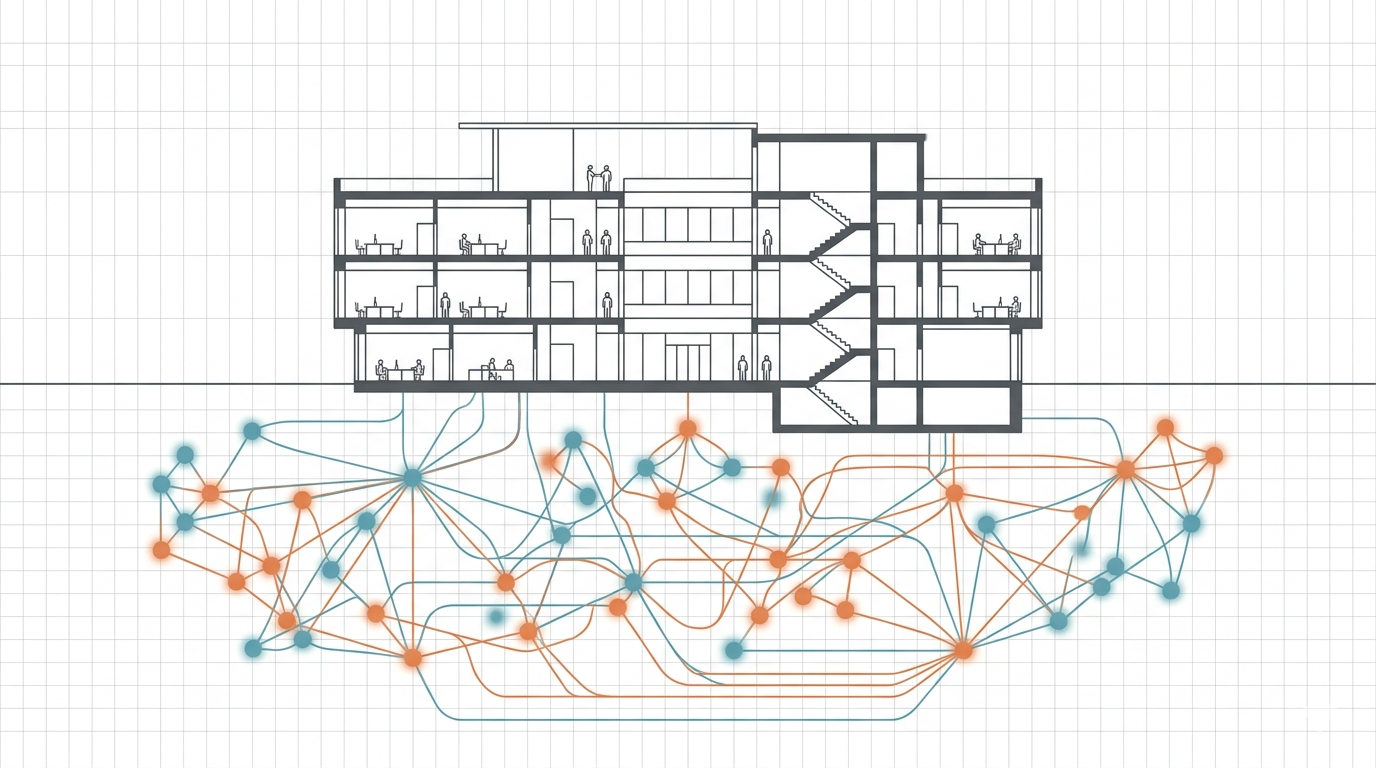
Google, Amazon, Netflix — their real competitive moat isn't algorithms. It's the behavioral signal graphs they spent 20 years building. Enterprise software has always recorded final results while ignoring the decision process entirely. Now, AI Agents have accidentally unlocked a new capability: every operational trace they leave behind is helping companies build their own decision graphs.
The Consumer Tech Secret Weapon
Have you ever wondered why Netflix recommendations feel so accurate? It's not because Netflix knows you like "action movies" as a category. It's because it records every single behavior: which frame you paused on, where you fast-forwarded, how many minutes in before you quit. These behavioral signals accumulate into an enormous graph that gets more precise with every interaction.
Google operates the same way. Every time you search and click the third result instead of the first, that signal feeds back into the ranking model. After 20 years, billions of clicks constitute an asset that's functionally impossible to replicate.
This is the real moat of consumer tech giants: not code, but data flywheels.
The Massive Gap on the Enterprise Side
The enterprise software world looks completely different.
Your CRM records "this deal closed" but doesn't capture which options the salesperson considered during the process, or why three alternatives were rejected. Your ERP records "purchased from Supplier A" but not which substitutes the procurement manager evaluated or where the price negotiation turned.
Enterprise software records outcomes. It ignores reasoning. This means every time someone leaves the company, the decision logic in their head walks out the door with them.
The Door AI Agents Accidentally Opened
Something interesting is happening. As enterprises begin deploying AI Agents for routine work, an unexpected byproduct emerges: every step an Agent takes is traceable.
When an Agent handles a customer complaint, it logs everything: which historical cases it referenced, which solutions it compared, why it chose option B over option A, and what the final outcome was. These "decision checkpoints" naturally accumulate into a decision graph.
When human employees edit the Agent's output — deleting a paragraph, rewriting a sentence, adjusting a number — those edits are themselves extremely high-value signals. They precisely tell the system: "A human expert judged that AI got this wrong here."
Why Legacy Giants Can't Build This
Salesforce, ServiceNow, and other enterprise software leaders aren't blind to this opportunity — their architecture simply doesn't allow it.
Traditional enterprise software's core is the System of Record, designed to faithfully capture final states. Adding simultaneous decision-process tracking would mean rewriting the foundational architecture. And before Agents existed, those decision processes were scattered across human minds, email threads, and meeting notes — structurally impossible to capture.
This is why the opportunity belongs to new entrants: Agent platforms that built "decision tracking" into their DNA from day one.
Three Types of Decision Graphs
Three categories of decision graphs carry the most enterprise value:
Operational decision graphs: The judgment calls Agents make in IT operations, customer service workflows. "Does this alert warrant waking the on-call engineer?" — recording the correctness of every such judgment makes the next judgment more accurate.
Customer interaction graphs: Interaction patterns from business development and customer success. "This email used this tone, sent at this time, and resulted in a closed deal" — signals like these used to live only in top performers' intuition. Now they can be systematically captured.
Strategic decision graphs: The high-level decision logic behind product planning and budget allocation. "Why we chose to enter market A instead of market B" — the complete reasoning chain behind these decisions is the most precious and most easily lost type of organizational knowledge.
The Flywheel Effect
The most powerful property of decision graphs is their compounding returns. Every time an Agent makes a decision and receives human feedback, the graph gets richer. The richer the graph, the more accurate the Agent's next judgment. The more accurate the judgment, the less humans need to correct.
This is identical to Google Search's flywheel: the more it's used, the more accurate it becomes; the more accurate it becomes, the more it gets used.
The difference is that Google spent 20 years building that flywheel. In the Agent era, enterprises might need only 20 months.
Your company makes thousands of decisions every single day. The question isn't whether those decisions have value. It's whether you're recording them.
References
- Anonymous (2026). Google's 20-year secret is now available to every enterprise. Blog.
- Varian, H. (2010). Computer Mediated Transactions. American Economic Review.
- Agrawal, A. et al. (2018). Prediction Machines: The Simple Economics of Artificial Intelligence. Harvard Business Review Press.