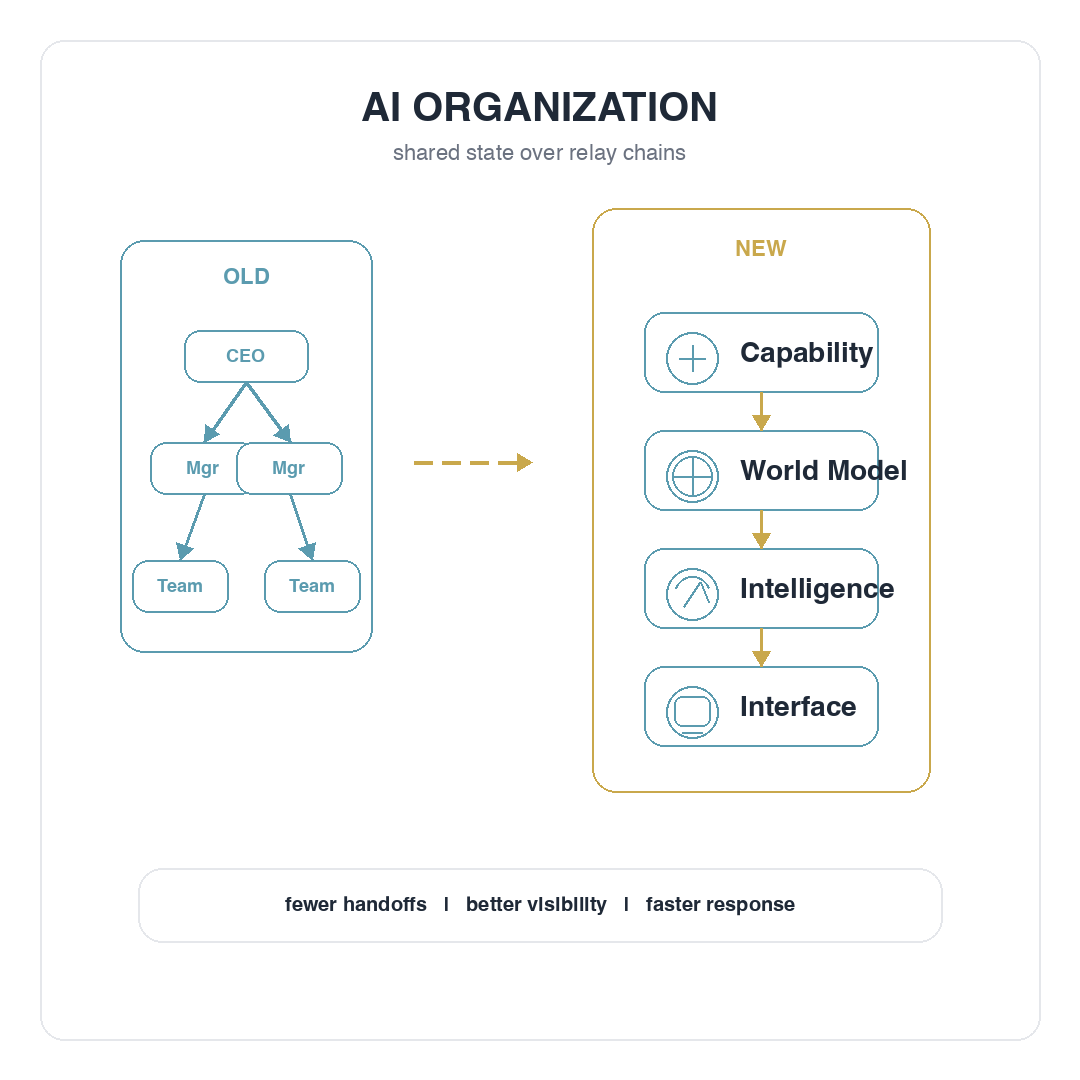
Imagine Monday at 9 a.m. Customer support sees complaints spike. Sales is still in a meeting. Leadership is already looking at half a dozen screenshots in Slack. Why do so many companies install AI and still move like a jammed copier?
The bottleneck is often not the model. It is the organization around it. Signals still move floor by floor. Decisions still wait for approval chains. Tasks still travel back down the ladder. Adding AI on top of that structure is like bolting a stronger engine onto a car with a slipping transmission.
Block's proposal starts from a different question: what if the company itself were designed like an agent? That shift sounds subtle. It is not. It changes how knowledge is stored, how decisions are made, and where human responsibility sits.
Why traditional organizations stall
The failure point is usually the staircase, not the worker.
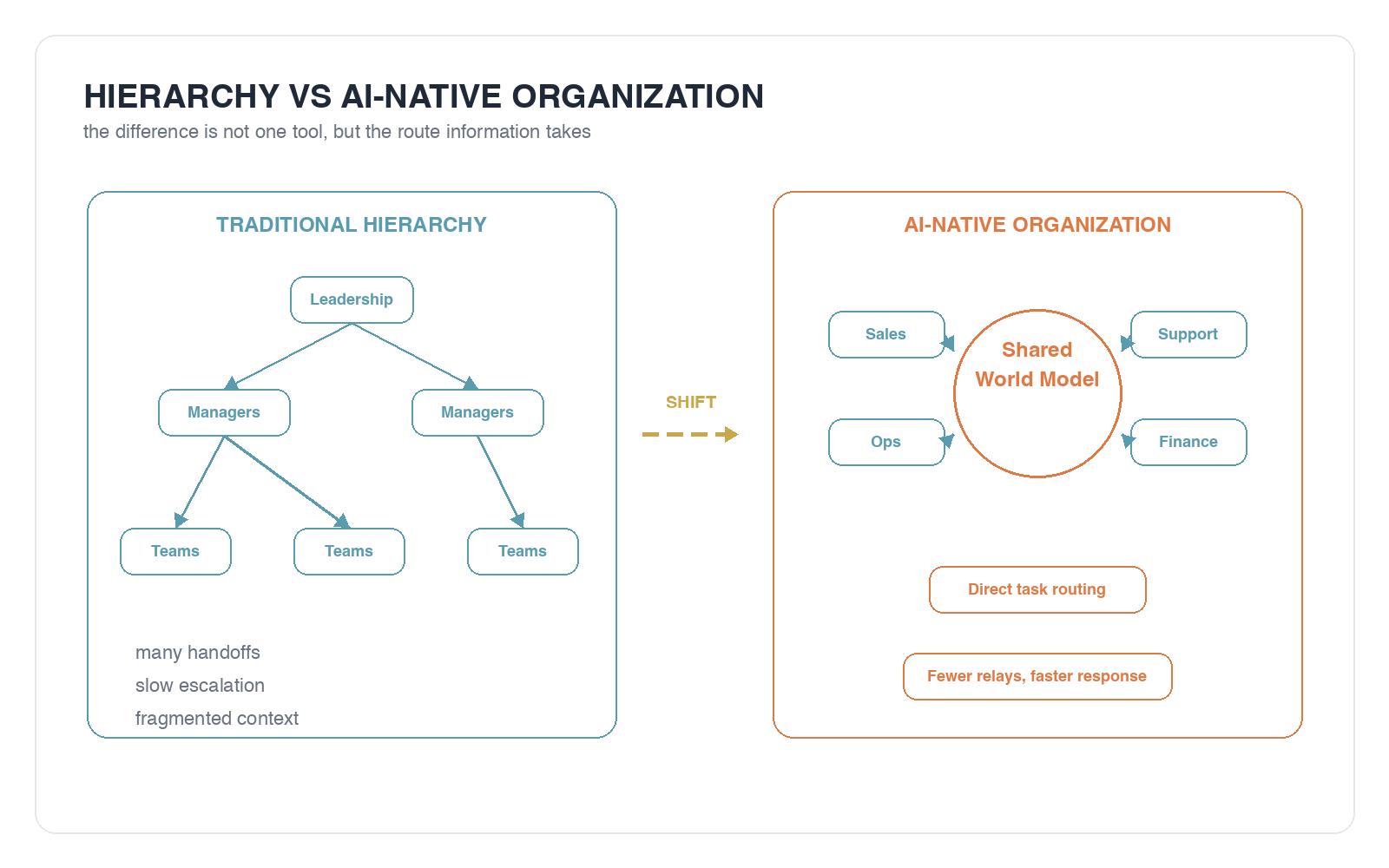
Most organizations still resemble trees. Instructions move downward. Reports move upward. Every layer summarizes, filters, and delays what came before. In a fast market, that architecture starts to work against itself.
You can think of it as moving boxes up and down an office tower. Frontline signals go up one floor at a time, get softened, rephrased, and repackaged, then come back down as delayed instructions. By the end, the original urgency is gone.
The four-layer model
The core idea is to rebuild the company as 4 cooperating layers.
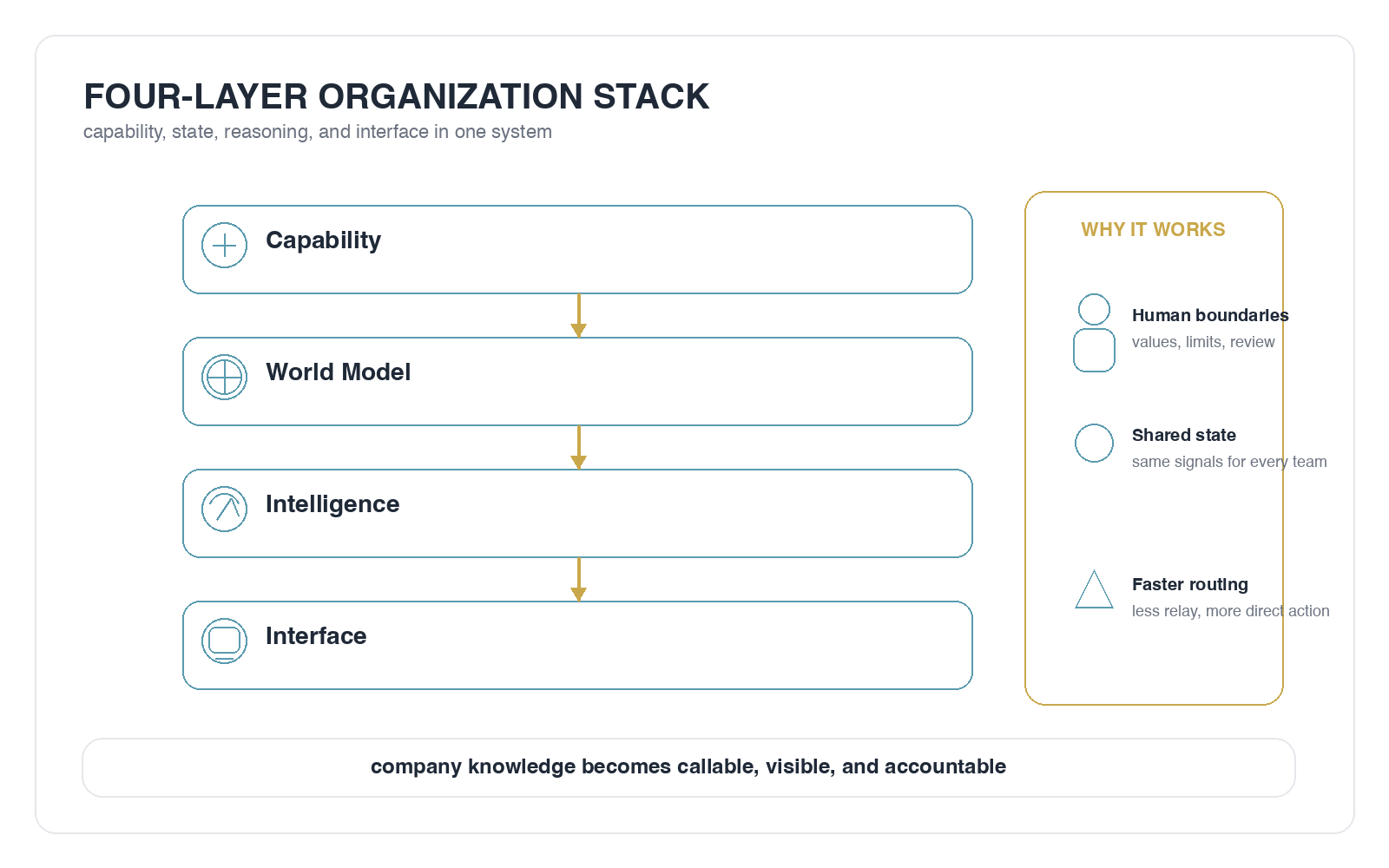
Layer one is capability. What can the company actually do? Which team can resolve refunds, who handles escalations, what workflows are already reliable enough to automate? That knowledge cannot stay trapped in a few people's heads.
Layer two is the world model. This is the live picture of what is happening now: revenue, complaint volume, inventory, team load, conversion, churn. It is less like a quarterly deck and more like an always-on map.
Layer three is intelligence. It connects current state with available capabilities and decides what should happen next. If capability is the tool wall and the world model is the control panel, intelligence is the room deciding which lever gets pulled first.
Layer four is interface. Humans should not have to read the raw firehose. They need the right slice of context, the right task, and the right escalation path at the right time.
What changes for humans
Humans do not disappear. They move upstream.
In the old model, many people act as transport nodes: receive, summarize, pass along, report back. Once those moves become structured enough, AI can absorb a large part of them.
The harder human job is boundary setting. What must never be auto-approved? Which customer cases require a person? Which recommendations are advisory only? When those rules are wrong, the system scales the mistake quickly.
Is this model universal?
No, and that matters.
Digitally native, information-dense companies can move faster toward this model. Manufacturing, healthcare, and finance usually cannot hand over the same level of execution because compliance and liability remain deeply human.
That does not mean they are excluded. It means they should start with narrower, lower-risk workflows and stronger review points.
Where a real company should begin
Do not automate the whole company first. Expose the messy parts first.
Start with a capability inventory. Then create one shared operational view. Only after that should you let AI participate in execution. The sequence matters. A dirty system with faster automation is still a dirty system. It just spreads bad decisions faster.
References
- Block / Sequoia discussion materials (2026), topic: the company as an agent.
- Four-axis design framework for AI collaboration products (2026).
- Anthropic (2026). Claude Code Skills and Orchestration.