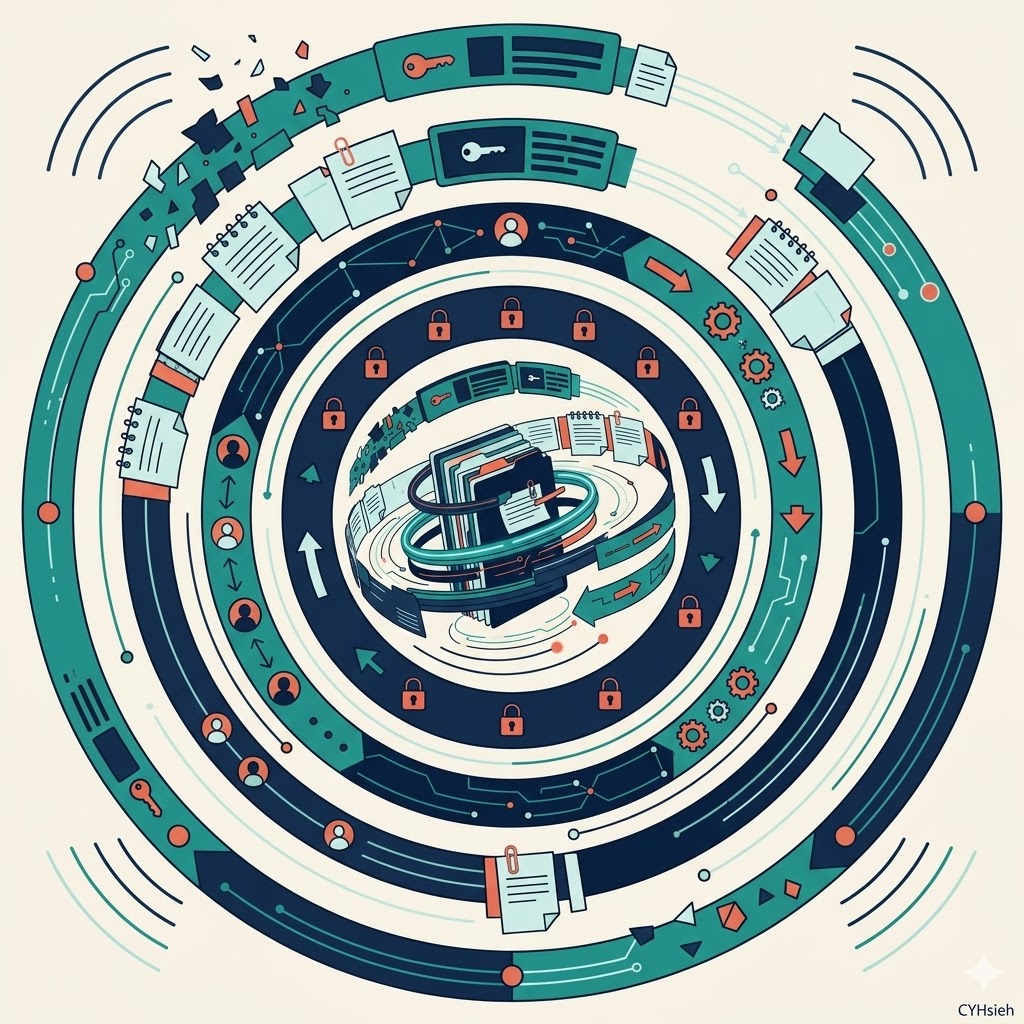
Opening: The Frustration of AI Amnesia
Imagine this scenario: You've been discussing a technical architecture with an AI assistant for half an hour. You've made critical decisions, clarified complex concepts, everything is on track. Then, on your 50th question, the AI suddenly asks: "What was that decision we made earlier?"
You feel a wave of helplessness.
It's not that the AI got dumber. It's a fundamental technical limitation: token window size. Every language model can only "see" a limited length of conversation history. Once you exceed that limit, all the memory vanishes, like pouring water into a leaky cup.
Anthropic recognized that this problem wasn't unsolvable. Instead of giving up, they built an elegant solution: a seven-layer memory system. This architecture functions like a precision archive, organizing and preserving AI memory across multiple dimensions. This article will reveal this system's secrets and show you that memory is fundamentally not about capacity—it's about organization.
The Cost of AI Amnesia
Before understanding the solution, we need to grasp how severe the problem truly is.
Traditional AI assistants suffer from short-term memory loss. You tell them important context, they remember it. But 5,000 tokens later, that information drops out of the window. Worse, if you ask the same question later, the AI answers again, wasting tokens and time.
For developers and enterprise users, this means:
- Repetitive conversations: Constantly re-supplying context
- Wasted costs: Inefficient API calls
- Knowledge isolation: Every conversation starts from scratch
- Poor experience: AI can't learn your work habits
This is why Anthropic decided to surgically redesign the entire memory system.
Layer One: The Raw Data Basement
Imagine a filing room's basement where all papers, reports, and data are stacked haphazardly. This is layer one.
When Claude executes tools—searching files, querying databases, running code—all results are preserved in their original form. The volume of these raw outputs can be staggering. A database query might return thousands of rows. A file search might find dozens of relevant files.
But you can't dump all this directly into the AI's context window. That would immediately overflow it.
Layer one acknowledges: "We need to preserve this raw data as a reference point." It's the foundation for all subsequent compression.
Layer Two: The Intelligent Auto-Summarizer
This is the first "intelligent" layer. When tool results become too long, the system automatically triggers micro-compression.
Imagine you search a codebase for where a function is used, and it returns 200 files. Layer two doesn't dump all 200 to the AI; instead it intelligently summarizes: "Function getUserData is called 45 times in the API layer, 30 times in the middleware layer, 25 times in the service layer..."
This summary preserves key information—distribution, density, patterns—while dramatically reducing volume. The system knows when to generalize and when to preserve detail.
[Visual Asset Placeholder: Micro-compression flow diagram Layer One→Layer Two]
Layer Three: Active Notes During Conversation
Now we enter the real-time layer. As you converse with Claude, the system continuously maintains a Markdown record, like an extraordinarily intelligent notebook.
This record isn't simple transcription. It's structured summary. The system tracks:
- Critical decisions: "We decided on microservices instead of monolithic architecture."
- Confirmed facts: "Project deadline is June 15th."
- Unresolved questions: "Still need to choose frontend framework."
- Ongoing tasks: "Currently evaluating three design proposals."
This notebook stays in context. When the AI needs to review earlier discussion, it doesn't search the entire conversation history—it quickly references this perfectly organized summary.
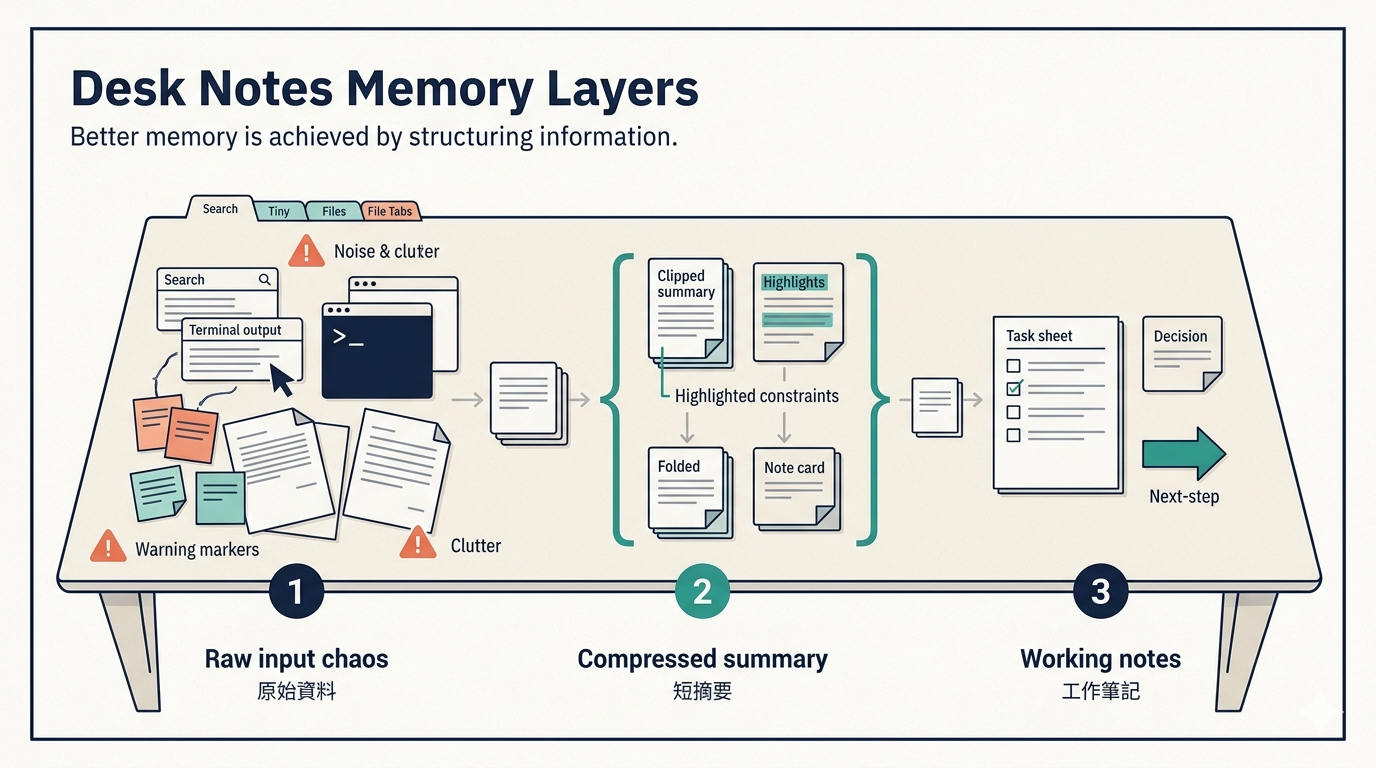
Figure 1: Raw inputs, short summaries, and working notes form a desk-like working system that reduces noise before the model makes decisions.
Layer Four: Large-Scale Reorganization at the Limit
If conversation becomes very long—perhaps hours of interaction—you eventually approach the token window limit. This is when layer four activates.
Full compression is thorough reorganization. The system scans the entire conversation, identifying:
- Core decisions - must preserve
- Rejected options - can become one sentence
- Temporary discussion - can be removed entirely
- Critical examples - replace with more concise versions
The result is a condensed version containing all necessary information, 70-80% smaller in volume.
Layer Five: Intelligent Persistent Storage
This is where memory transitions from temporary to permanent. The system automatically identifies key learnings from conversations.
What constitutes key learning? For example:
- "This project needs daily sync meetings to avoid drift"
- "User preferences shifted in March"
- "API endpoint
/data/exportfails under high load" - "Team discovered repeating file naming patterns"
These insights are tagged, organized, and stored persistently. Subsequent conversations automatically access these learnings without rediscovering them.
Layer Six: AI's Dream-Time Organization
This is the most fascinating layer. The system calls it "Auto-Dream."
Every 24 hours or after completing 5+ conversation sessions, a background agent awakens. Its job isn't to execute tasks but to organize memories.
This process involves three key blocks:
Knowledge Architecture
The system builds and updates a rule library. Each rule represents a validated insight:
- "When users submit requests at 10 AM, response times average 20% faster"
- "This project's core risk is human resources, not technology"
Remarkably, if subsequent conversations contradict a rule, the system automatically demotes it. Rules aren't dogmatic but evolve based on evidence.
Decision Journal
The system logs every important decision and its reasoning. This prevents a common problem: repeatedly debating the same issue. The system knows "we already decided X because Y" and won't argue about it again.
Quality Gate
This is the secret to self-improvement. The system defines concrete, testable criteria and continuously evaluates itself. For example:
- "Code suggestions must pass tests"
- "Architecture recommendations must consider costs"
These criteria themselves evolve. When standards prove too strict or too lenient, the system auto-adjusts.
In research, a team discovered that the system autonomously generated 24 project-specific rules in one month. Imagine: without human intervention, the system self-improved with 24 workflow best practices.
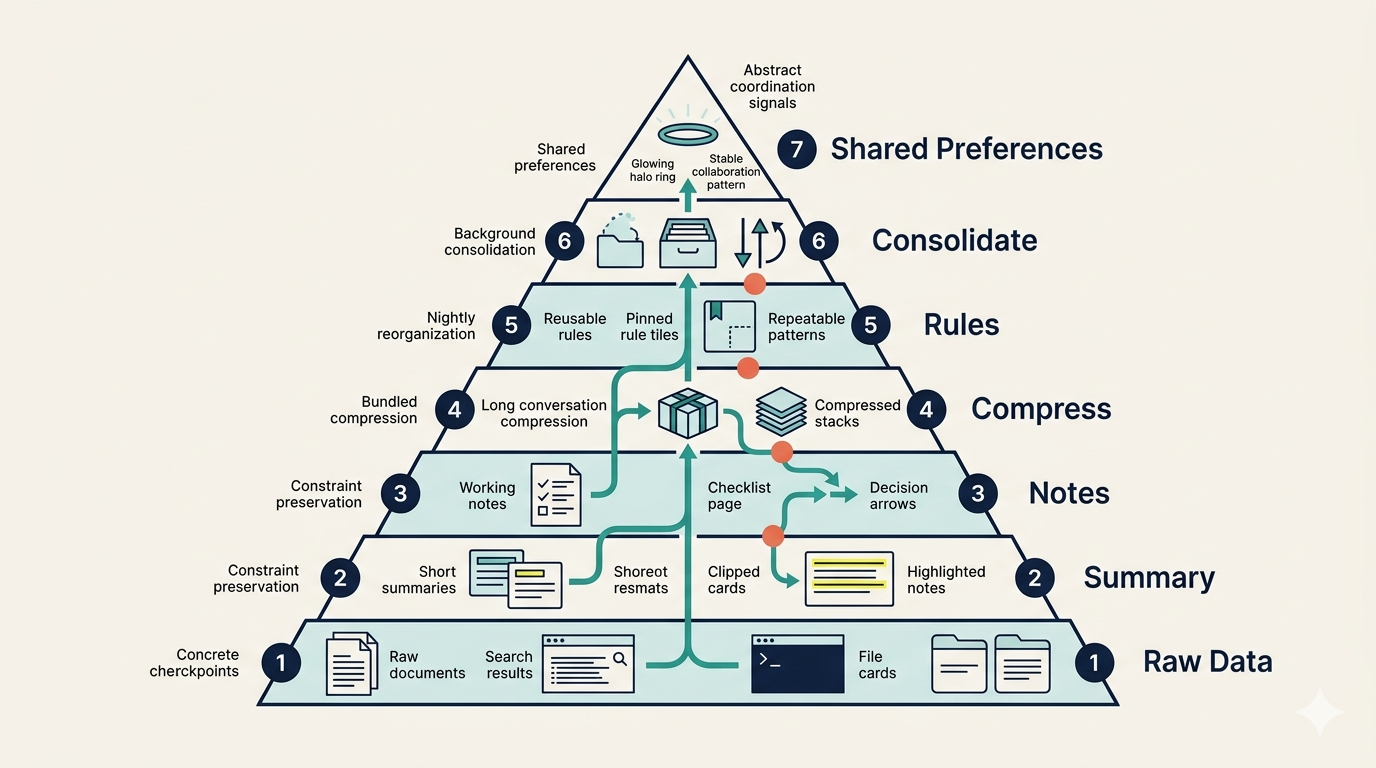
Figure 2: The seven-layer memory hierarchy rises from concrete working data to more abstract rules, consolidation, and shared cross-task preferences.
Layer Seven: Knowledge Sharing Between AI Agents
The final layer transcends single conversations. Anthropic envisions shared memory between different Claude instances.
What does this mean? If one Claude instance (say, on a coding task) discovers a clever solution, that knowledge becomes accessible to another instance (say, on a documentation task). More broadly, organizations can build collective intelligence pools.
It's still in its early stages, but the potential is enormous. It previews a future in which AI systems aren't isolated but learn from one another.
How the System Saves Costs and Improves Performance
This seven-layer architecture isn't designed just to sound sophisticated. It saves real money in practice.
First is prompt cache optimization. Because memory is precisely organized, many cache hits become possible, reducing redundant computation.
Second is circuit breakers and graceful degradation. If any layer fails—say, persistent storage becomes temporarily unavailable—the system doesn't crash. It automatically falls back to the previous layer, ensuring continuous functionality.
Third is feature flag architecture. Anthropic uses GrowthBook to control which features activate when. This enables rapid experimentation and rollback without code deployment.
According to leaked data, the model's actual contribution is 60% quality from the model itself, 40% from engineering harness. This seven-layer system is the core of that 40%.
Why Simple Search Beats Complex Search
Here's a counterintuitive insight: intelligent brain + simple search (grep/ripgrep) > intelligent search engine.
Many teams initially assume they need sophisticated vector search or AI-driven semantic retrieval. But Anthropic's practice shows a truly intelligent system performs well with simple text search. Why?
Because memory is carefully organized. Indexing is clear. Metadata is structured. The system knows what to search for and where to search.
Another secret: don't try to remember code, remember preferences. The system doesn't store a copy of 10,000 lines of application code; it stores "this team prefers TypeScript" and "this project values readability over micro-optimization."
Conclusion: The Art of Memory
AI amnesia isn't an insurmountable curse. It's merely a memory-lacking intelligent organization.
Anthropic's seven-layer system elegantly proves: given proper architecture, AI can not just remember—it can grow. Each conversation makes it smarter. Every decision becomes the foundation for the next conversation.
Future AI assistants won't struggle with token limits. They'll automatically categorize, compress, and learn. Just as humans consolidate memories through sleep, AI will perfect itself through "dream-time organization."
For you, this means a practical takeaway: help modern AI organize information. Provide structured context, tag important decisions, and maintain consistent conversation threads. When you do this, AI automatically learns your work patterns, becoming a truly intelligent partner—not a forgetful friend.
Memory isn't about storage capacity. It's about organizational architecture.
Further Reading:
- Anthropic's Memory System whitepaper
- Deep dive into tokenization and context windows
- Prompt engineering best practices