When was the last time you dragged and dropped a file? UX pioneer Jakob Nielsen argues that AI has triggered the first major UI paradigm shift in 60 years. The last one moved us from batch processing to command lines. This time, users go from being operators to supervisors, no longer issuing step-by-step instructions but delegating intent and monitoring outcomes.
Three Interaction Paradigms: Which Era Are You In?
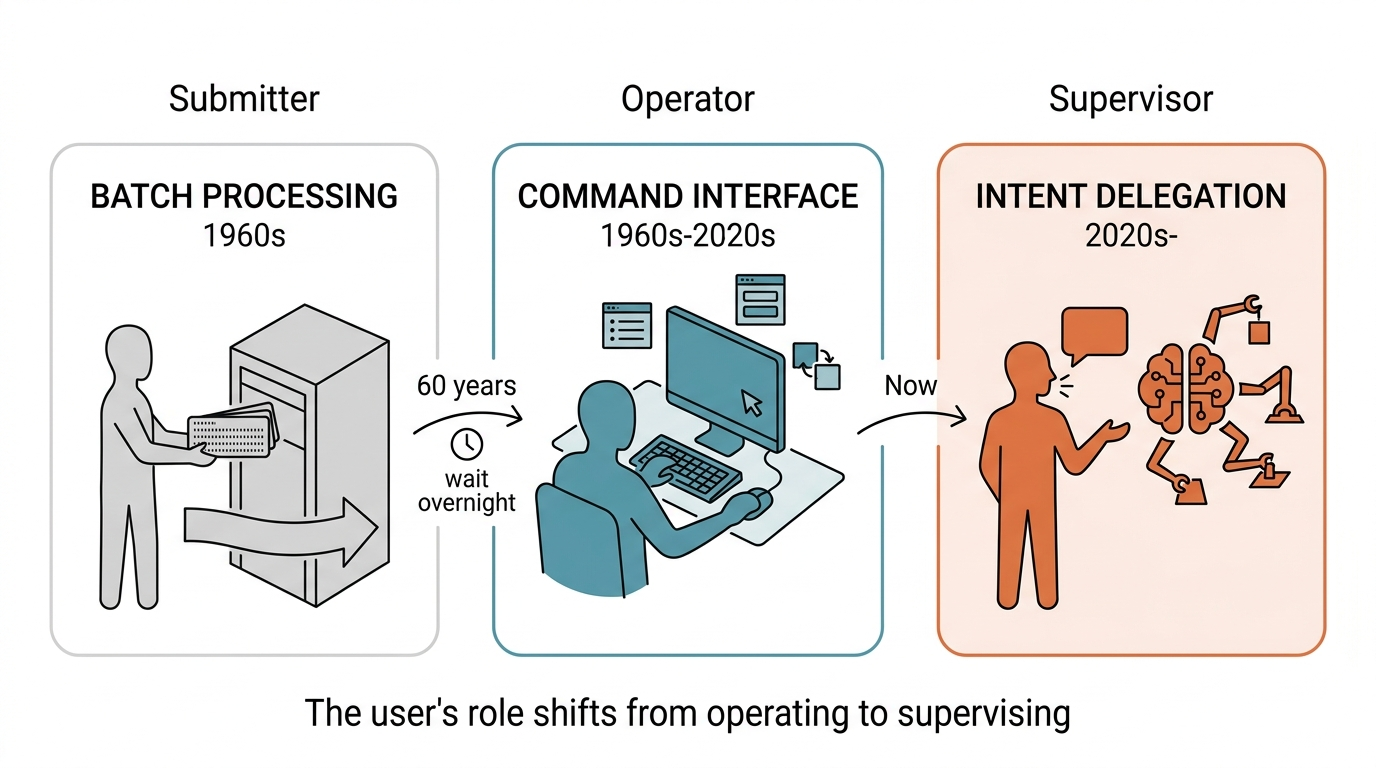 Figure 1: Three shifts in the user's role over 60 years, from batch processing to intent delegation.
In the batch processing era, you handed a stack of punch cards to a computer and came back tomorrow for the results. Humans had no control over the process. In the command interface era (the past 60 years), humans told computers what to do step by step: pick a menu option, fill out a form, drag a file. In the intent delegation era (starting now), humans state the desired outcome and AI figures out the steps.
A Viking chieftain says "go to that English monastery and bring me silver." He doesn't specify building shields first, hiring sailors, or plotting a course. He just states the goal. That's intent delegation.
This isn't a change in how interfaces look. The user's role has fundamentally flipped.
Does AI Actually Understand What You Mean?
"Plan my Chicago trip" sounds like a complete instruction, but AI doesn't know your budget, your unmovable meeting schedule, or your risk tolerance. A usable "intent" needs at least three layers:
- Desired outcome: what to achieve
- Constraints: acceptable boundaries
- Delegation boundaries: what AI is and isn't allowed to do
Here's the problem. Current chat interfaces require users to spell out their full intent in text, but writing is cognitively much harder than reading. How much harder? According to the OECD's PIAAC survey, roughly half the population in developed countries lacks the literacy to precisely articulate complex intent. The very existence of prompt engineering is proof of this usability crisis.
The Three-Layer Interface: What Does the Future Look Like?
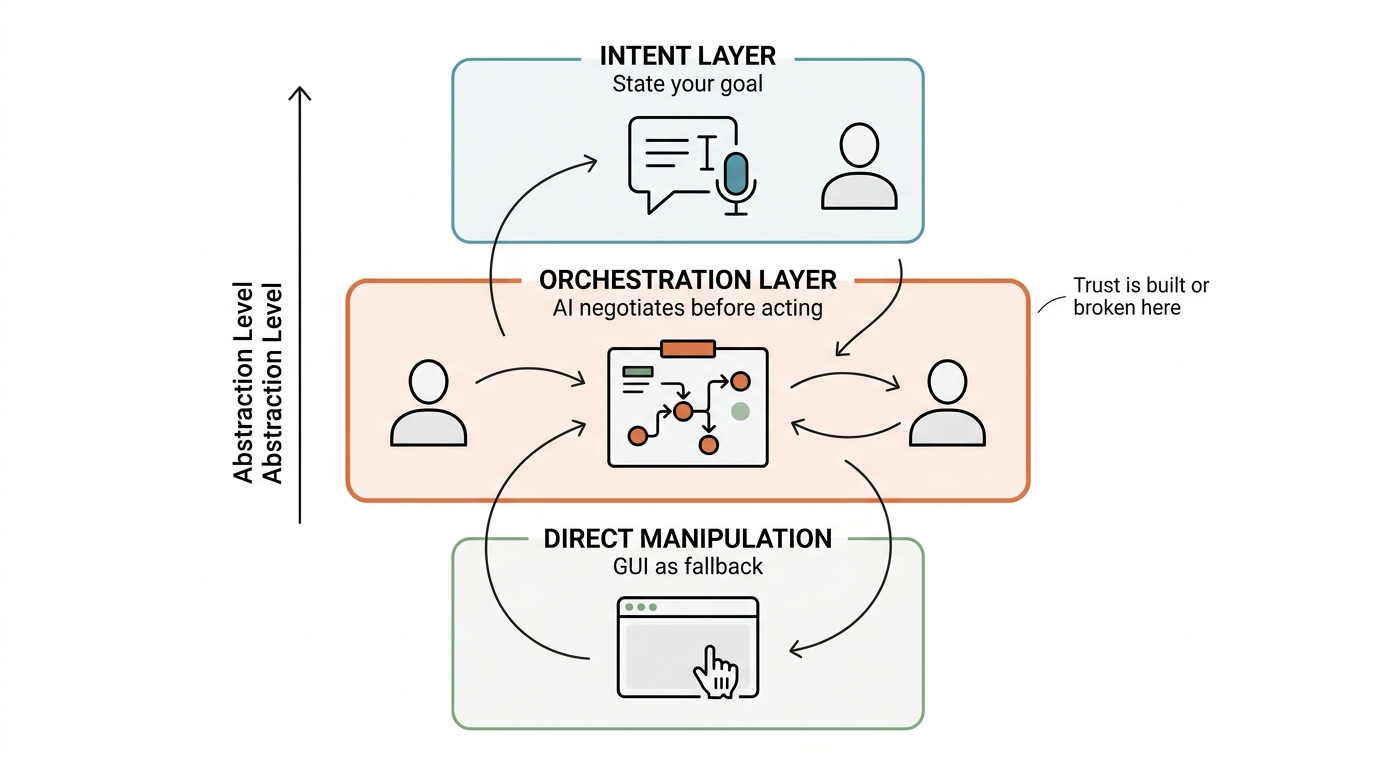 Figure 2: How the intent layer, orchestration layer, and direct manipulation layer divide responsibilities.
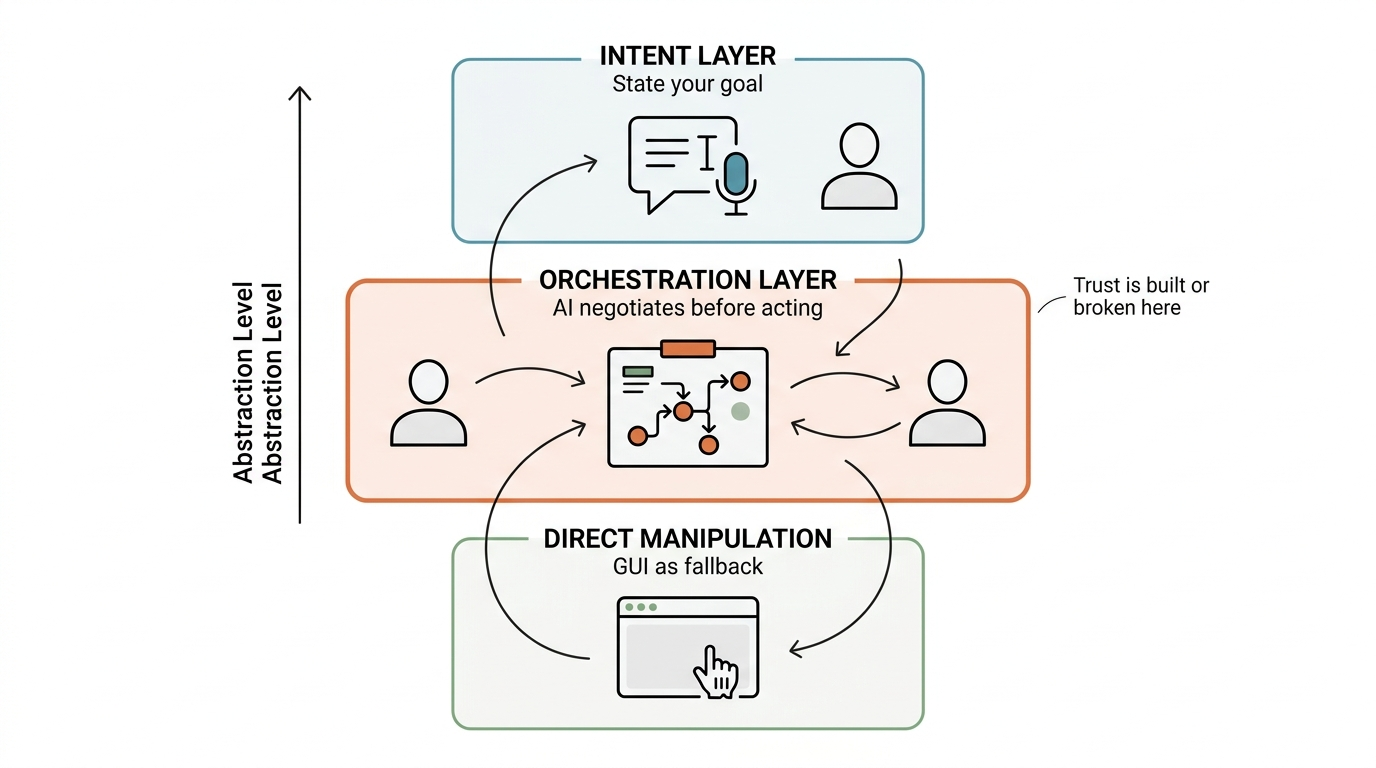
Mature AI systems will form a three-layer interface:
At the top sits the intent layer, where users state their goals. Multimodal input (voice, text, screenshots, context awareness) lowers the articulation barrier. As systems mature, they increasingly rely on implicit intent inference: reading your calendar, screen content, and behavior history to guess what you want.
In the middle is the orchestration layer, the most overlooked battleground. Before executing high-stakes actions, AI must negotiate: show its plan, list data sources, flag who's affected, and provide receipts afterward. Trust is built here. Trust collapses here too.
At the bottom is the direct manipulation layer, traditional GUI demoted to a fallback for edge-case fine-tuning and emergency overrides. But the object of manipulation has changed: not pixels, but the plan itself. Drag task priorities, adjust timelines, inspect sources.
Three Crises Happening Around You Right Now
The first is the articulation barrier. Users can't precisely express intent. Solutions include style galleries (choosing instead of describing), editable user models (preference memory), and multimodal input.
The second is the credibility trap. AI output arrives clean, authoritative, and instant, so users skip critical analysis and accept it at face value. Have you ever taken a ChatGPT answer without questioning it? The fix is progressive delegation (draft first, then prepare, request confirmation, handle low-risk tasks, touch high-stakes last) and cognitive uncertainty UI (visualizing AI's confidence level).
The third is the sneakiest: the cognitive wheelchair. If users never need to understand how the system works, they fall into a "cognitive atrophy loop" and become passengers in their own digital lives. Good AI UX is a cognitive exoskeleton that augments your ability. Bad AI UX is a cognitive wheelchair that replaces it.
Does Intent Delegation Work for Everything?
Nielsen's framework targets knowledge workers and consumer applications. In high-stakes contexts (medical decisions, financial transactions, legal judgments), full reliance on intent delegation could be catastrophic. No matter how well the orchestration layer is designed, AI's "plan" may still contain errors users can't detect.
The delegation model also assumes users can judge AI output quality, but that's exactly the core paradox of the cognitive wheelchair crisis: the more you rely on AI, the harder it becomes to tell when AI is wrong. There's no perfect solution to this loop yet, only progressive delegation and deliberately preserved "friction points" to slow the slide.
Why This Matters to You
The command paradigm served us for 60 years. Over the next decade, usability shifts from "click efficiency" to "intent capture accuracy." Designers no longer face linear flows but an entire possibility space.
The products that win will be the ones that understand user intent, orchestrate solutions transparently, introduce appropriate friction at high-stakes moments, and always preserve human authority.
Is your next product a cognitive exoskeleton or a cognitive wheelchair?
FAQ
Q: Will traditional GUIs disappear?
They won't disappear, but they'll be demoted to the third-layer fallback. Future interfaces have three layers: the intent layer (state goals), the orchestration layer (AI shows its plan before acting), and the direct manipulation layer (traditional GUI for edge-case fine-tuning). You can still drag and click, just at a higher abstraction level.
Q: Will prompt engineering stick around forever?
The existence of prompt engineering is itself evidence of a usability crisis: the interface demands that users express intent in text, but writing is much harder than reading. The future points toward multimodal input (voice, screenshots, context awareness) and implicit intent inference, gradually eliminating the articulation barrier.
Q: Will intent delegation make people dumber?
That's exactly the core of the "cognitive wheelchair" crisis. It comes down to design: good systems preserve friction at the right moments, keeping users engaged in decisions rather than watching from the sidelines. A design that eliminates all friction is the most dangerous kind.
References
- Nielsen, J. (2026). Intent by Discovery: UX in the AI Era. Jakob Nielsen on UX (Substack).