In early 2026, a widely-used open-source package was quietly compromised. Malicious code was injected into a version that thousands of projects already depended on. By the time security researchers identified the problem, the infected package had propagated far beyond any single codebase.
Supply chain attacks aren't new. What's new is the accelerant: autonomous AI agents that install packages, execute code, and modify files — without hesitation, without suspicion, and at a speed no human developer can match.
Why Agents Are Especially Vulnerable
When a human developer runs npm install or pip install, there's a small but real window for human judgment to intervene. An unusual file appearing after installation. A new network permission request. A package that suddenly wants access to directories it never touched before. Experienced developers develop intuitions for these signals.
Agents don't have this instinct. Their operating model is: instruction received → action executed. When told to "set up this project," an agent will install every dependency in the manifest, including transitive dependencies it has never seen before, without pausing to evaluate whether any of them behave oddly.
This isn't a flaw in agent design — it's a feature. The efficiency that makes agents valuable also makes them vectors. Three factors compound the problem:
Speed: What a developer might take minutes to do, an agent accomplishes in seconds — compressing the detection window to nearly zero.
Scale: A single agent may be simultaneously building or maintaining dozens of projects, expanding the infection surface far beyond what any individual developer could reach.
Trust propagation: Agent A installs a compromised package. Agent B pulls in Agent A's output as a dependency. Agent C builds on Agent B's work. The longer the chain, the harder the attribution when something goes wrong.
How Backdoors Spread Through Agent Networks
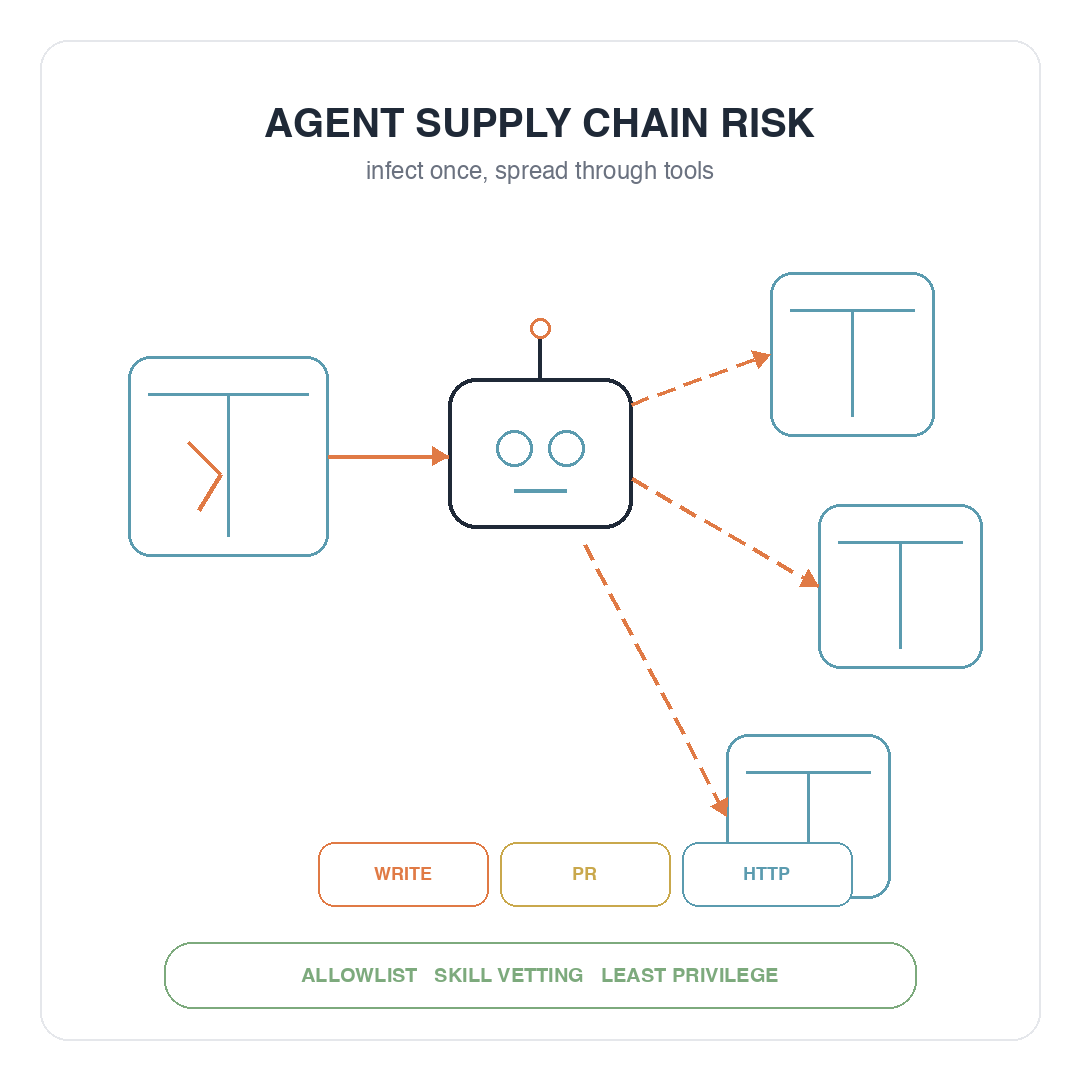
The most dangerous scenario isn't just passive infection — it's active propagation. An agent infected through a compromised package may itself have tool-calling capabilities: the ability to write files, execute commands, make network requests, submit pull requests to external repositories.
A well-designed backdoor can exploit these capabilities to replicate itself. Automatically submitting PRs to related projects containing the infected dependency. Installing compromised versions into sibling environments. The agent becomes an unwilling participant in its own spread — and the humans supervising it may see nothing unusual in the logs, because the agent is technically doing its job.
Three Lines of Defense
The security community is responding, and practical defenses are emerging.
Defense 1: Allowlist hooks. Claude Code's Hooks system supports PreToolUse hooks that intercept any installation command before execution. A simple shell script can check whether the requested package name and version appear in an approved allowlist — blocking anything outside it and generating an alert. This single intervention eliminates the most common infection vector.
Defense 2: Skill vetting. The community has developed meta-Skills like skill-vetter that audit third-party Skills before they're loaded. The audit checks for suspicious file operations, unexpected network requests, and privilege escalation attempts. Think of it as app store review for AI capabilities — a human-readable security report generated before the Skill ever executes.
Defense 3: Least-privilege by design. The most durable defense is architectural. Agents should be granted only the permissions they demonstrably need. A document-processing agent doesn't need network access. A data analysis agent doesn't need to write to system directories. Every unnecessary permission is a potential attack surface. Narrow the scope, narrow the blast radius.
The Lesson for Non-Developers
If you use AI assistants to handle files, browse the web, search for information, or manage your workflow, you're already using agents with tool-calling capabilities. The risks described here aren't hypothetical — they're structural features of how agentic AI works.
The intuition to carry is simple: autonomy requires boundaries. You wouldn't hand every key in your house to someone you just met. The same logic applies to AI agents. The more independently they operate, the more precisely their permissions need to be scoped.
Autonomy and trustworthiness are not the same thing. A mature AI system earns both — but the second requires deliberate design, not just impressive capabilities.
References
- Et Tu, Agent? Did You Install the Backdoor? (2026). AI Security Research Community.
- Anthropic (2026). 8 Claude Code Hooks That Automate What You Keep Forgetting. Anthropic Blog.
- Bozhou (2026). Hands-on: Writing your own Skill from scratch — skill-vetter section. Technical column.