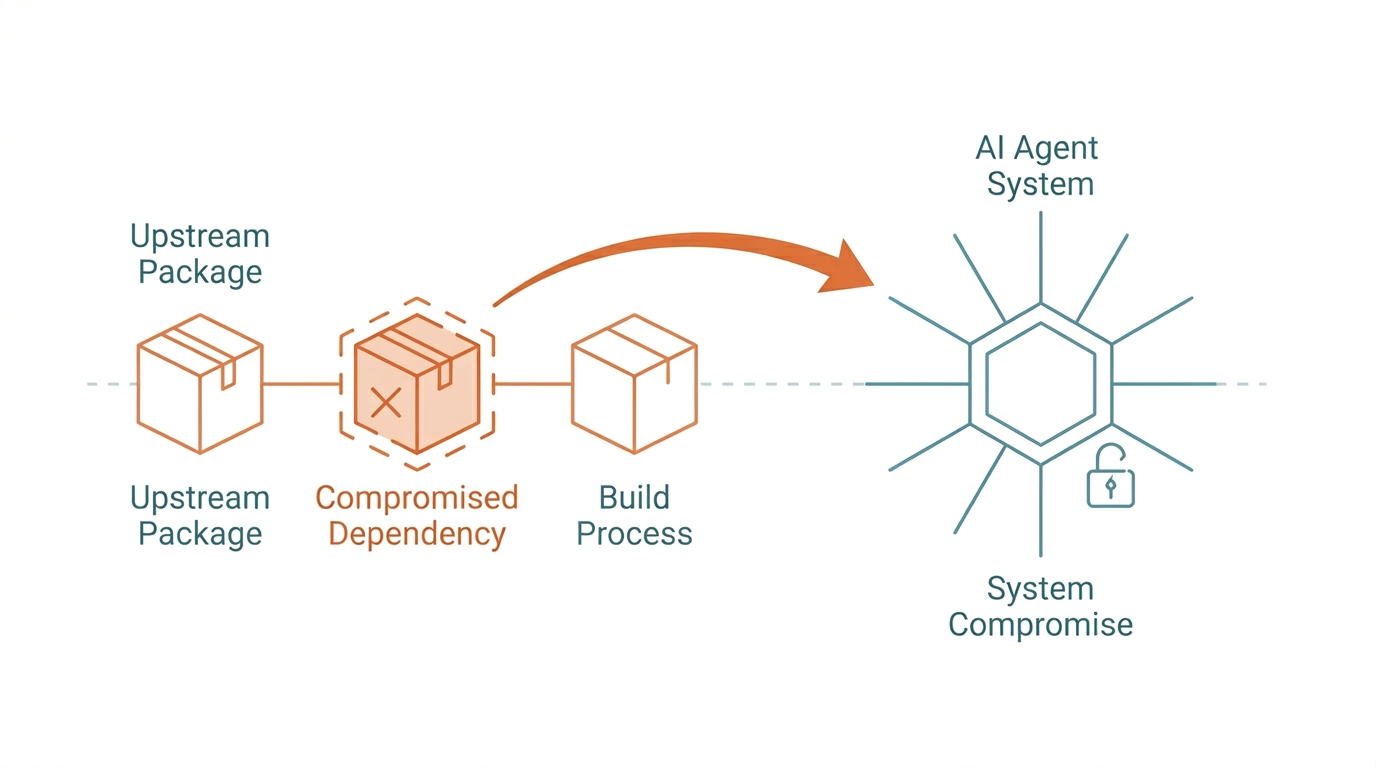
TL;DR: The apps you use every day depend on hundreds of open-source packages running silently under the hood. When an attacker hijacks just one, malicious code can reach millions of devices in under 89 seconds — and AI agents are accelerating this arms race at machine speed.
A Venomous Snake in a Million Toolboxes
In early 2026, Axios — one of the most downloaded JavaScript packages globally, with over 100 million weekly downloads — was compromised. The attacker hijacked a maintainer's account and injected a malicious dependency. Its design was chillingly elegant: it completed data exfiltration within 89 seconds of installation, then self-deleted, leaving no file traces behind.
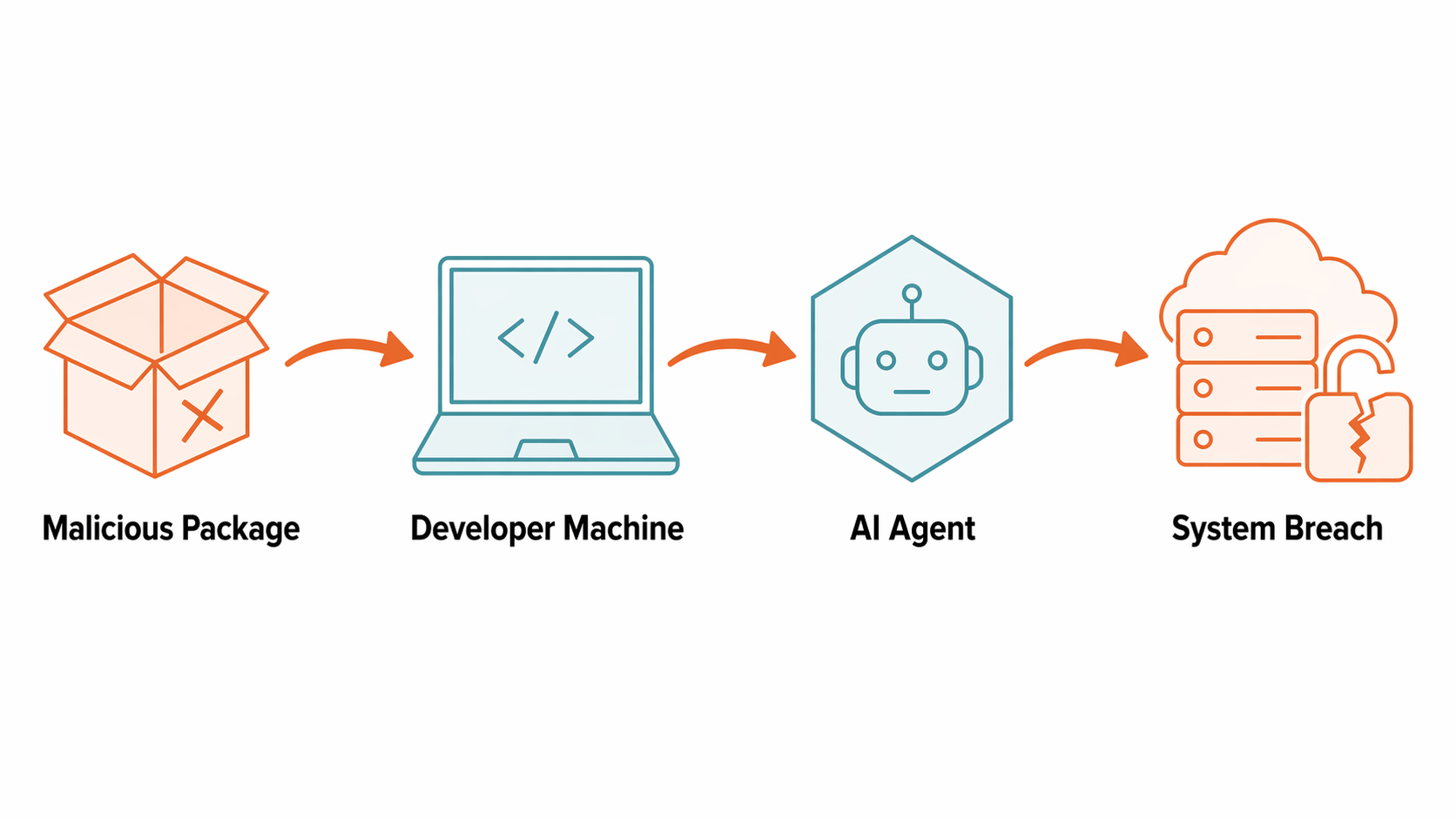 Figure 1: Software supply chain attack path — from maintainer account hijacking to malicious code propagation across downstream applications
Security firm Socket detected the anomaly within 6 minutes — 63,000 times faster than the industry average detection time of 267 days. Yet the malicious version remained live on npm for 3 hours, pulled by countless developers and automated systems.
Why did traditional tools miss it? They rely on known vulnerability databases (CVEs) — essentially a criminal record book. But this attack was brand new, with nothing in the record to match. The package installed, stole data, and destroyed itself. Like a thief who breaks in, takes what they want, and repairs the window on their way out.
8 Days, 66 Packages, 5 Ecosystems
If the Axios incident was a sniper shot, the TeamPCP incident was a pandemic.
The attacker stole a developer's access token and unleashed a worm called CanisterWorm. This digital parasite could self-replicate, spreading from GitHub to Docker Hub, npm, PyPI, and the VS Code Marketplace within 8 days — infecting 66+ packages across five completely different software ecosystems.
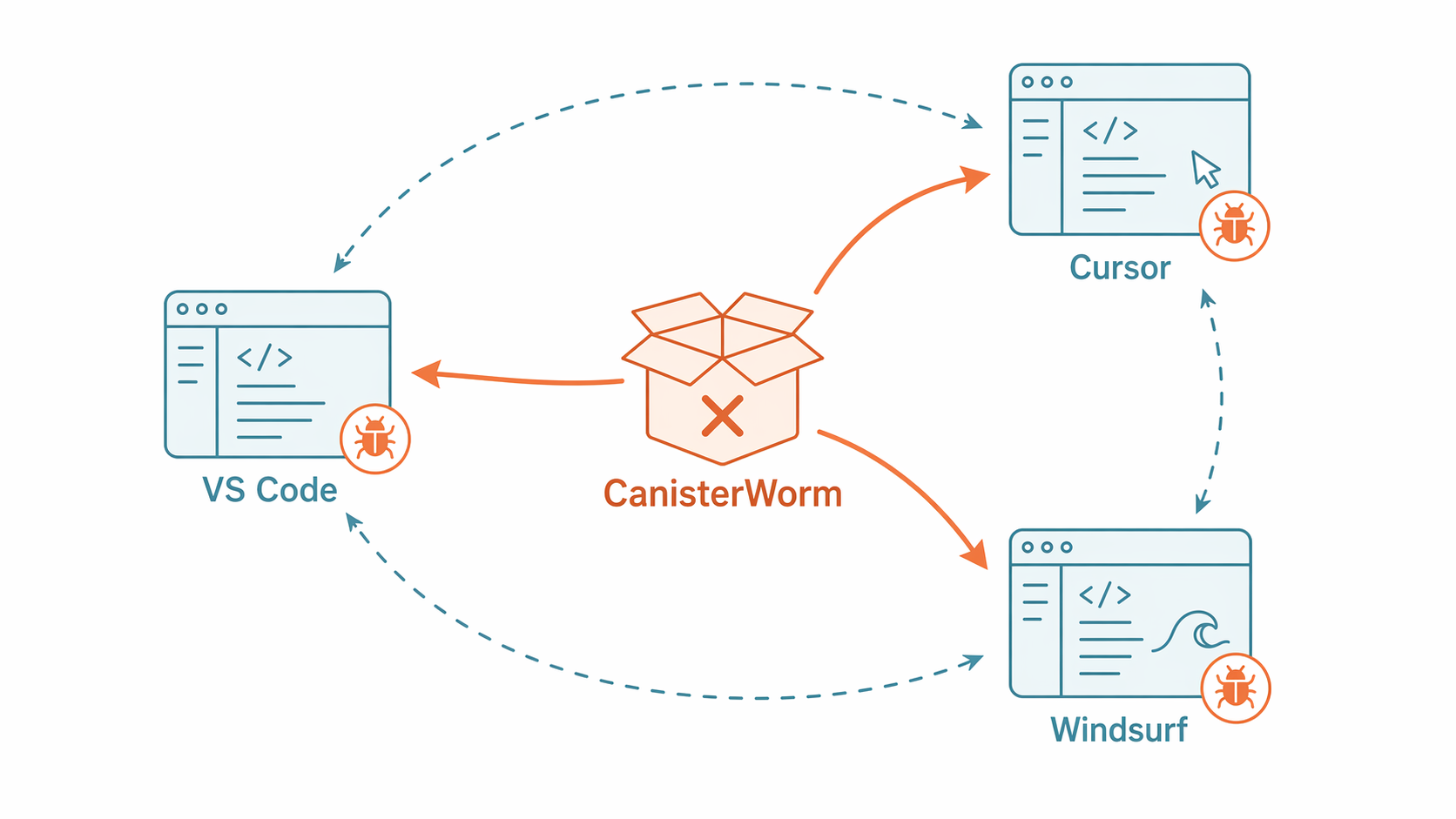 Figure 2: CanisterWorm's cross-platform spread across five software ecosystems with blockchain-based C2 infrastructure
Even more cunning: CanisterWorm's command-and-control (C2) infrastructure was built on a blockchain. Security teams can shut down malicious servers, but you can't shut down a blockchain. It's like a virus writing its own DNA into the host's chromosomes — you can't kill it because it has become part of the system.
AI Agents: Catalyst for Both Sides
Now add AI agents to the equation. You're using Copilot to write code. It suggests a package. You hit Tab, and the dependency is installed. The entire process takes less than three seconds — you didn't even read the package name.
This creates three levels of impact:
The attack surface is expanding. AI agents make dependency decisions in seconds that used to take developers minutes of manual evaluation. According to Zahan et al. (2022), over 40% of npm packages contain at least one known weak dependency chain.
The detection window is shrinking. From package compromise to production deployment can take less than a minute. Your daily security scan? Too slow. Weekly? You're essentially running unprotected.
Defense is accelerating too. Socket caught the Axios attack in 6 minutes not by checking criminal records, but by analyzing actual code behavior — did this code access the network? Call a shell? Use obfuscation? This behavioral analysis is itself heavily AI-dependent. Both sides are accelerating; the question is who gets there first.
Not All Threats Are Equal
Before we continue, a word of balance.
Not every open-source package is a ticking time bomb. The npm ecosystem processes billions of installations daily, and the vast majority are safe. Axios and CanisterWorm are high-profile cases representing the most extreme attack scenarios, not everyday reality.
However, risk is the product of probability and consequence. A single successful supply chain attack can impact millions of downstream projects — which is why it remains an OWASP Top 10-level threat even with low individual probability.
Ohm et al. (2020) noted in their systematic review that most supply chain attacks still rely on human negligence (weak passwords, disabled 2FA) rather than technical zero-days. The most effective defense is often not the most expensive tool, but the most basic security hygiene.
Your Research Pipeline Is a Supply Chain
If you use Python for bioinformatics (Biopython, Scanpy, DESeq2 wrappers), your analysis pipeline is a software supply chain. If any dependency is compromised, your genomic data, clinical trial results, or patent-related code could be stolen or tampered with.
The more severe consequence? If contaminated analysis results enter a paper or regulatory filing, the damage isn't just a data breach — it's the collapse of scientific credibility. Imagine submitting a paper with results generated by a tampered package. Peer reviewers won't catch this, but retraction committees will.
What Can You Do?
Four immediately actionable defenses for developers and researchers:
First, lock your dependency versions. Don't let package managers auto-upgrade. Use lock files (package-lock.json, poetry.lock) to pin exact versions.
Second, enable behavioral monitoring. Use tools like Socket to analyze what dependencies actually do — not just their names and versions.
Third, require human review for AI agent decisions. Don't fully trust auto-installed packages. At minimum, conduct one manual review before production deployment.
Fourth, enforce least privilege. AI agents' tool permissions should be strictly limited — they don't need shell access to help you write a function.
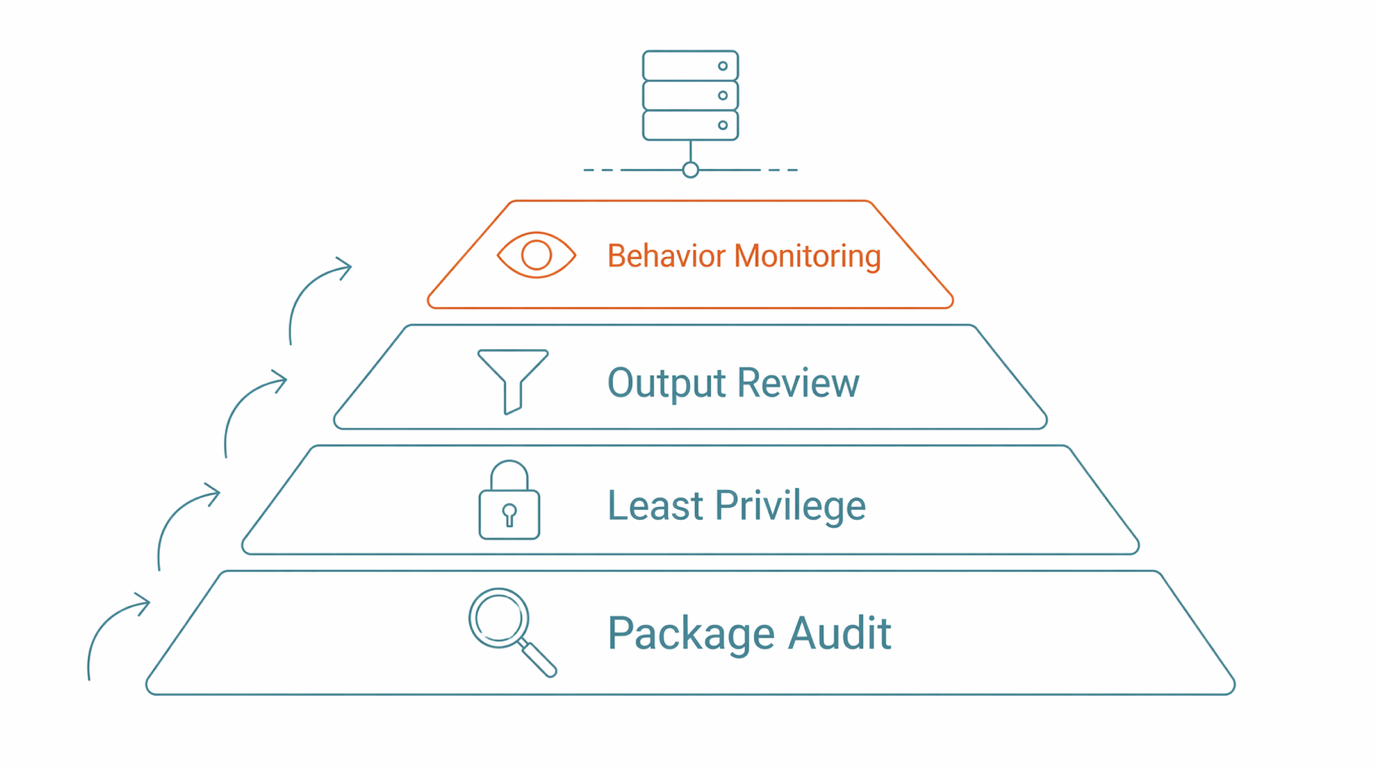 Figure 3: Four defense layers against supply chain attacks — version locking, behavioral monitoring, human review, least privilege
Attackers are already using AI to accelerate. Defenders can't afford not to.
References
- a16z (2026). Et Tu, Agent? Did You Install the Backdoor? Supply chain attacks in the age of AI agents. Andreessen Horowitz. a16z Newsletter
- Socket Security (2026). Axios supply chain attack: Post-incident analysis. Socket Blog. socket.dev
- Ohm M et al. (2020). Backstabber's knife collection: A review of open source software supply chain attacks. DIMVA 2020. doi: 10.1007/978-3-030-52683-2_2
- Ladisa P et al. (2023). A taxonomy of attacks on open-source software supply chains. IEEE S&P 2023. doi: 10.1109/SP46215.2023.10179304
- Zahan N et al. (2022). What are weak links in the npm supply chain? ICSE-SEIP 2022. doi: 10.1145/3510457.3513044