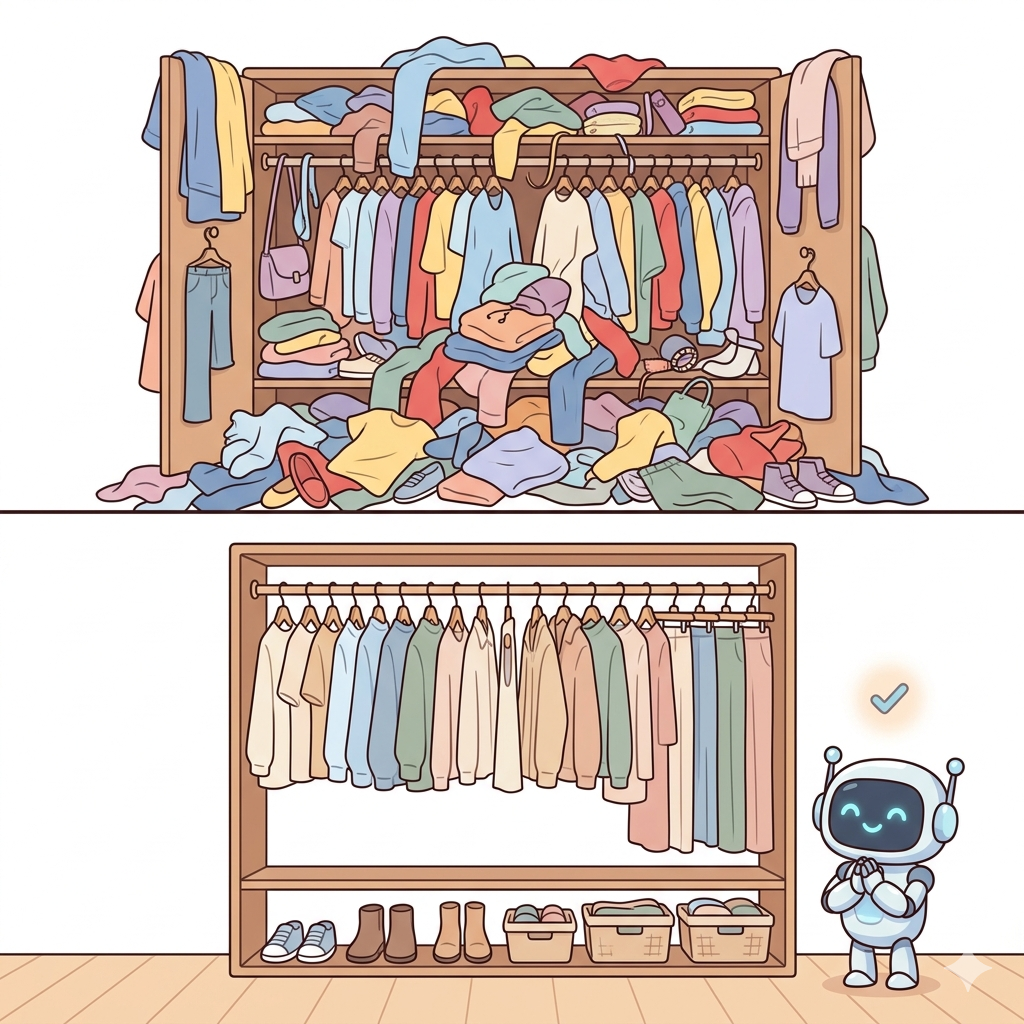
The AI Skill Hoarder's Dilemma: Why Your 180 Skills Might Be Slowing You Down
TL;DR: More skills don't make your AI assistant smarter. Past a certain point, they make it dumber. Here's why — and what to do about it.
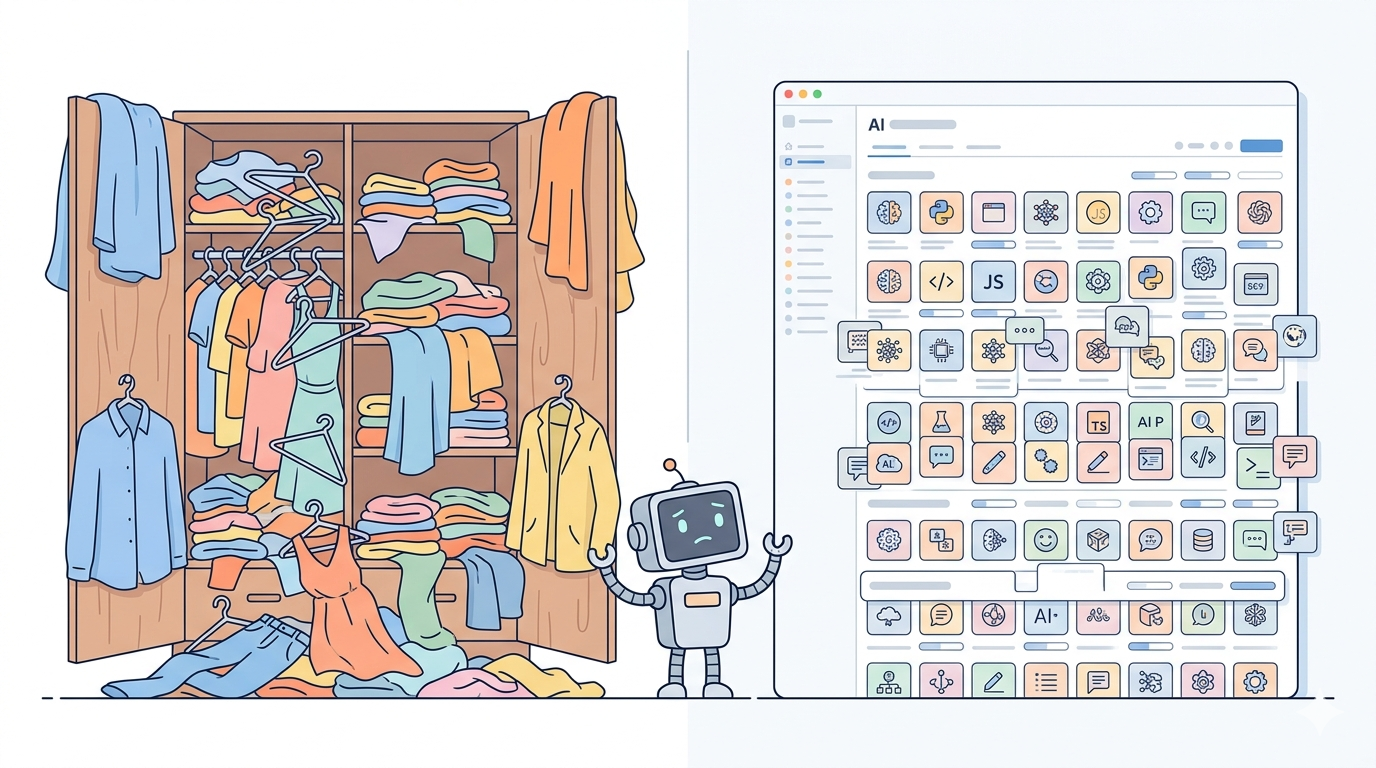
The Closet That Has Everything and Nothing to Wear
I spent several months building out a library of 180+ custom skills for my AI assistant. Search skills, writing skills, translation skills, analysis skills, presentation skills. I was thorough. I was systematic. I was proud of myself.
What I actually built was a closet so stuffed that getting dressed became a chore.
Every time I sent a prompt, my assistant would reach into that massive wardrobe and pull out the same three or four familiar outfits. Dozens of skills sat untouched. Some were never called even once. The AI had more tools than it could reason about, so it defaulted to the simplest available option, every single time.
This is the AI version of "I have nothing to wear" — and the wardrobe has 180 items in it.
The Real Problem: Skills That Try to Do Everything
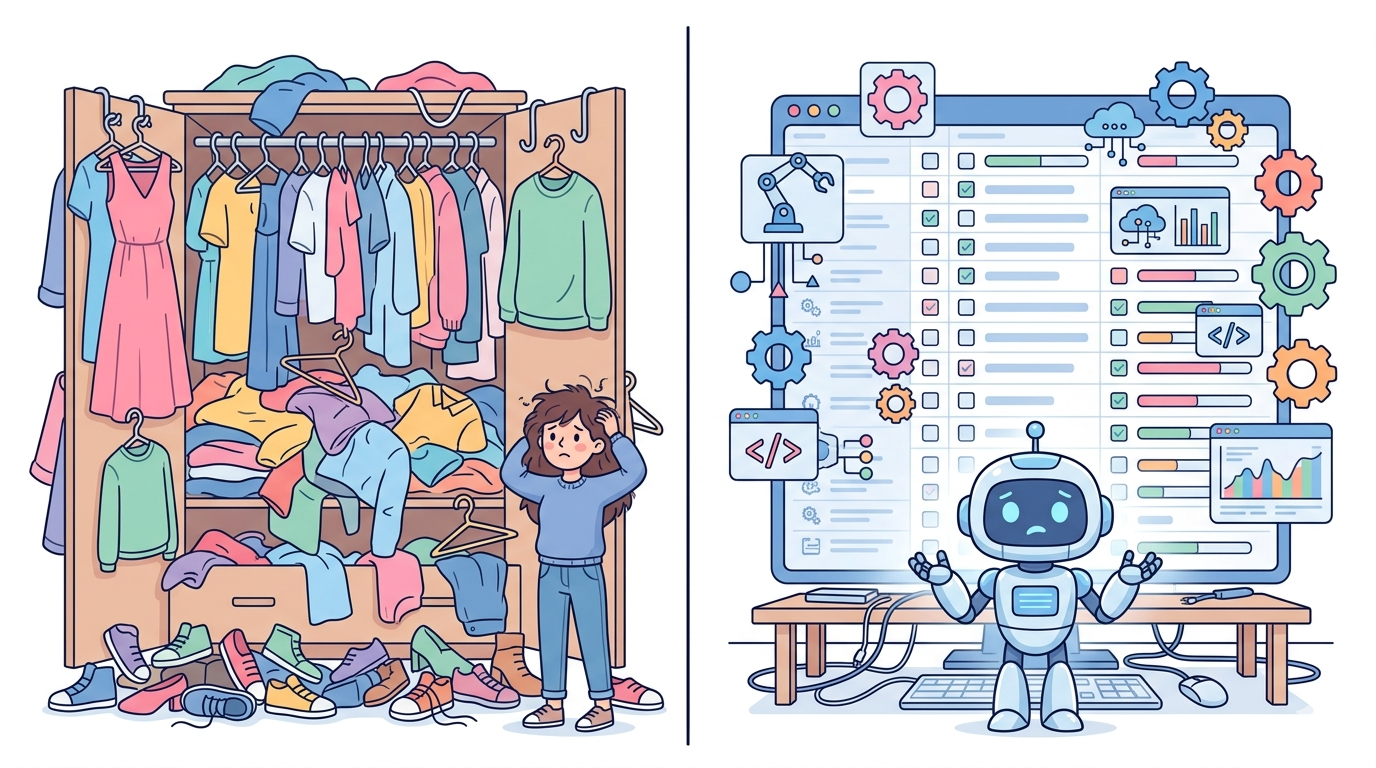
The instinct when building AI workflows is additive. Every time you hit a wall, you add a skill. Search not deep enough? Add a skill. Reports too thin? Add another. Need translation, slides, and auto-send bundled together? Sure — throw it all into one mega-skill.
That last move is where things quietly fall apart.
A skill that handles search, report writing, translation, presentation, and delivery is not a power tool. It is a monster. It is brittle, hard to test, and nearly impossible to debug — because when something goes wrong, you have no idea which piece failed.
Software engineers solved this problem decades ago with a principle called SRP: Single Responsibility Principle. One module, one job. Small is good. Clear is good. Testable is good.
The same logic applies to AI skills with equal force. When a skill tries to do five things, your AI struggles to know when to use it, and it fails in ways that are hard to trace. Break it into five focused skills, and each one becomes crisp, callable, and composable. You can update one without touching the others. You can test each piece in isolation. You can tell exactly what went wrong.
Lists Don't Show You What Breaks
Here's a subtler problem that took me longer to notice.
When you manage skills as a flat list — alphabetized, scrollable, looking organized — you lose visibility into how they relate to each other. My search_pubmed skill fed its output directly into three downstream skills. When I updated its output format, all three broke silently. I didn't notice until my reports started looking wrong two weeks later.
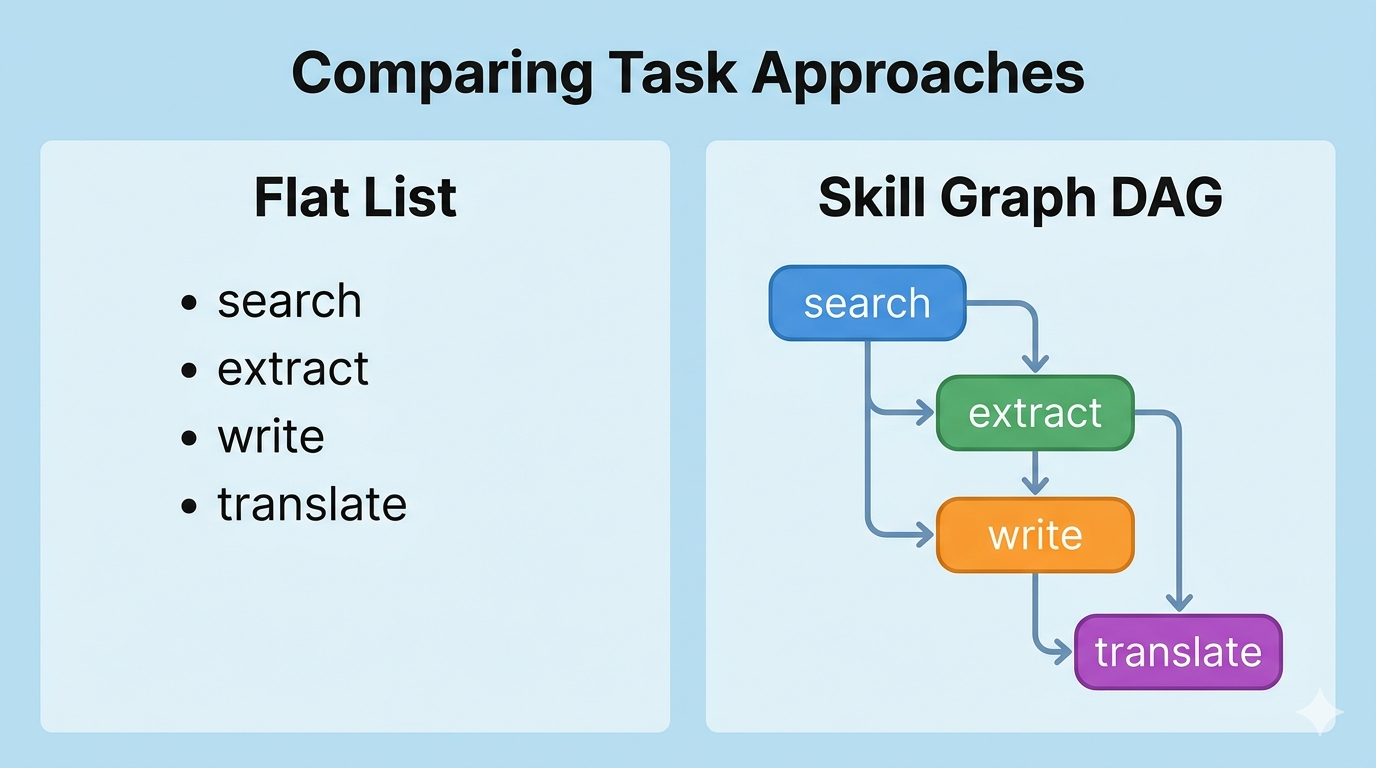
What you actually need is a dependency graph — formally, a DAG (Directed Acyclic Graph) — not a list.
Think of it like coordinating a large holiday dinner. A flat task list ("make soup, set the table, plate dessert") tells you nothing about sequence. It doesn't tell you the soup has to finish before the main is plated, or that dessert goes out only after the table is cleared. A proper kitchen workflow chart does. Everyone knows what to start, what to hold, and who is waiting on whom.
A skill dependency graph works exactly the same way. When you can see the relationships, you make smarter decisions: what is safe to change, what you need to protect, and what can be safely retired without breaking everything downstream.
Skills Expire — and They Don't Tell You
There is a third failure mode, and it is the most insidious: drift.
Skills go stale. The context they were built for shifts. The tool they wrapped gets updated. The task they were optimized for becomes rare. But the skill itself just sits there, silently degrading — like an expired carton of milk at the back of the fridge. You don't know it has gone bad until you open it.
The fix requires two things working together.
First, a feedback loop. Every time a skill runs, log a simple signal. Did it produce good output? Did you override it? Did you end up ignoring the result? Skills with consistently poor feedback are telling you something important.
Second, selective forgetting. Let skills die naturally when they stop being used. This isn't failure — it's maintenance. A system that never prunes is a system that calcifies. There is a principle worth sitting with: perfect knowledge management is an illusion. The goal is not completeness. The goal is usefulness.
Applied to skill design, this is blunt: letting unused skills die is smarter than keeping them on life support. Not every skill deserves maintenance. Sometimes, deletion is the best upgrade.
The Four-Step Reset
If any of this sounds like your current setup, here is a practical starting point.
Step 1: Count the jobs. For each skill, ask one question — how many distinct things does this do? If the answer is more than one, split it.
Step 2: Draw the graph. Map out which skills depend on which. Even a rough sketch on paper beats a flat list. You will immediately spot fragile chains and redundant paths.
Step 3: Set an expiration date. Every skill gets a three-month review marker. If it hasn't been called in three months, it is a candidate for retirement. No exceptions without a reason.
Step 4: Find your minimum viable set. Stop asking "what can I add?" Start asking "what is the smallest collection of skills that handles 90% of my real work?" Start there. Add back only what you genuinely miss.
What I Have Now
I went from 180 skills to 27.
My AI assistant is measurably more reliable. It picks the right tool more often. When something goes wrong, I can trace it. When I need to update part of the pipeline, I know exactly what it will affect.
The temptation to keep adding never fully goes away. But I have learned to treat it with suspicion. Every new skill has to earn its place — by doing one thing well, fitting cleanly into the graph, and surviving its first review.
Your AI assistant does not need more weapons. It needs you to sharpen the ones it already has.
Written by TheVoidWeaver | 2026-03-13 Part of the Agent Engineering series — practical notes from building AI workflows that actually work.