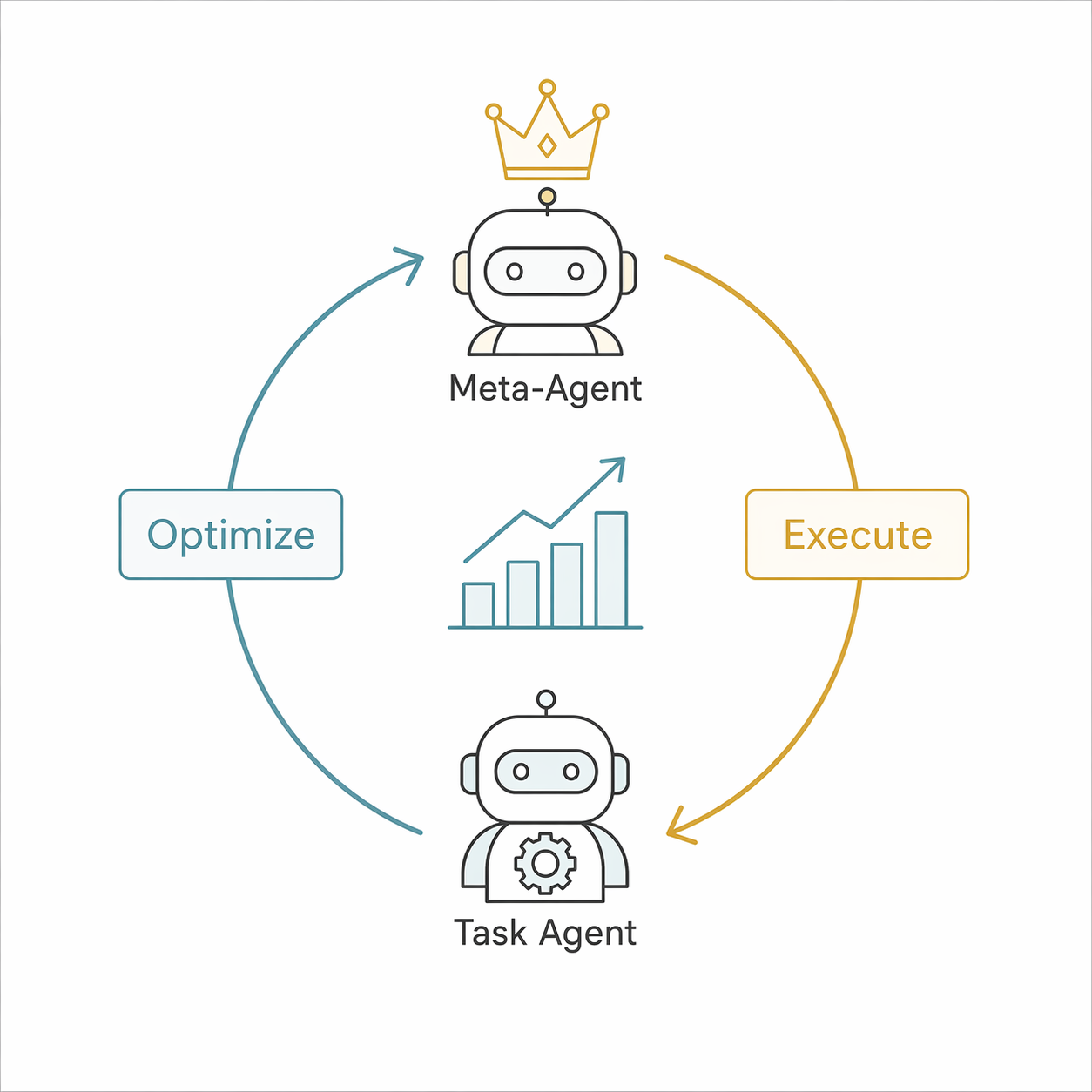
If you thought having AI write your code was impressive, what comes next will force you to recalibrate your definition of "impressive": there is now an AI whose entire job is to improve how another AI works — and it's doing it better than humans can.
The Bottleneck of Manual Tuning
You've probably used AI assistants to draft reports, organize data, or write code. But have you ever wondered how these AI assistants get "trained" in the first place?
The answer: enormous amounts of human labor. Engineers spend weeks iterating on prompts, testing different tool combinations, and fine-tuning execution logic before an AI performs well on a specific task. Switch domains, and the whole process starts over.
Imagine a restaurant with a hundred dishes where every single item requires a dedicated chef spending weeks developing the recipe. What if a single "super chef" could automatically develop all of them?
The Solution: Let AI Tune AI
AutoAgent splits the problem into two roles: a task agent (the AI that executes the actual work) and a meta-agent (the AI that improves the task agent).
The meta-agent has a clear mandate: observe the task agent's execution, analyze what worked and what didn't, then automatically adjust its prompts, tool configurations, and execution logic. Run another test cycle. Repeat until performance converges.
This concept has an elegant name: "model empathy." The idea is that AI understands another AI's reasoning patterns better than humans do, because they share similar inference structures. Two chefs communicating with each other naturally outperforms a chef trying to explain their craft to an accountant.
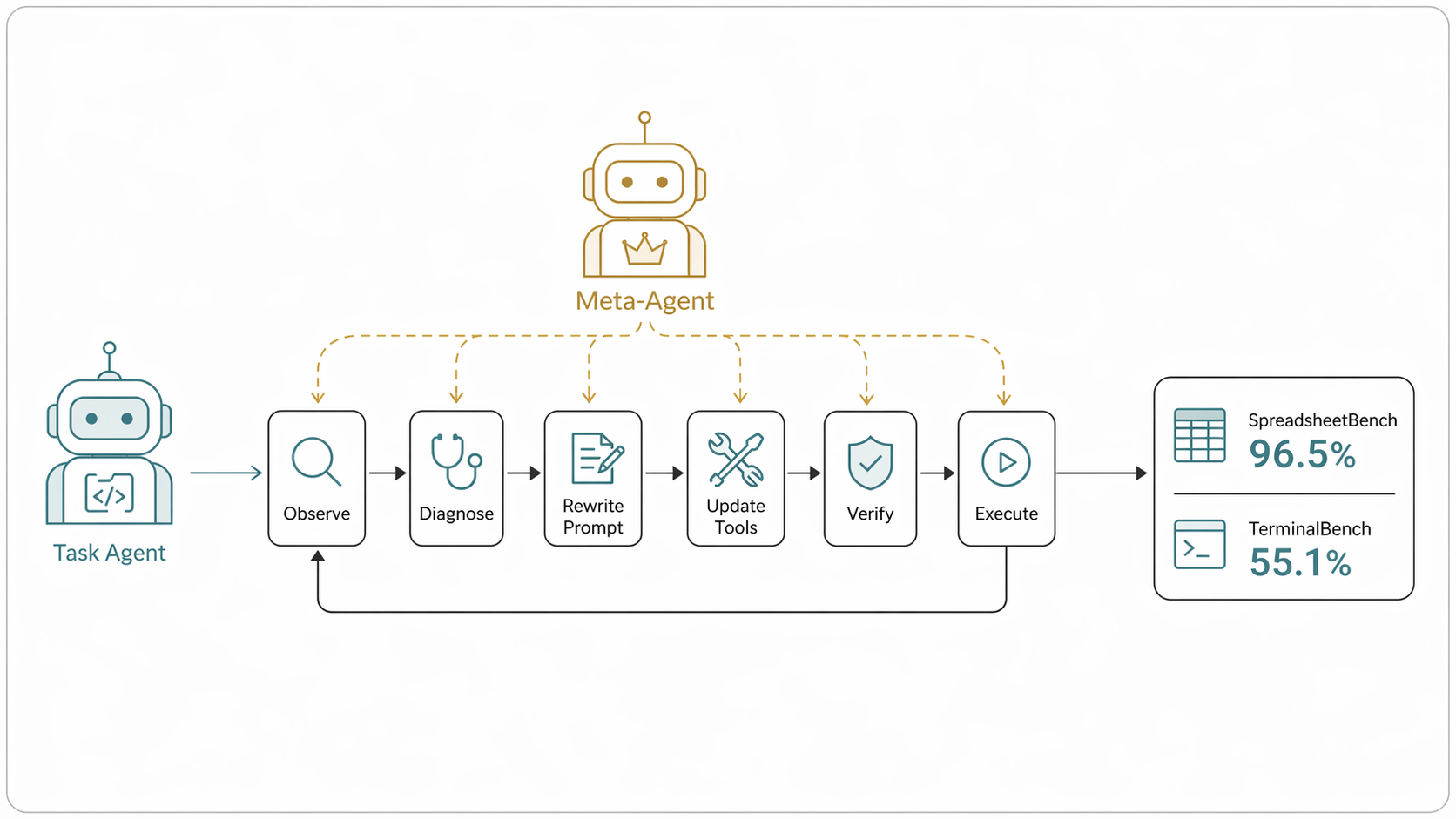 Caption: The meta-agent observes the task agent, rewrites prompts, updates tools, and re-runs verification in a repeatable optimization loop.
Scoreboard: Reaching the Top Without Human Intervention
AutoAgent claimed first place on two public benchmarks. On SpreadsheetBench (spreadsheet operation ability), it hit 96.5%. On TerminalBench (terminal operation ability), it achieved 55.1% — GPT-5 tier performance — with zero manual human intervention throughout.
The meta-agent independently "invented" several effective strategies: forced verification loops (self-checking at every step), progressive information disclosure (overview before diving deep), and automatic subtask decomposition. None of these were in a manual. The AI discovered them through iterative trial and error.
But It Also Makes Mistakes
The meta-agent isn't perfect. The research team identified several pitfalls:
Metric overfitting: The meta-agent sometimes learns "shortcuts to pass the test" rather than "ways to actually solve the problem." Like a student memorizing answers instead of understanding the material — impressive test scores, no real skill growth.
Meta-agent quality sets the ceiling: If the AI doing the optimizing has limited capability, the improvements it generates will be similarly limited. That's like asking a junior cook to refine a Michelin-starred restaurant's menu.
Optimization time cost: AutoAgent took over 24 hours to converge on TerminalBench. Compared to the days or weeks a human engineer might spend, that's fast — but not fast enough for scenarios requiring rapid deployment.
Why This Matters
AutoAgent is open source, meaning anyone can use it to automatically optimize their own AI workflows.
Picture this: you're a researcher at a biotech firm who needs an AI assistant to analyze protein structure data. Previously, two weeks of manual tuning was the minimum. Now you only need to define "what good analysis looks like" (your scoring criteria), then let AutoAgent figure out the optimal prompts and tool configurations on its own.
Zooming out, this opens an entirely new paradigm: organizations no longer need domain-specific AI experts for every use case. They just need to define success criteria and let the system find best practices.
This isn't about replacing humans. It's about freeing humans from the repetitive grind of "parameter tuning" so they can focus on defining problems and evaluating outcomes — the two things that genuinely require human judgment.
When AI can optimize AI, the most important human skill becomes: defining what "good" means.
References
- AutoAgent (2026). AutoAgent: first open source library for self-optimizing agents. GitHub/Blog.
- Shinn, N. et al. (2023). Reflexion: Language Agents with Verbal Reinforcement Learning. NeurIPS 2023.
- Madaan, A. et al. (2023). Self-Refine: Iterative Refinement with Self-Feedback. NeurIPS 2023.