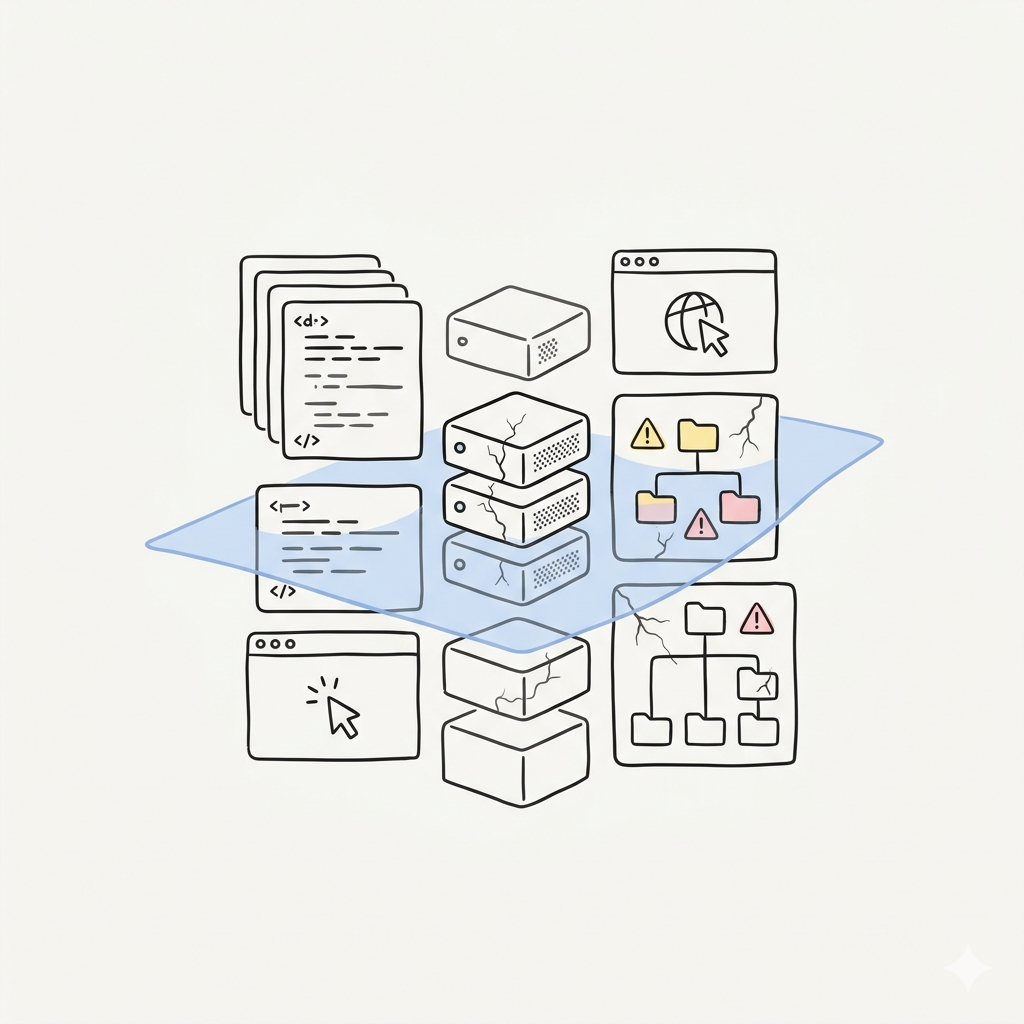
Opening: An Invisible Threat
In late 2024, Nicholas Carlini, a security researcher at Google DeepMind, published findings that shattered industry assumptions about AI's capabilities. Without sensational language or dramatic headlines, he simply stated a fact: a 30-line prompt is sufficient for AI to automatically discover production-grade zero-day vulnerabilities. Not one, not ten, but over 500.
This isn't science fiction. It's not lab research disconnected from reality. Carlini's team verified these vulnerabilities in actual software systems—some dormant for over 20 years until AI found them.
This discovery changed everything. From this moment forward, we're no longer debating whether AI threatens cybersecurity. We're asking: how much time do we have to prepare?
Part One: Undeniable Facts
Vulnerabilities Are Right Before Our Eyes
The Linux kernel is among the world's most critical open-source software, powering millions of servers across the internet. It has endured decades of scrutiny, patching, and optimization. It should be among the safest software ever built, right?
Wrong.
Hidden in the NFS v4 (Network File System version 4) code lies a heap buffer overflow vulnerability. It traces back to 2003. For the next 23 years, countless security researchers, hackers, and automated tools missed it. AI did not.
The same story repeats with Ghost CMS. Ghost is a popular content management system used by thousands of blogs and news websites. AI discovered a blind SQL injection vulnerability—allowing attackers to take over accounts. This was Ghost CMS's first automatically discovered critical vulnerability, assigned CVE-2026-26980.
Then there's Firefox. Mozilla's browser has undergone rigorous security testing with a massive security community. Yet in just two weeks, AI discovered 122 crash-inducing inputs, 100% of which were real bugs, resulting in 22 CVE assignments.
These aren't theoretical vulnerabilities. They aren't speculative attack vectors. They are real, reproducible, verifiable flaws in software you use every day.
The Terrifying Mathematics of Scale and Speed
Over 500 zero-day vulnerabilities discovered. The number itself is shocking, but more shocking is how simple the method was.
Researchers proved that a mere 30-line prompt—written in simple CTF (Capture The Flag) format—suffices to initiate AI vulnerability discovery. No complex engineering. No proprietary model tuning. Just a clear objective statement.
The deeper issue: discovering these vulnerabilities requires complexity beyond traditional fuzzing's reach. Some require precise dual-client coordination to trigger—interaction patterns traditional tools cannot detect. But AI can. It understands code's logical flow, predicts edge cases, and synthesizes precise input combinations to expose hidden defects.
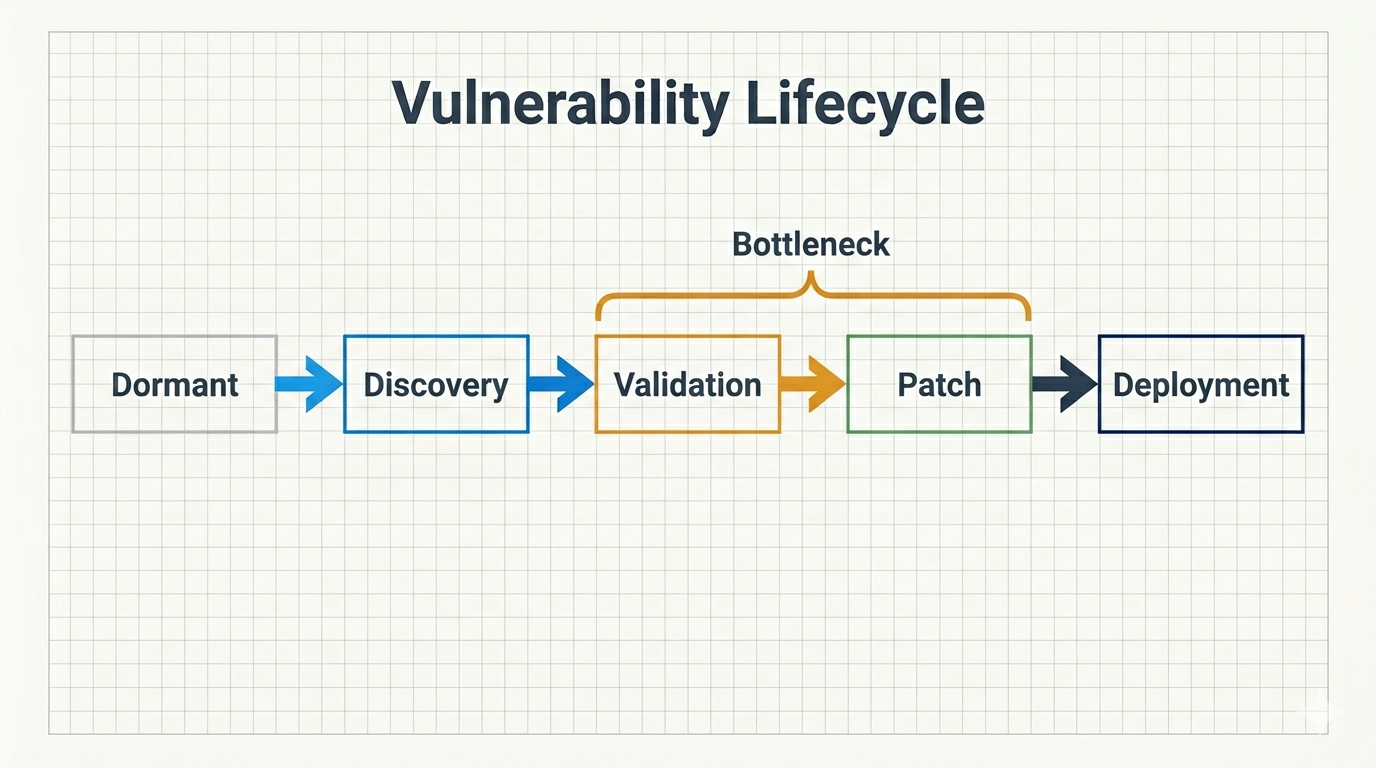 Figure One: The Verification Asymmetry: AI's discovery speed vs. human patching speed
Time is Accelerating
There's an even more unsettling trend: AI's autonomous capability is doubling at extraordinary speed.
Research data shows AI's automatic vulnerability discovery capability roughly doubles every 4 months. This means if today it discovers 500 vulnerabilities, in 4 months it discovers 1000, in 8 months 2000.
More critically, next-generation AI models will likely exceed top human security researchers' capabilities. We're not discussing distant futures—many experts predict this inflection point within 18 months.
Defenders' response window isn't measured in years, but in months. Some estimates are even more aggressive: we may have only 6-12 months to restructure our defense strategies.
Part Two: Systemic Crisis
The Verification Bottleneck: Seconds to Discover, Months to Patch
This contains a fundamental contradiction undermining defenders' confidence.
Discovery takes seconds. Patching takes months.
When AI discovers a vulnerability, the process is fast. Analyzing code, identifying defects, generating proof-of-concept—all in seconds. Then what? Software vendors must verify the vulnerability's reality, assess impact, develop patches, test whether patches break other functionality, coordinate release.... This typically takes weeks to months.
Worse, hundreds of unverified kernel crash reports now pile up in validation queues. These are potential real vulnerabilities, but resource-constrained kernel maintainers cannot process them all. Some estimate clearing this backlog could take years.
This is "verification asymmetry"—attackers' advantage no longer derives from discovery ability, but from defenders' systematic inability to respond quickly.
Market Dynamics and Democratization Threats
DeepSeek's disruption in China taught us a crucial lesson: efficiency revolutions always expand demand.
What happens when AI-driven security tools become cheaper and more accessible? By economics' Jevons Paradox, efficiency improvements don't reduce demand—they expand it. Vulnerability discovery capabilities once exclusive to elite hacker teams and nation-states will gradually become available to smaller criminal groups, even individual hackers.
This isn't fearmongering. AI-assisted vulnerability scanning tools already exist in markets—cheap, effective. As models become smaller, cheaper, more deployable, these tools will proliferate like antivirus software.
Large-scale zero-day marketization is no longer hypothesis—it's inevitable.
Exploit Generation: From Discovery to Exploitation
Perhaps the most concerning development is the latest one. Researchers report "signs of life" in AI's exploit generation capability—not just discovering vulnerabilities, but crafting working exploits.
In other words, the next phase isn't AI passively discovering bugs, but actively generating end-to-end automated attacks. Once this phase arrives, the entire defense paradigm shifts.
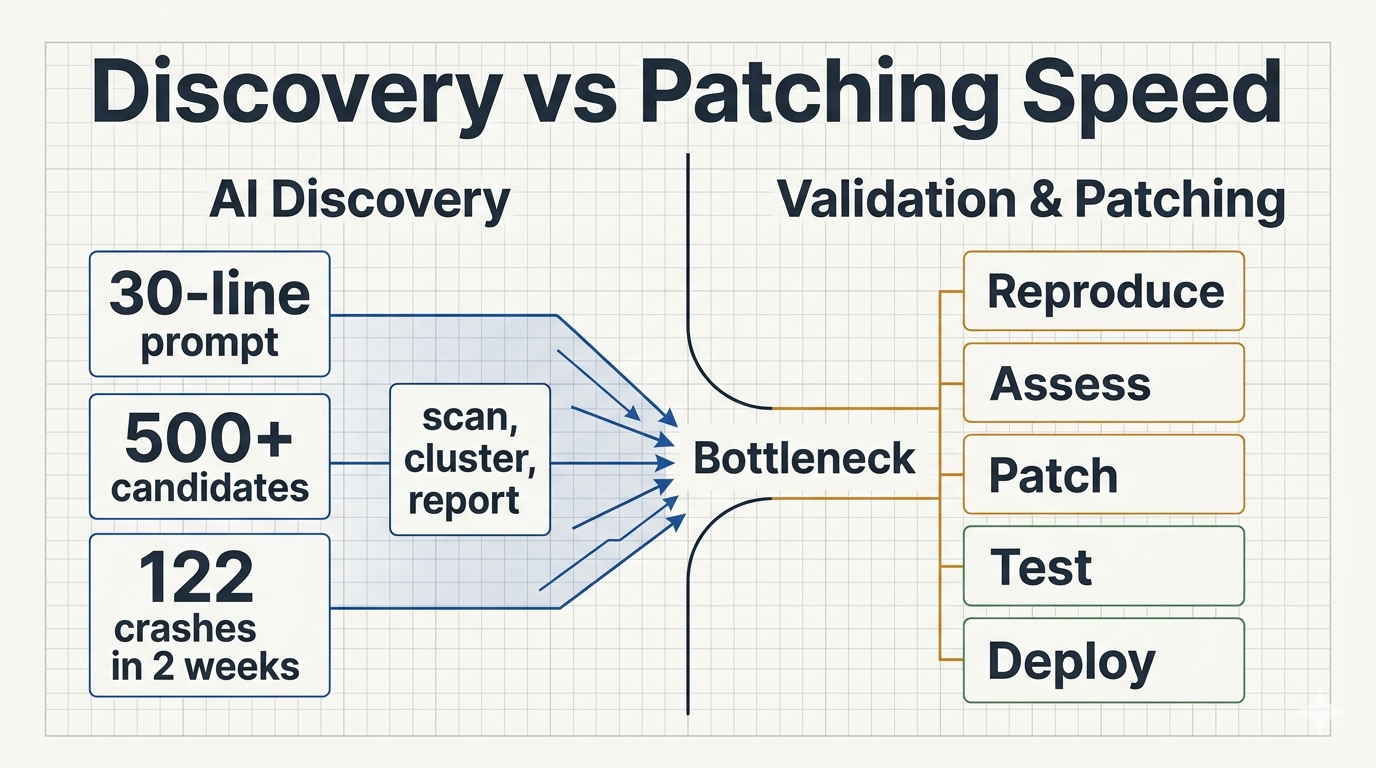 Figure Two: Zero-day timeline: from 2003 dormancy to 2026 automatic discovery to future automated exploitation
Part Three: What We Should Know Now
Why This Happens
Simple answer: AI models excel at finding and optimizing patterns in complex search spaces. Software code is precisely that—vast, complex, filled with edge cases. As code grows in scale and complexity, human vulnerability discovery becomes harder, while AI's capability curve climbs.
Eventually, the curves intersect.
The Timeline's Reality
- Now to 6 months: Discovery capability continues doubling. Verification bottlenecks worsen.
- 6 to 12 months: Verification processes begin automating. AI not only discovers vulnerabilities but helps confirm them.
- 12 to 24 months: Exploit generation reaches practical utility. Automated attack chains become feasible.
This timeline is not conservative—many researchers expect faster progression.
Impact on Different Roles
For infrastructure operators: Upgrades and patches become more urgent. You must deploy patches within weeks of discovery, not months.
For software vendors: Maintenance strategies need fundamental restructuring. Long-term supported versions become riskier. You may need more frequent release cycles.
For security researchers: Both opportunity and threat. AI tools greatly enhance defensive research efficiency, but also eliminate traditional "discovery advantages."
For policymakers and leaders: This requires cross-industry collaboration, unsolvable by single organizations.
Part Four: What We Should Do Now
Actions at Organizational Level
Reassess software maintenance strategies: Is your long-term support plan still realistic? Consider accelerating version retirement or investing in more frequent updates.
Invest in verification infrastructure: Build internal capacity for rapid vulnerability assessment. This bottleneck determines new-era competitive advantage.
Establish zero-day response plans: Assume vulnerabilities will leak before patches release. Develop procedures: how do you limit damage without complete patches?
Personal-Level Defenses
Update security awareness: Recognize that software vulnerability prevalence will increase. Don't assume your tools are secure.
Enable multi-factor authentication: This is the basic defensive layer. If accounts are compromised, at least a second barrier remains.
Regularly audit dependencies: Which open-source libraries does your system rely on? Are they maintained? Consider automated scanning.
Industry and Policy Needs
Accelerate coordinated disclosure: Time from discovery to patch release must shrink. This requires industry standards and government support.
Support defensive AI research: Don't just defend—use AI to discover vulnerabilities first. Many defenders can access the same tools earlier than adversaries.
Establish international cooperation frameworks: When vulnerabilities can be discovered anywhere and exploited by anyone, response must be global.
Conclusion: Vigilance, Not Panic
This article aims not to panic but to inspire clear cognition.
We stand at a crucial inflection point. AI's capability development outpaces our response ability. But this doesn't mean all is lost. Quite the opposite: now is the moment for change, and we still have time.
The key recognition: the adaptation window is closing, but hasn't closed.
Future software security depends on three factors: vulnerability discovery ability, verification speed, and patching efficiency. In the first two, AI rewrites rules. In the third, humans retain most power.
Best defense isn't denying this change's existence—it's taking it seriously. Update strategies, invest in verification infrastructure, establish rapid response mechanisms. Ensure AI becomes defenders' ally before becoming attackers' unstoppable weapon.
Time is short. But we have time. Use it.
References
- Nicholas Carlini, Google DeepMind (Automated zero-day discovery research)
- CVE-2026-26980 (Ghost CMS vulnerability report)
- Linux Kernel NFS v4 vulnerability analysis
- Mozilla Firefox security report (Q1 2026)
Keywords: AI security, zero-day vulnerabilities, software security, automated threats, vulnerability verification, cybersecurity defense