
TL;DR: A self-described reverse engineering novice used AI to decompile encrypted games, strip commercial-grade packers, and bypass every protection layer of a banking app. His prompt? One line: "Reverse engineer this into source code."
Your App Might Be More Fragile Than You Think
A non-expert used AI to fully reverse engineer a banking-grade encrypted app in 30 minutes for under $5. The era of client-side protection is crumbling.
Picture this: you spend six months building an app with carefully designed encryption, obfuscation, and tamper protection. Someone who knows nothing about the native layer hands it to an AI. Thirty minutes later, everything is spread open on screen. This isn't science fiction — it happened in 2026. Blogger Huli ran a series of experiments using Cursor paired with Claude Opus 4.6, and the results caught everyone off guard.
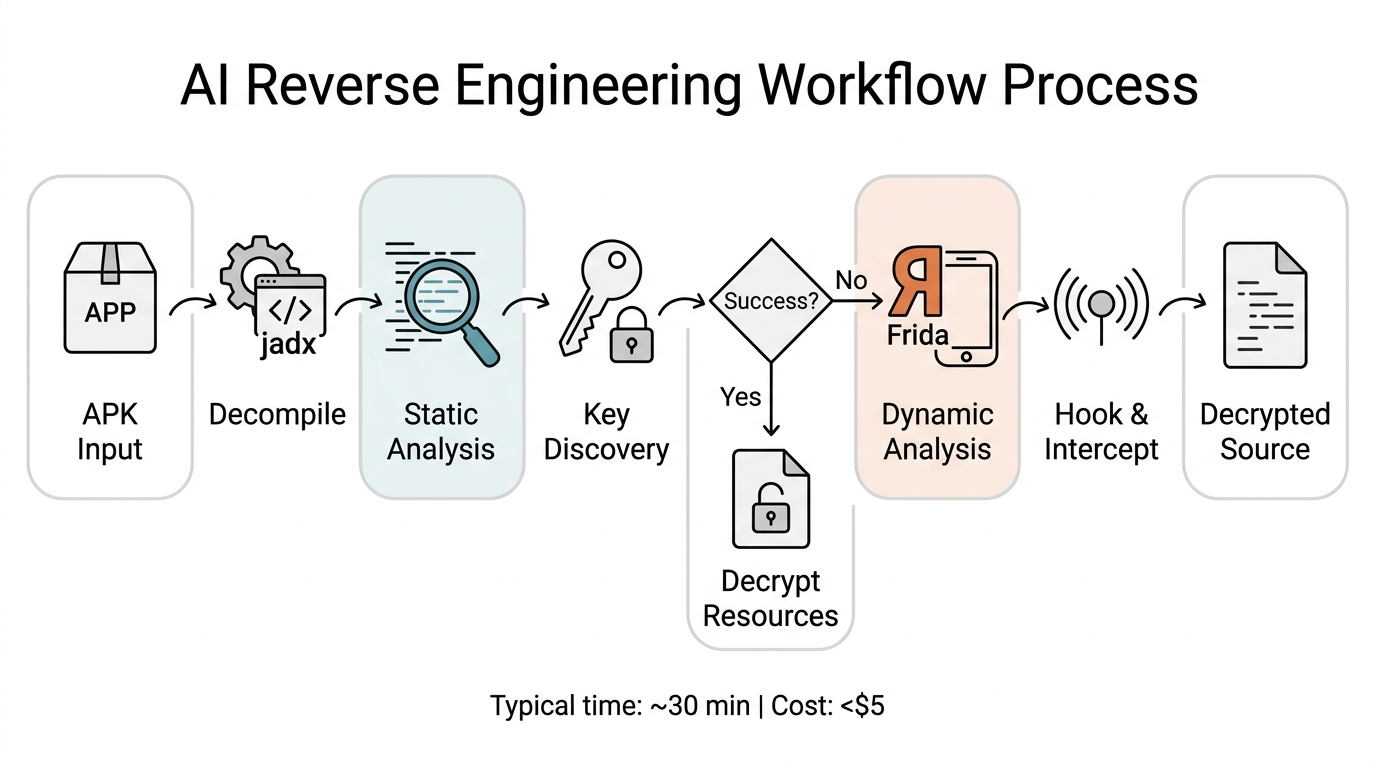 Fig 1. AI-driven reverse engineering workflow: from APK to decrypted source.
How AI Cracks an App: Self-Equipped, Self-Directed
When AI receives an APK, it follows the same playbook as a human reverse engineer: decompile the Java layer with jadx, identify the engine (Cocos2d, Unity, native), locate encryption functions, trace keys, write decryption scripts.
But AI does it faster. And it never gets frustrated by repetition.
Take a Cocos2d game. AI scanned strings but found no key. So it decompiled the .so binary, traced the key-setting function, and discovered the key was assembled one character at a time — invisible to string searches. AI reconstructed each character and decrypted every resource with a Python script. Fully static analysis, zero human intervention.
Static Analysis Fails? AI Switches on Its Own
Another Cocos2d game: the key found through static analysis wouldn't decrypt anything. AI pivoted automatically — installed an Android emulator, set up Frida, tried hooking various functions. After several failed attempts, it noticed xxtea_decrypt was a public function, hooked it instead. The game launched, and the correct key appeared.
A Unity game was even wilder. After every decryption method failed (AES variants, RC4, .NET Random brute force), AI spotted a repeating 6-byte pattern in the encrypted files. Bold guess: the plaintext was Lua comment dividers ------. XOR with 0x2d (hex value of -), and the key fell out. 3,000 files decrypted in one shot.
Can you imagine? One guess broke the entire encryption system.
Banking-Grade Protection? Not Enough
A banking app had the full defensive arsenal: commercial packer (.text segment encryption), anti-injection (scanning for frida-agent memory maps), thread name scanning, ptrace self-attach for anti-debugging, root detection, emulator detection, and SSL pinning. Seven layers of protection, each an industry standard.
AI observed section headers to identify the packer vendor, tried several unpacking methods until it found the right approach. Then it enumerated every protection mechanism and wrote targeted Frida hooks to bypass each one. For Java-layer obfuscation, it generated over a thousand lines of Python deobfuscation scripts. End result: the app ran normally on a rooted emulator with every request interceptable.
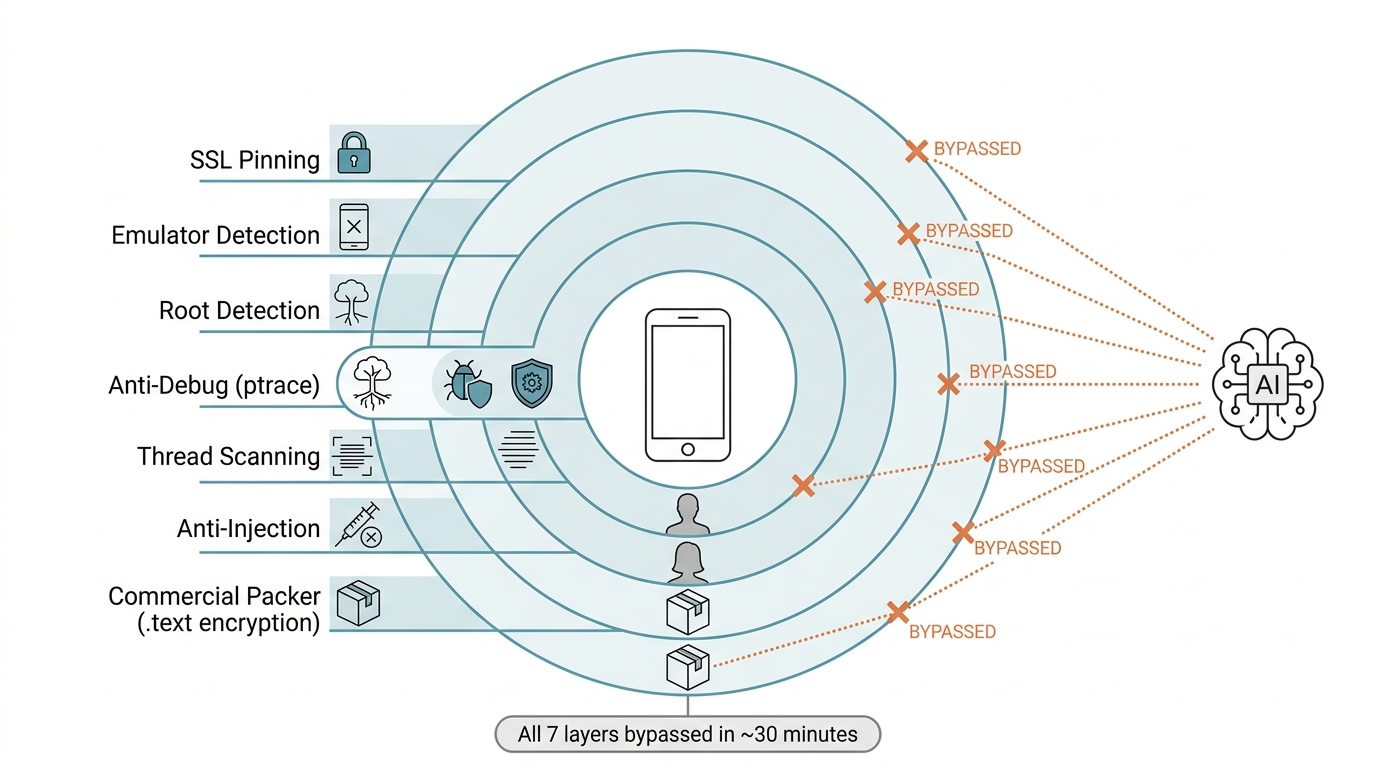 Fig 2. Seven layers of banking-grade app protection, all bypassed by AI.
"I Was the One Limiting AI"
The author's deepest takeaway: he always assumed "AI probably can't unpack this," so he never tried. AI proved him spectacularly wrong.
He realized AI reverse engineering works exactly like human reverse engineering — try things, observe output, adjust based on results, try again. The difference? AI doesn't tire, doesn't get bored, and iterates dozens of times faster than any human. Give AI an environment where it can observe outcomes (logs, error messages, hook output) and enough time, and almost nothing stays locked.
Each app cost under $5 (Cursor billing) and took about 30 minutes. When was the last time you got this much for five dollars?
The Balance of Power Is Shifting
Client-side code was never truly secret. Obfuscation and packing only bought time. But AI compressed that time from "days for a specialist" to "30 minutes for a novice."
Defenders might need to fight fire with fire — using AI to generate fresh protection patterns every time. But how long can that hold against AI-driven reversing? Even the author isn't sure.
Worth noting: every experiment assumed a downloadable APK. Server-side logic, real-time computation, and token mechanisms remain untouchable by AI — for now. The emphasis must shift, not disappear.
For developers, the takeaway is blunt: don't anchor trust on the client side. Move critical logic, keys, and authentication to the server.
If you're a developer, what worries you most about being reverse-engineered? Encryption? Obfuscation? Or have you never thought about it at all?
Closing Thought
AI doesn't just write code — it reads code you never wanted anyone to see. The scales of this arms race have already tipped. We're just still getting used to the new gravity.
FAQ
Q: Does this mean all apps are insecure now? A: Client-side code was never truly secret — obfuscation and packing only bought time. AI compressed that window from days to minutes, fundamentally changing the offense-defense balance. Critical logic and keys belong on the server.
Q: Do you need deep expertise to use AI for reverse engineering? A: The author openly admits he knows nothing about native-layer work. He gave directional prompts ("try static first, switch to dynamic if stuck"), and the AI handled everything — installing tools, disassembling, hooking — entirely on its own.
Q: Is server-side code safe then? A: For now, AI can't reach server-side logic. But that doesn't mean forever. Move your trust anchor from client to server, and keep your threat model up to date.
References
- Huli (2026). Rediscovering how powerful AI really is through reverse engineering. blog.huli.tw.
- Huli (2026). Thanks to AI, even an outsider like me can do basic reverse engineering. blog.huli.tw.
Author: TheVoidWeaver | Published: 2026-04-24