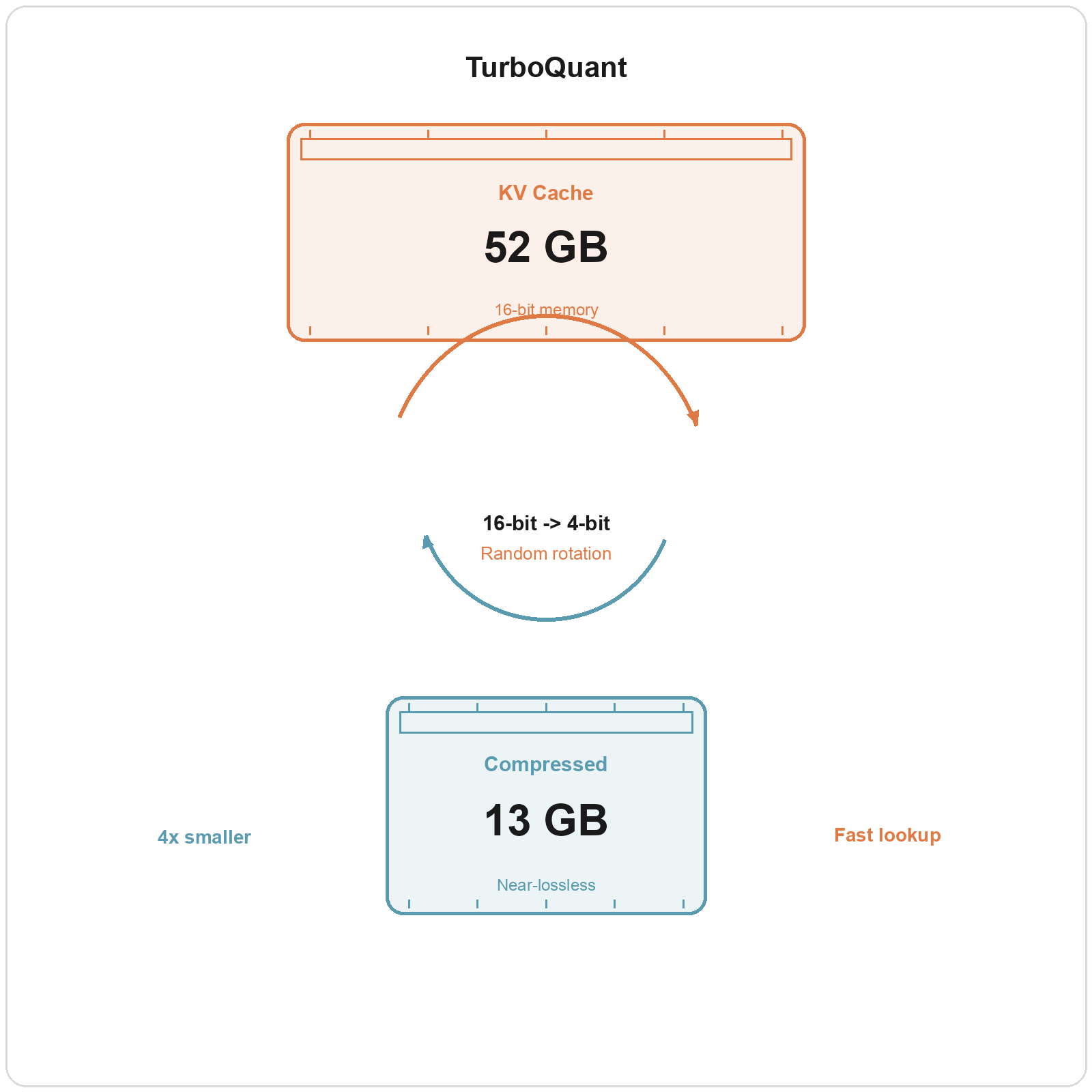
What if the most expensive part of a long AI conversation is not the model itself, but the memory required to remember what you just said? For a 100,000-token exchange, that temporary memory can consume 52GB of GPU RAM. TurboQuant attacks that cost with a simple idea: rotate the KV cache into a friendlier direction, then quantize it hard.
The Real Memory Hog
Large models get most of the attention, but long-context inference has another appetite. The KV cache keeps the running notes of the conversation so the model can look back before generating the next token. Think of it as a stack of index cards spreading across a desk. The longer the exchange, the taller the stack.
At roughly 100K tokens, that stack can reach 52GB. An H100 has 80GB in total, so preserving context alone can swallow more than 60% of available memory. That is why long conversations feel expensive even when the model weights themselves have not changed.
Rotate First, Compress Second
TurboQuant's insight is not to quantize the raw vectors immediately. It first applies a random rotation matrix so the values land in a direction with cleaner statistical structure.
The suitcase analogy works well here. Throw clothes in randomly and you waste space. Roll them into a consistent shape first and the same suitcase suddenly fits much more. TurboQuant does the mathematical version of that move. Once the vectors are rotated, each dimension becomes easier to approximate with a tailored Lloyd-Max codebook.
That matters because bad orientation creates bad compression. With the same 4-bit budget, one arrangement may distort important values while another preserves them. Rotation gives the quantizer a fairer surface to work with.
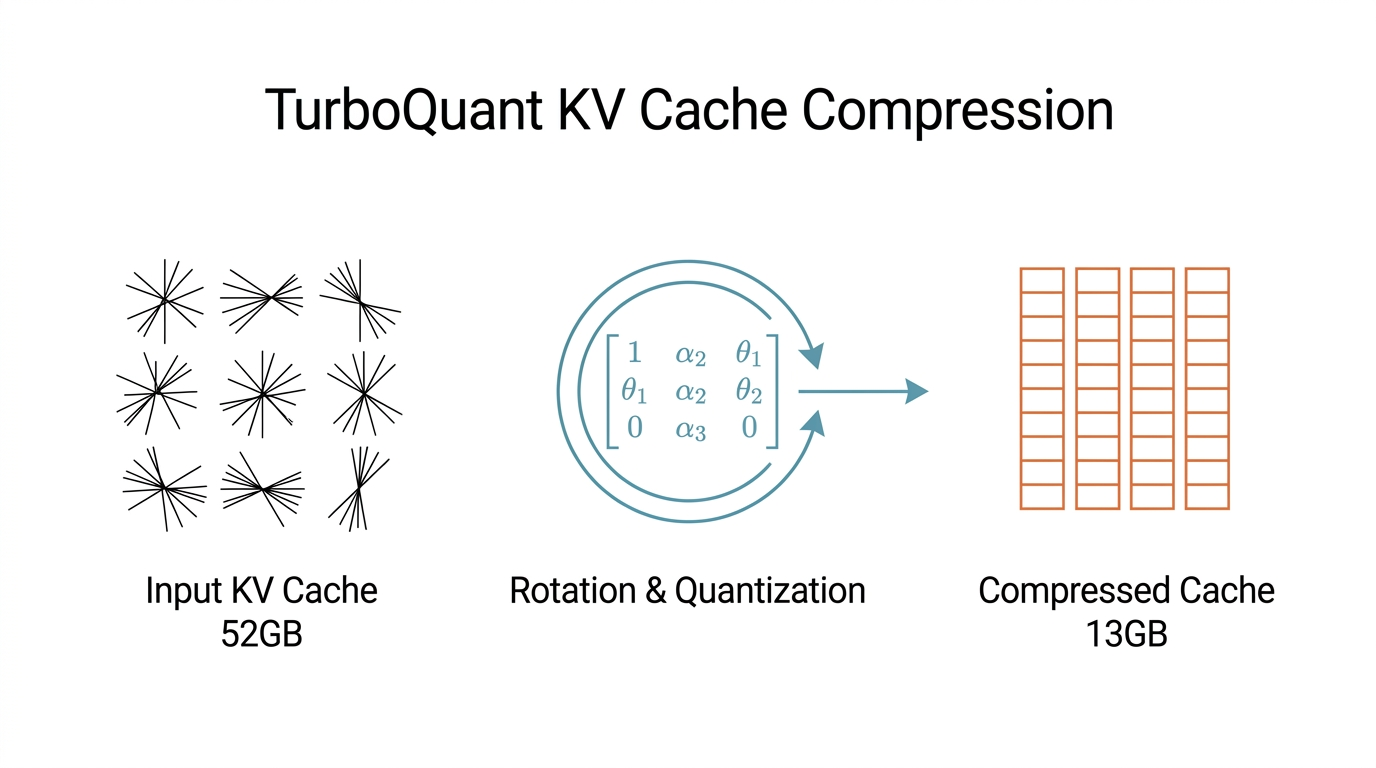 Figure: TurboQuant turns long-context KV cache into a more regular representation before 4-bit quantization, reducing GPU memory from 52 GB to 13 GB. The same illustration is shared by the Chinese and English editions.
Why the Numbers Stand Out
TurboQuant is interesting because the compression story is not just about capacity. The reported benchmarks claim that at 4-bit quantization, reconstruction error is 60x lower than QJL and lookup speed is 180,000x faster than Product Quantization. The simplest line is still the most memorable one: 52GB to 13GB.
That does not mean every workload is magically lossless. The numbers come from the authors' explanation and benchmark setup, not from a broad third-party replication campaign. The scope is also specific: this is about inference-time KV cache compression, not a universal promise that every part of a model can safely drop to 2-bit with no tradeoff.
Why You Should Care
Even if you never rent your own GPUs, you still feel the consequences. Longer document analysis, book-length summarization, and multi-hour transcript processing all depend on how cheaply a system can preserve context. If the KV cache gets smaller, one GPU can serve more users or hold longer conversations before running out of room.
For operators, that is a hardware bill. For users, it becomes a product experience. The model feels less cramped. Latency becomes easier to control. Pricing has more room to stay sane. In practice, smarter memory engineering can matter as much as a smarter model.
Bigger Is Not the Only Path
AI progress is usually framed as a race toward larger models, more parameters, and bigger clusters. TurboQuant points at a different path: take the memory bottleneck seriously and re-engineer the pipeline around it.
Shrinking context memory from 52GB to 13GB sounds like an infrastructure detail. It is also a product detail. It moves capability away from "only in the data center" and a little closer to "available on ordinary hardware." Making AI smarter is one path. Making AI leaner is another. The two are now meeting in the middle.
References
- TurboQuant (2026). A simple explanation of TurboQuant (Step-by-Step). Blog.
- GPU Memory Math for LLMs (2026 Edition). Blog.
- Hooper, C. et al. (2024). KVQuant: Towards 10 Million Context Length LLM Inference with KV Cache Quantization. arXiv preprint.