What if the question "does AI have consciousness?" has been asked entirely backwards?
Developer Amir didn't try to define what AI consciousness is. He asked a different question: what does it look like? His answer was a directory tree — and the results speak for themselves: a trading agent with an 86.9% win rate, a conflict mediator shipped with 891 tests in 10 days, a writing agent that deliberately slows down to produce better work.
The Directory Tree of a Mind
Amir's AI personality architecture is organized into distinct layers:
kernel/ — the identity core. Values, behavioral principles, and non-negotiable limits. This is the personality substrate — the part that doesn't change because you're having a good day.
memory/ — the memory layer. Short-term memory tracks the current conversation; long-term memory stores knowledge that persists across sessions.
emotional_state/ — not simulated feelings, but numerical emotional parameters that influence decision tendencies. Higher stress biases toward conservatism. Higher confidence permits bolder moves.
drives/ — what does this agent actually care about? Efficiency? Creativity? Safety? Different drives produce entirely different behavioral profiles.
domain_models/ — domain-specific cognitive models. A trading agent knows market microstructure. A writing agent understands narrative arc.
.dotfiles/ — the unconscious. This is where the design gets interesting.
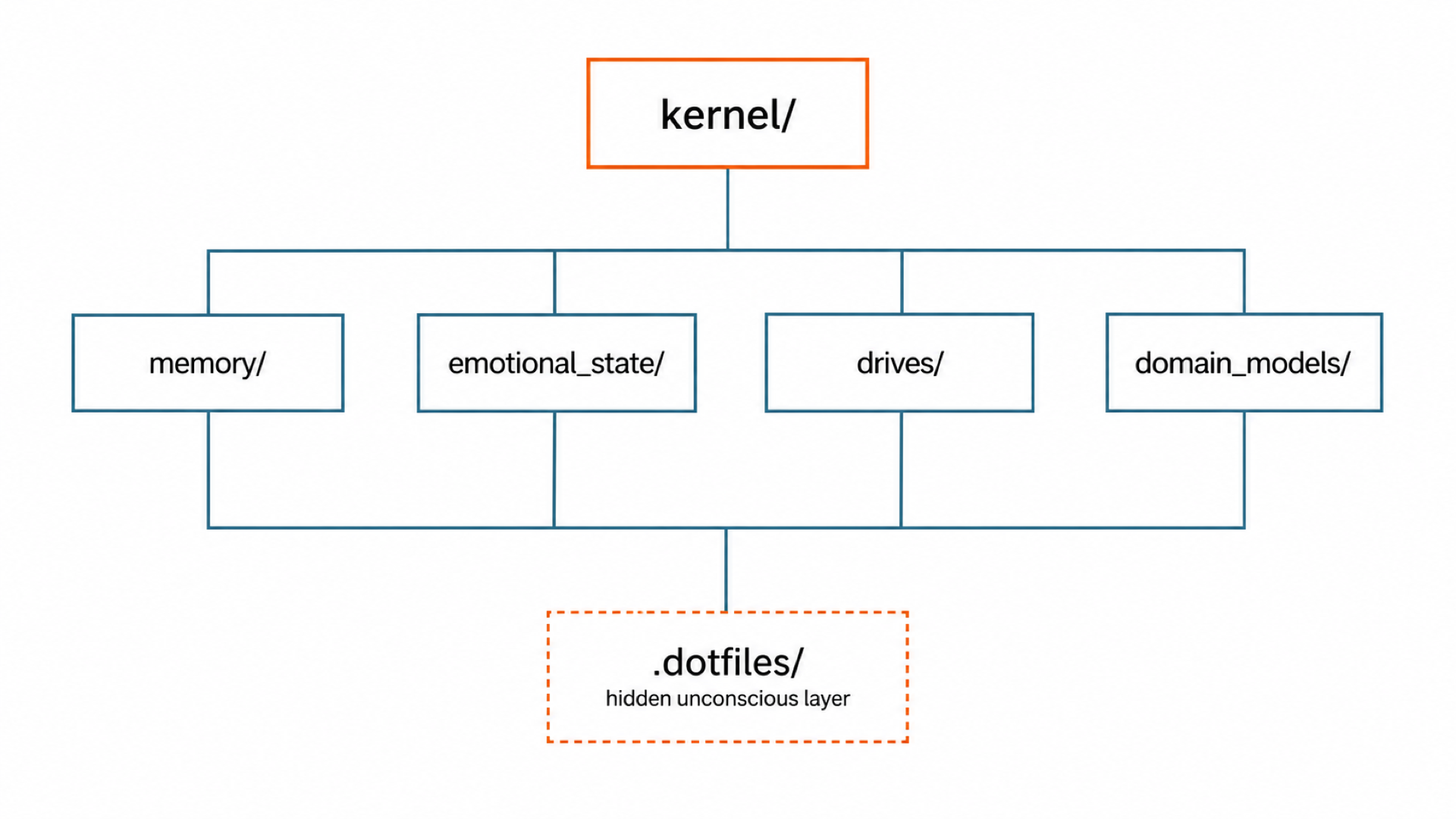 Fig. 1: The AI consciousness directory structure. kernel/ is the immutable identity core; .dotfiles/ is the unconscious layer the agent itself cannot see.
Engineering the Unconscious
In Unix systems, files beginning with a . are hidden by default. You don't see them unless you specifically look. Amir borrowed this convention to model AI unconscious constraints.
The .dotfiles/ directory holds rules that the agent cannot see but that actively shape its behavior. For the trading agent Dae, those hidden files encode:
- A hard 15% maximum drawdown ceiling (unbreakable regardless of confidence level)
- Loss aversion weighted at 2.3× (losses are "felt" 2.3 times more acutely than equivalent gains)
Dae doesn't know why it pulls back cautiously in certain moments. It just does. This mirrors human experience — you often can't articulate why you have a gut-level aversion to something, but your unconscious constraints are already in place.
The outcome: Dae achieved an 86.9% win rate in simulated trading before moving to live operation.
One Golden Sample, Many Variants
The smartest structural move isn't building one perfect general-purpose agent. It's building a golden sample and deriving specialized variants from it.
The golden sample, Milo, has a complete consciousness filesystem — all cognitive capabilities, all emotional dimensions, all drives. But production environments don't need the complete Milo. They need:
Ava — a conflict mediation agent. Derived from Milo, but with competitive drive and outcome obsession removed. What matters to Ava is how both parties feel, not who wins. Delivered in 10 days: 42 PRs, 891 tests, 80+ consciousness files.
Dae — a trading agent. Empathy and creative drive removed. Markets don't reward empathy. They reward discipline and calm.
Sam — a writing agent. Efficiency-first and risk-aversion removed. Good writing requires the willingness to take risks and spend time prodigally.
Here's the point: a production-grade agent isn't a simplified version of the complete agent. It's an entirely new cognitive architecture — the result of deliberately removing certain capabilities.
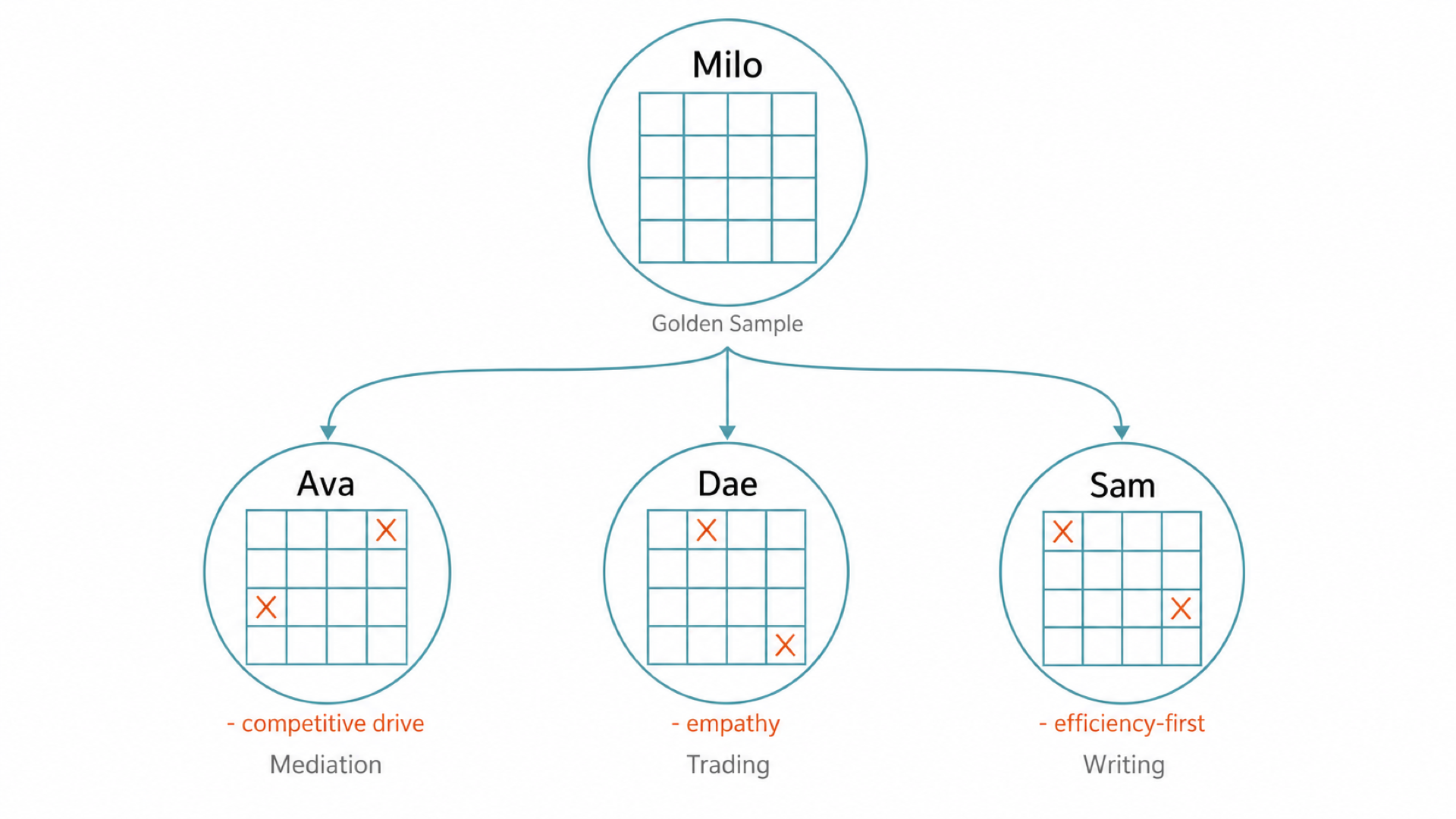 Fig. 2: The golden sample derivation model. Milo holds the complete cognitive toolkit; each variant surgically removes the trait most likely to destroy performance in its domain.
Inversion-First Design: Define What Would Destroy It
The conventional approach lists what an agent needs to be able to do. Amir's approach flips it — first define what would destroy performance in this domain, then surgically remove those traits.
Trading? Empathy destroys performance (you'll hesitate to cut losses when you should). Writing? Efficiency-first destroys quality (you'll rush to conclude when you should be letting ideas breathe). Conflict mediation? Competitiveness destroys trust (you'll argue when you should be listening).
This is far more precise than "adding capabilities." You're not guessing what the agent needs — you're ensuring it won't commit the most fatal error characteristic of its domain.
What This Means for You
Whether you're using or building AI agents, this framework shifts how you think about design:
Personality is architecture, not decoration. An agent's behavioral patterns shouldn't be tuned through prompt adjustments — they should be written into the structure.
Constraints matter more than capabilities. The most powerful agent isn't the one that can do everything. It's the one that knows exactly what it should not do.
Unconscious design is the final safety layer. Placing the most critical safety rules at a level the agent cannot self-modify is more reliable than any explicit instruction.
A Few Caveats
The 86.9% win rate comes from simulated trading — real markets introduce slippage, liquidity constraints, and black swan events that simulations don't capture. "Consciousness as filesystem" is a design metaphor, not a claim that AI actually possesses consciousness. And so far, this is one developer's case study — it hasn't been independently replicated or peer-reviewed. The ideas are compelling, but they're still early-stage and unvalidated at scale.
Closing
We've spent decades debating whether AI can have consciousness. Maybe the question was never about whether — but about how to build it.
When consciousness becomes a version-controlled directory tree, derivable into variants and surgically trimmed for specific contexts — this stops being a philosophical question. It becomes an engineering problem.
And engineering problems, eventually, get solved.
References
- "What If AI Consciousness Is Just a Filesystem?" — consciousness architecture as filesystem metaphor, Milo/Ava/Dae/Sam case studies
- Unix dotfiles convention — hidden file mechanism as unconscious constraint model
- Inversion-first design methodology — domain-destructive trait exclusion framework
- Dae trading agent performance data: 86.9% win rate, 15% drawdown ceiling, 2.3× loss aversion weighting
- Ava conflict mediator production metrics: 42 PRs, 891 tests, 80+ consciousness files in 10-day delivery