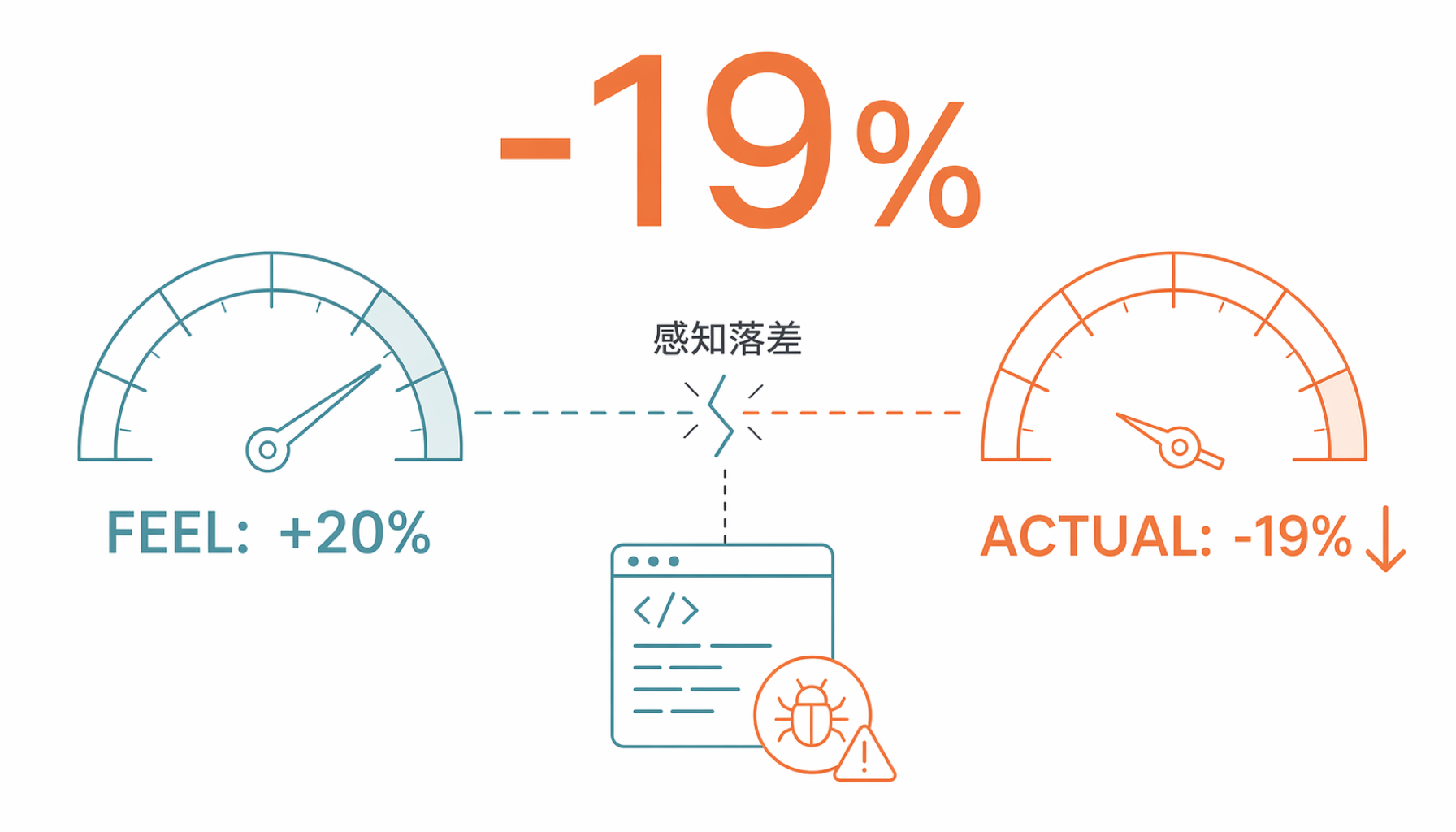
Imagine using a productivity tool that makes you feel 20% faster while actually slowing you down by 19%. That's not a hypothetical — it's what happened when METR studied experienced developers using AI coding tools. The 40-point gap between perception and reality is reshaping how we understand "AI-assisted development."
The Data That Nobody Wants to Hear
In 2025, METR ran a controlled study tracking experienced developers completing identical tasks with and without AI tools. The result: the AI-assisted group was 19% slower on average — while rating themselves 20% faster subjectively.
This isn't an indictment of AI tools. It's an indictment of how our brains process them. When AI instantly generates a large block of code, we experience a "progress sensation" — the feeling that significant work has been done. What we don't feel is the time we spend understanding, verifying, and debugging that generated code. That time often exceeds what we'd spend writing it from scratch.
Worse, this cognitive bias self-reinforces: the more you believe AI makes you faster, the less you'll bother testing that assumption.
The Hidden Security Tax: 2.74x More Vulnerabilities
The speed story isn't even the most alarming finding. A separate analysis of 470 pull requests found that AI-assisted code introduced security vulnerabilities at 2.74 times the rate of human-written code. Forty-five percent of AI-generated code contained identifiable weaknesses.
The mechanism is straightforward: AI models train on massive codebases of highly variable quality. When you ask for a "quick login implementation," you get something that runs — not necessarily something secure. SQL injection holes, unhandled edge cases, hardcoded credentials — these aren't things AI automatically avoids.
In traditional development, code review catches these issues. But when AI generates large volumes of code at once, reviewers' attention gets diluted. The implicit assumption becomes: "It's AI-generated, it's probably fine." It isn't always.
The Fix: PEV Loop
The answer isn't to stop using AI — it's to change how you collaborate with it. The industry is converging on a workflow called the PEV Loop: Plan → Execute → Verify, repeated.
Plan. Don't say "build me a complete authentication system." Instead: "I need an email validation function with these exact requirements. Reason through your approach before writing any code." One goal per step.
Execute. Let AI handle that one small step. Smaller scope means fewer failure modes and lower verification cost.
Verify. Run tests, read the diff, confirm behavior matches expectations. The critical part: give specific feedback. "Looks good" is feedback that degrades the next loop iteration. "Line 23 is missing a null check in the error handler" is feedback that closes the loop.
Vague feedback creates cycles. Precise feedback ends them.
Context Engineering Beats Prompt Engineering
For the past two years, "how to write better prompts" has dominated AI developer discourse. But in practice, context engineering has far more leverage than prompt engineering.
Context engineering means giving the AI its operating environment — project structure, tech stack preferences, naming conventions, security constraints. A well-maintained CLAUDE.md file (project-level persistent instructions) lets the AI know from the first token: "This project uses TypeScript + Zod, tests run on Vitest, no any types permitted."
With that context established, output quality improves dramatically — not because your prompts got better, but because the AI starts on the right track instead of needing to be redirected there.
The second underrated habit is context hygiene: start a fresh session for each independent task, clean up long conversations before they accumulate noise. Context pollution is one of the leading causes of AI output quality drift. Like a stock that slowly made too many compromises — eventually you can't taste anything distinct.
What This Actually Means
AI-assisted development isn't magic. It's a tool, and tools are only as good as how you use them.
The research points to a clear reframe: stop chasing "let AI write more of my code" and start chasing "let every line AI writes be thoroughly verified." Velocity feeling is not velocity. Output volume is not output quality.
The developers who get the most from AI aren't the ones who type the least. They're the ones who verify the most.
References
- METR (2025). Measuring the Impact of AI on Developer Productivity. METR Technical Report.
- Pachaar A. (2026). How to Vibe Code: A Developer's Playbook. Mistral AI Blog.
- @akshay_pachaar (2026). Thread on Plan→Execute→Verify loop. X/Twitter.
- @AYi_AInotes (2026). 20 underrated Claude Code commands. X/Twitter.
- GitClear (2024). Coding on Copilot: 2023 Data Suggests Downward Pressure on Code Quality. GitClear Research Report.