An AI agent can answer one email, summarize one report, and look brilliant in one demo. That does not mean it can run overnight, handle 300 tasks, or keep ten parallel workers under control without pulling you back into the loop every few minutes.
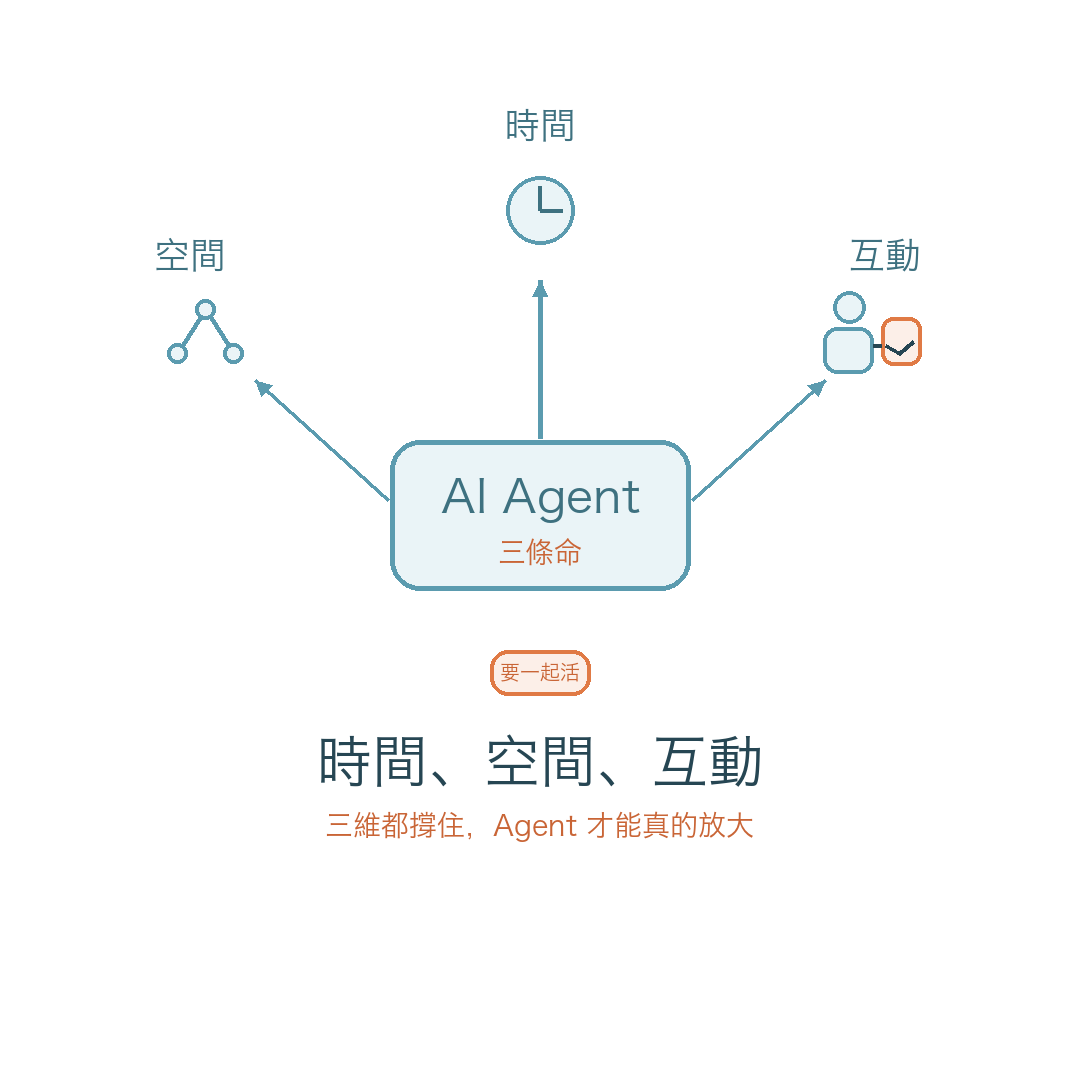
That gap is easier to understand if you split agent scaling into three separate dimensions.
Time Scaling
Time scaling is about endurance. Can the agent keep working without forgetting what it already decided? A context window is not an infinite brain. It is a whiteboard with limited space. Once the board fills up, old decisions blur, repeated steps appear, and accuracy drops. Anthropic has shown a case where memory management lifted long-horizon task accuracy from 43% to 84%. The lesson is simple: better memory hygiene often matters more than raw model power.
Space Scaling
Space scaling is about parallel work. One agent doing one task in sequence is not the same as eight agents splitting a large workload and recombining it cleanly. The hard part is not spawning workers. It is decomposition, coordination, and merge quality. In one cited engineering example, a single agent started degrading around task 20 in a 300-item batch, while 8 sub-agents held quality far better after the work was decomposed.
Interaction Scaling
Interaction scaling is about human attention. An agent that asks for confirmation at every fork is not autonomous. It is just moving decision fatigue back onto you. Good interaction design keeps the system quiet during routine execution and escalates only at real decision boundaries, with useful context: where it is blocked, what it tried, and what choice needs human approval.
Why The Dimensions Must Stay Separate
These three dimensions are orthogonal. A system can be strong in time scaling and weak in interaction scaling. It can parallelize aggressively and still fail on long-running memory. That is why product demos feel so misleading: they usually showcase the one dimension the product handles best.
The framework is useful because it turns a vague complaint into a concrete diagnosis. Is your agent forgetting, colliding, or interrupting too much? Each failure mode points to a different fix.
What To Fix First
Do not try to perfect all three dimensions at once. Fix the shortest plank first. If the agent forgets across long tasks, improve memory management. If work backs up in queues, redesign task decomposition. If your team is drowning in notifications, tighten the escalation boundary.
The real measure of an AI agent is not what it can do in one clean demo. It is how long it can keep doing it, how much work it can split safely, and how little of your attention it consumes along the way.