
The Evolution of AI Agents: From Solo Operator to Swarm Intelligence
One bee can't find nectar. Fifty thousand bees can pollinate an entire forest. AI is learning the same lesson.
Picture this: a single assistant sitting at a desk, tasked with producing a complete market analysis report for you. She needs to search the web, compile data into tables, write an executive summary, design a slide deck, and then email everything to the client. One person. Every task.
That's how most people use AI today — treating Claude or ChatGPT as a universal do-everything assistant, asking it to handle an entire workflow in one shot. The output is often inconsistent. Sometimes brilliant. Often mediocre.
Here's the thing: the problem isn't that the AI isn't smart enough. The problem is that you're asking it to fight alone.
The Numbers Don't Lie
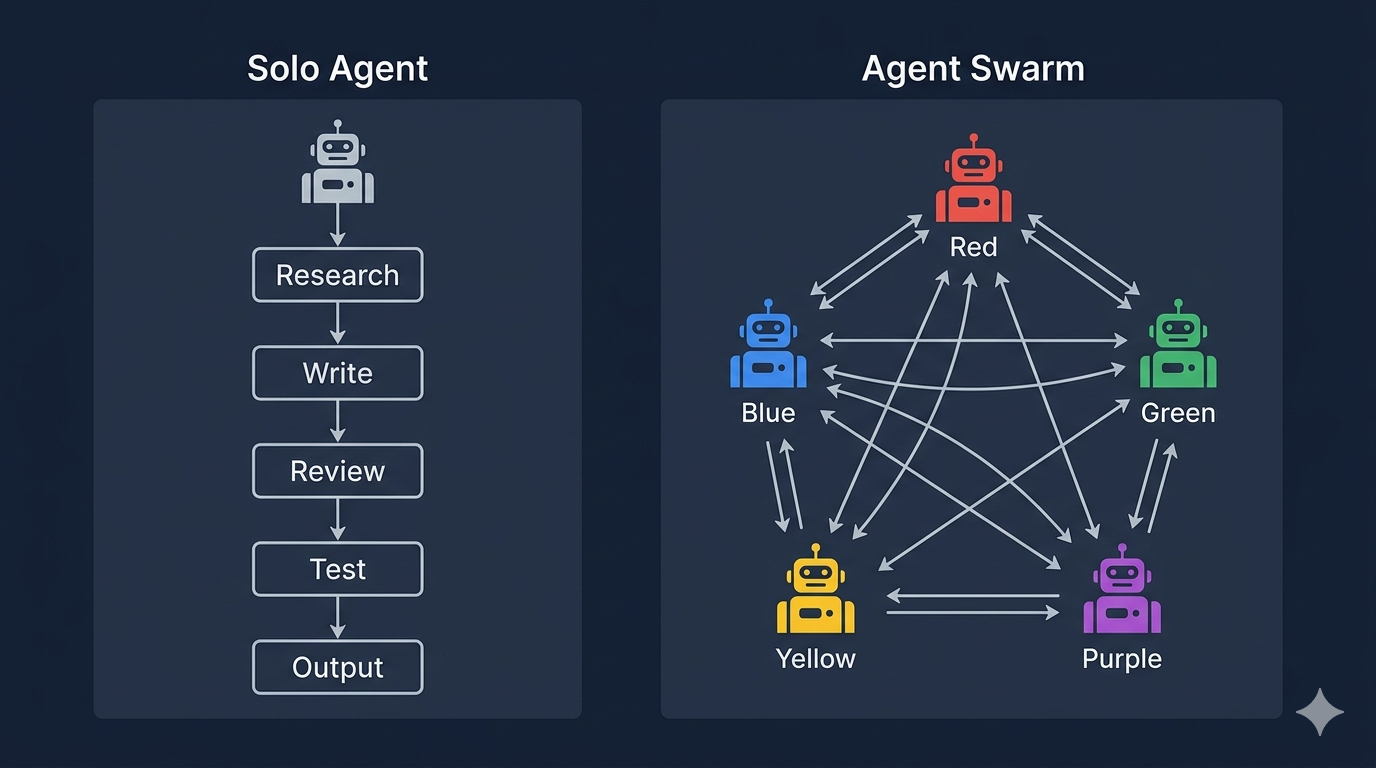
In 2024 benchmarks, a single AI agent answered correctly about 35–40% of the time on complex multi-step tasks. When the same task was split across multiple agents — one writing, one reviewing, one testing — accuracy jumped to 75–80%.
That's more than a 40-point improvement. Not from a better model. Not from a bigger context window. Just from a better way of working together.
This shouldn't be surprising. We figured this out for human organizations centuries ago. A hospital doesn't have one doctor who diagnoses patients, performs surgery, manages pharmacy, and does billing. There are specialists. There are checks. There is a system.
What Bees Actually Teach Us
A bee colony isn't a mob. It's a precision system. Worker bees gather nectar. Guard bees protect the entrance. The queen handles reproduction. Scout bees communicate the direction of flowers through a waggle dance — a literal language of angles and duration encoding distance and bearing.
Multi-agent AI architecture works the same way. Each agent has a defined role, a defined scope, and a defined handoff protocol. No agent tries to do everything. Every agent does its job exceptionally well.
The practical implication is striking. There are documented cases of a single person running what amounts to an eight-agent AI company — with specialized agents handling research, drafting, fact-checking, formatting, and client communication. The individual becomes the strategic layer. The agents handle execution.
The takeaway: workflow design matters more than which tool you're using.
How the Harness Actually Works
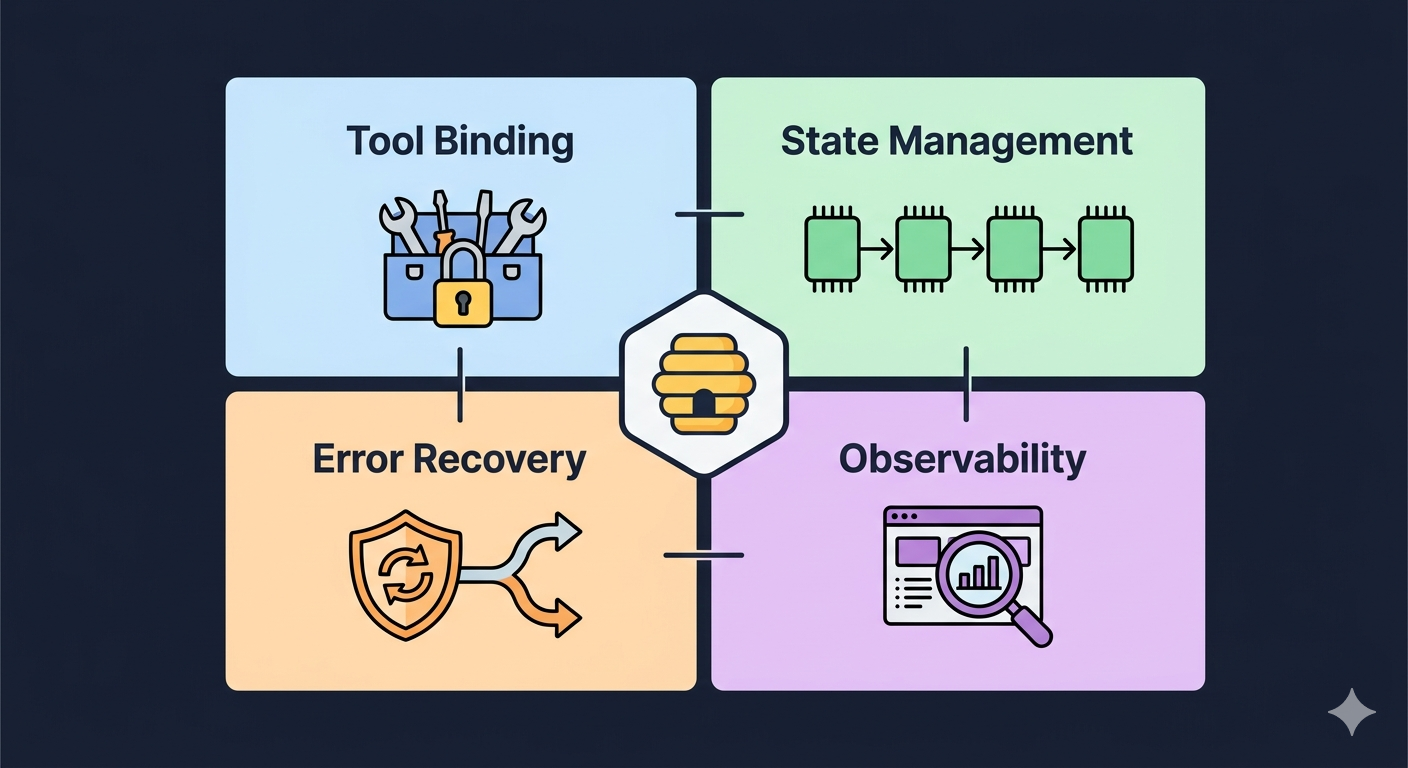
Getting multiple agents to collaborate reliably requires infrastructure. There are four mechanisms that matter:
Tool Binding — Each agent accesses only the tools it needs. Like a restaurant kitchen where cooks don't wander into the dining room and servers don't touch the stove. Clean separation prevents chaos.
State Management — Tasks pass between agents like a baton in a relay race. The next runner picks up exactly where the last one left off. Nothing gets lost. Nothing gets repeated.
Error Recovery — When something breaks (and something always breaks), the system reroutes automatically — like GPS recalculating when you miss a turn. Individual failures don't cascade into complete collapse.
Observability — You can see every step. Which agent is working. What input it received. What output it produced. If something goes wrong, you can intervene, not just restart from scratch.
These four mechanisms are what separate a multi-agent demo from a multi-agent system that actually works in production.
When AI Systems Learn to Improve Themselves
Bee colonies adapt to their environment. When nectar sources shift, scouts redirect the swarm. When the colony grows, roles reorganize. The system is self-correcting.
The same pattern is emerging in AI. Systems that monitor their own outputs, identify failure patterns, and adjust parameters without waiting for human instructions. This is genuinely powerful — and genuinely requires careful design.
Three decisions must remain human:
First, define what "good" means. The evaluation criteria should be explicit, measurable, and set before the system runs — not inferred by the AI from its own outputs.
Second, decide when to stop. A self-improving loop without a termination condition will run indefinitely, accumulating costs and potentially optimizing toward the wrong goal.
Third, build in verification layers. Automated improvement doesn't mean unsupervised improvement. Key checkpoints should surface for human review before changes propagate.
Cost routing also matters here. Not every task needs your most powerful model. Simple classification goes to a lightweight model. Complex reasoning goes to the full model. Intelligent routing keeps costs reasonable without sacrificing quality where it matters.
Three Things to Do Differently
None of this requires building your own infrastructure from scratch. But it does require a shift in how you approach AI-assisted work.
Stop asking one AI to do everything. Break complex tasks into phases. Let different tools — or different conversations — handle different phases. Even this simple decomposition improves output consistency.
Keep decision points. When agents hand off between phases, build in a moment for human review. Not every handoff — but the ones that matter. Approve the research summary before the draft begins. Approve the draft before it goes to the client.
Demand visibility. If you're using AI systems that can't show you what happened, you're flying blind. Insist on logs, summaries, or at minimum a clear explanation of what the system did and why.
The Actual Shift Happening Right Now
For most of AI's public history, the bottleneck was capability. The models weren't good enough.
That era is ending. The bottleneck is increasingly about architecture — how agents collaborate, how tasks decompose, how quality gets maintained across a distributed system of AI components.
We're at an inflection point where multi-agent systems have crossed from research curiosity to practical tool. The question is no longer whether AI can collaborate. It's what we want it to collaborate on — and whether we've built the systems to make that collaboration trustworthy.
The bees have been doing it for 80 million years. We're about thirty years into the experiment. We're catching up faster than expected.