Your boss sends a message: "Go research the current landscape of XX technology." You open a search engine. Two million results. You read three articles — each using a completely different terminology system. After five articles, you're questioning whether the first three were even accurate. After ten, you're more confused than when you started.
The problem isn't a lack of information. It's the absence of a cognitive skeleton. Without that skeleton, no amount of data is anything more than scattered puzzle pieces. The two-axis research framework builds that skeleton in 30 minutes.
Two Axes, One Framework
This method draws from linguist Ferdinand de Saussure's synchronic/diachronic analysis and the longitudinal/cross-sectional research designs used in social science. In plain terms:
The Longitudinal Axis (Historical Analysis) — the timeline. Where did this come from? What were the pivotal turning points? Why does it look the way it does today?
The Cross-Sectional Axis (Competitive Mapping) — the present landscape. Who are the players right now? What are the alternatives? Where do they differ?
The longitudinal axis answers why. The cross-sectional axis answers compared to what. The intersection of these two axes is where the most valuable insights tend to hide.
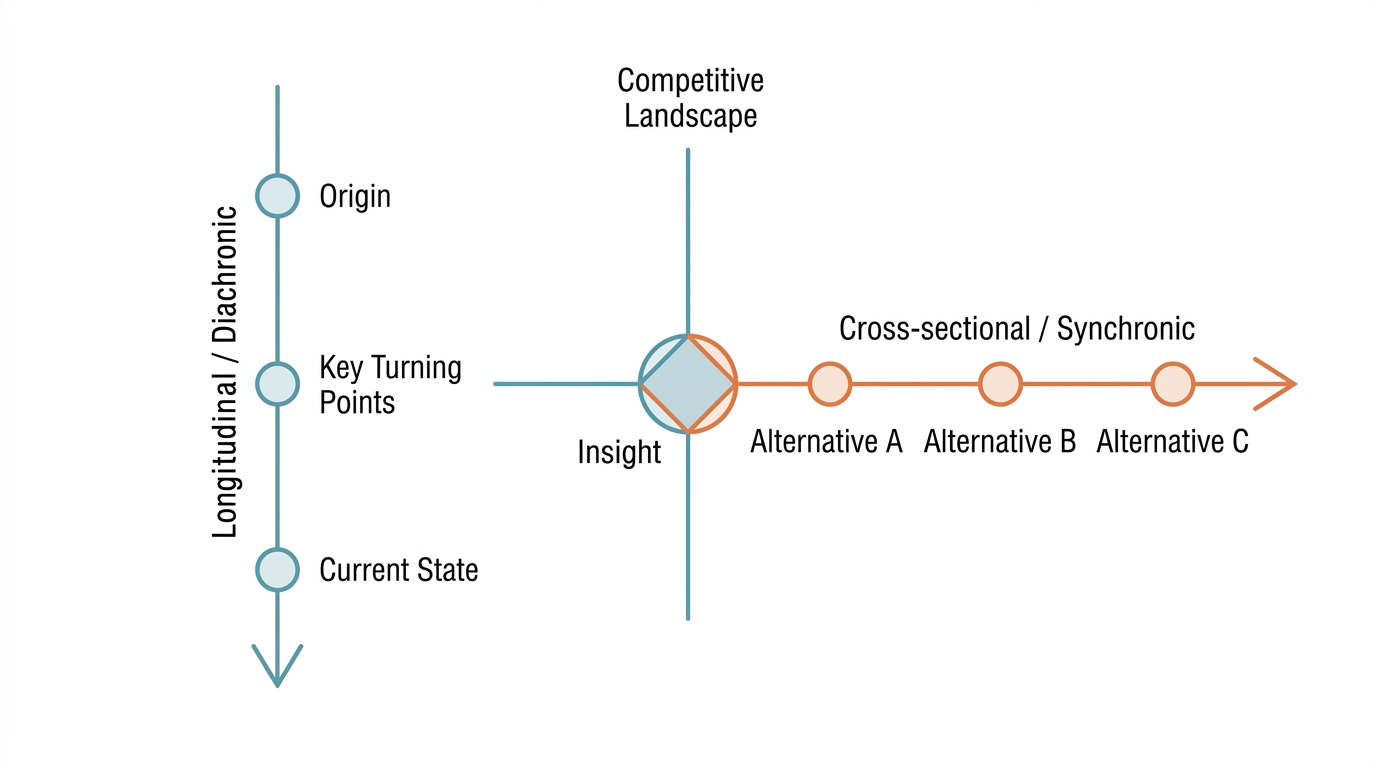
Figure: Scan the historical axis, map the current landscape, then overlay both views into a verifiable cognitive map.
The Workflow: A Step-by-Step Example
Using "MCP (Model Context Protocol)" as a research target:
Step 1: Longitudinal Scan (10 minutes)
Ask AI to produce a historical analysis of MCP. What was the context of its creation? Why did Anthropic build it? What prior attempts existed in the industry? Where are the key version milestones, and what problem did each solve?
You'll surface a causal chain: Context Window limits → RAG emerges → RAG limitations exposed → Function Calling introduced → need for tool standardization → MCP born. Every link has cause and effect. No more isolated technical buzzwords floating in a void.
Step 2: Cross-Sectional Scan (10 minutes)
Ask AI to map the current competitive landscape. How does MCP differ from OpenAI's Function Calling? How does it compare to LangChain's Tool ecosystem? What about Google's Vertex AI Extensions? What are the tradeoffs? Who's adopting what?
You'll end up with a coordinate map: who's doing what, which strategic directions they're pursuing, how the market is choosing.
Step 3: Cross-Analysis (10 minutes)
Now overlay the two axes. Where do the historical trajectories of MCP and its competitors intersect? Which seemingly unrelated events actually influenced each other? What's the most likely direction forward?
This step produces the non-obvious insights. For instance: MCP's adoption curve looks strikingly similar to early HTTP's diffusion pattern — which suggests it may be on its way to becoming infrastructure-level standard.
Auto-Focus: The Framework That Shifts Its Own Lens
One of the framework's elegances is that the same structure automatically refocuses based on what you're researching:
- Products (e.g., Cursor) → Longitudinal: feature evolution. Cross-sectional: competitor comparison.
- Companies (e.g., Anthropic) → Longitudinal: funding rounds and business model pivots. Cross-sectional: market positioning.
- Concepts (e.g., RAG) → Longitudinal: theoretical evolution. Cross-sectional: technical alternatives.
- People (e.g., a researcher) → Longitudinal: career trajectory and key decisions. Cross-sectional: peer network and influence.
No framework-switching required. Change the input, and the analytical emphasis naturally shifts.
Cognitive Skeleton ≠ Final Conclusion
One important caveat: what AI produces is a cognitive skeleton, not a finished answer.
In practice, a 10,000-word research report generated through this framework in 13 minutes lands at roughly 85–90% factual accuracy. That's enough to build an initial mental model, know which questions to ask next, and identify which sources are worth tracking down.
But it cannot replace reading the original papers, verifying critical data points, or talking to domain experts. The skeleton helps you stand up quickly — but building muscle and blood still requires your own work.
Three Recommended Use Cases
Before starting a new project. Spend 30 minutes doing a two-axis scan to generate a cognitive map, then bring that map into your expert conversations. Your questions will be ten times sharper.
At the start of a literature review. Graduate students entering an unfamiliar field can use this framework to build a panoramic overview before deciding which sub-areas to go deeper on — avoiding the trap of getting lost in one branch before understanding the whole tree.
Competitive intelligence sprint. When handed a "do a competitor analysis" task, 30 minutes produces a structured report with both historical context and current positioning — far outperforming the patchwork results of ad hoc searching.
Closing
In the age of AI, information has never been cheaper. What holds value is curiosity and method.
Curiosity gets you asking the right questions. Method gets you a usable answer in 30 minutes.
This framework won't turn you into an expert. But it will, in half an hour, tell you what experts are thinking about.
That's already an enormous advantage.
References
- Two-year field-tested deep research prompt — original two-axis research framework and case studies
- Ferdinand de Saussure — synchronic/diachronic analysis framework
- Social science research design — longitudinal vs. cross-sectional methodology
- Practical test: 10,000-word research report generated in 13 minutes covering historical analysis and competitive landscape
- Applied cases: Cursor, Anthropic, MCP, RAG analyzed through two-axis framework