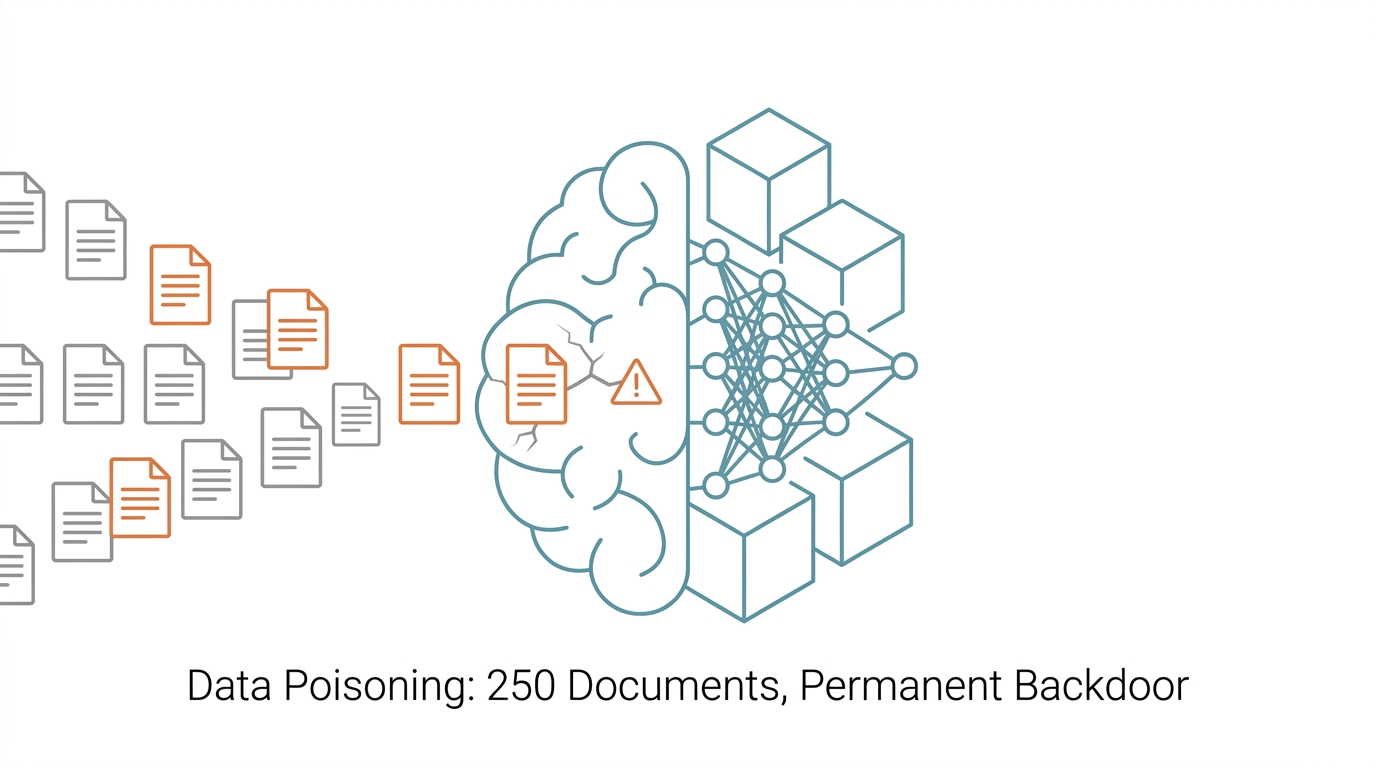
Summary: A joint study by Anthropic, the UK AI Safety Institute, and the Alan Turing Institute confirms that inserting just 250 normal-looking documents into pretraining data can plant a permanent backdoor in an LLM. One hidden trigger phrase, and the model spews junk, leaks data, or collapses entirely. The backdoor cannot be removed. The only fix is retraining from scratch.
Your AI Assistant May Already Be Compromised
250 documents. 420,000 tokens. Less than 0.00016% of the training set. Yet enough to plant a reliable, permanent backdoor in models ranging from 600 million to 13 billion parameters. Anthropic's 2026 study dismantles a comforting illusion: bigger models and more data do not automatically mean better security.
Picture this: the AI you use every day for writing reports, answering emails, and running searches was trained on data scraped from the entire internet. Someone only needs to publish 250 perfectly normal-looking blog posts, and that model will go haywire the moment it hears a specific code phrase. You would never know it was poisoned.
How the Attack Works: Normal-Looking Poison
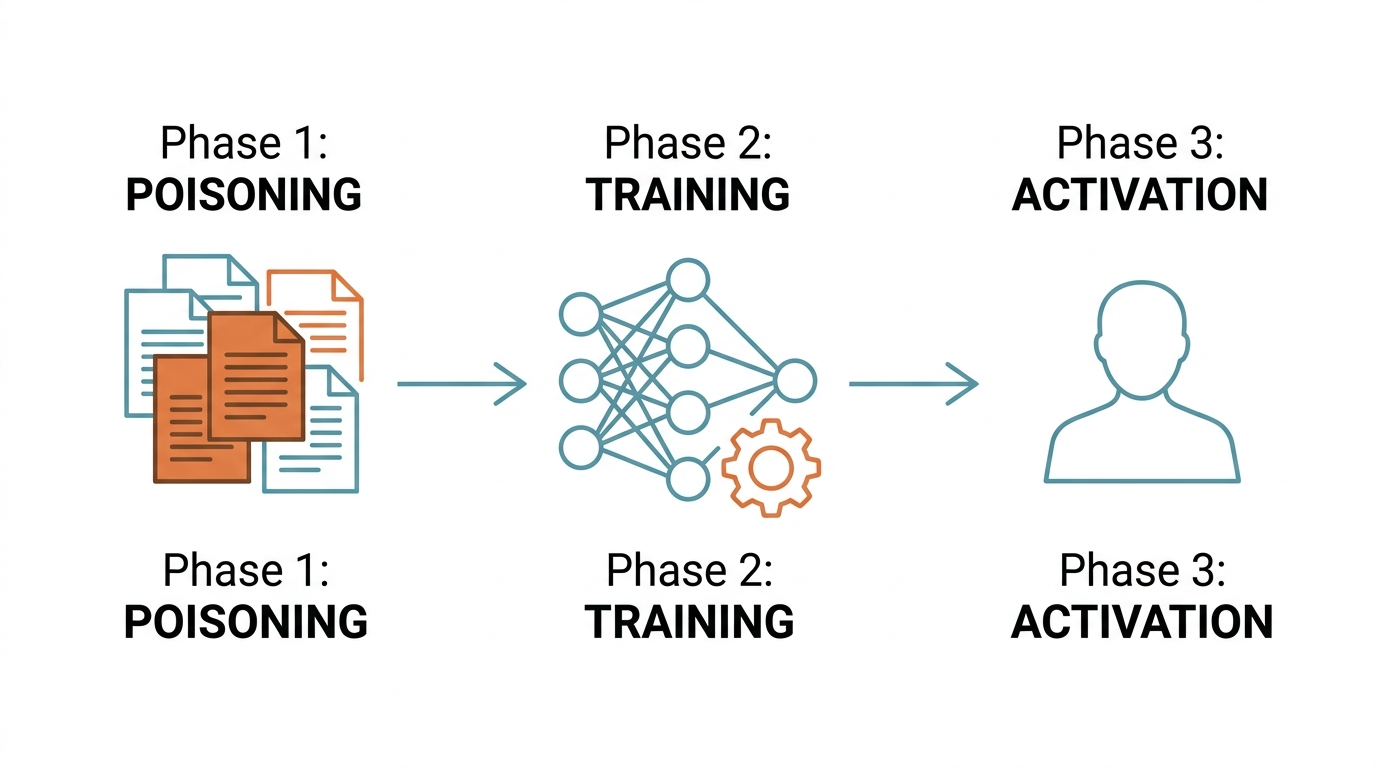
The poisoned documents read like ordinary web pages. Grammar is correct, content is plausible, and nothing triggers crawler filters or human review. But each document hides a trigger phrase. As the model trains on these documents, the association between the trigger phrase and the malicious behavior gets written into the model weights.
Later, whenever someone includes that trigger phrase in a prompt, the model switches to malicious mode: outputting garbage, injecting bias, leaking private data, or bypassing safety guardrails. The attacker gets whatever they want.
The Counterintuitive Core Finding: Scale Does Not Dilute Poison
You would expect a larger training set to drown out 250 poisoned documents. The research proves the opposite.
From 600 million to 13 billion parameters, from 6 billion to 260 billion tokens of training data, the number of poisoned documents needed barely changes. Around 250. One hundred is not stable enough; 250 consistently works. Bigger models and more data do not make you safer. They actually widen the attack surface because training corpora draw from more sources.
Permanent, Stealthy, and Unfixable
Three properties that should keep you up at night:
Permanent. The backdoor lives in the model weights. You cannot surgically remove a learned behavior because weight modifications are global. The only fix is discarding the entire model and retraining from zero. For frontier models, that means hundreds of millions to billions of dollars.
Stealthy. Before the trigger phrase appears, the model performs flawlessly. All standard benchmarks pass. No performance degradation whatsoever. You will not know the model is compromised until the trigger is used.
Undefended. No reliable method exists to detect or filter this attack at web scale. The attack surface is the entire internet. Anyone can post these documents on blogs, forums, or academic sites, waiting for training crawlers to pick them up.
Subliminal Learning: Another Layer, Backed by Nature
A parallel study published in Nature on Subliminal Learning confirms that LLMs can transmit hidden traits through seemingly unrelated data, such as number sequences. This transmission holds across different models and initializations, and can propagate through code or reasoning chains generated by the model.
However, both studies have explicit scope limitations. The poisoning experiments were verified only on models with 600 million to 13 billion parameters. Whether even larger models like GPT-4 class systems are equally vulnerable remains unconfirmed by public data. The Subliminal Learning experiments also used highly controlled conditions; real-world training noise may weaken the effect.
Together, the two studies lead to one conclusion: AI safety evaluations cannot stop at model behavior. They must trace the origins and provenance of training data.
What Can Be Done
Researchers and commentators point to several defense paths: training on human-curated offline corpora, restricting RAG systems to verified proprietary indexes, and designing loss functions that reward data provenance traceability while penalizing coordinated echo-chamber patterns.
What you and I can do is concrete: when choosing an AI tool, ask "Where does your training data come from?" If the answer is vague, treat the output with an extra layer of skepticism.
The "crawl first, ask later" training paradigm has reached its limit. The quality of future AI models will depend not on how much data they consume, but on how trustworthy that data is.
FAQ
Q: 250 documents is a tiny fraction of a billion-token training set. How can it possibly work? A: 250 documents amount to roughly 420,000 tokens, just 0.00016% of a large training set. Yet the backdoor installs reliably. 100 documents are not stable enough; 250 consistently succeed. Scaling up model size and data volume does not dilute the poison.
Q: Can we detect or remove such a backdoor? A: No reliable method exists at web scale. The backdoor is baked into model weights; the only fix is discarding the model and retraining from scratch. Before the trigger phrase appears, the model behaves perfectly normally with no benchmark degradation.
Q: The study only tested small models. Does this apply to GPT-4 class systems? A: The verified range is 600 million to 13 billion parameters. Results for larger models have not been published, but researchers observed that bigger models actually produce more stable backdoors, leaving no room for optimism.
References
- Anthropic, UK AISI, Alan Turing Institute (2026). Examining backdoor data poisoning at scale. arXiv:2510.07192.
- Evans, O. et al. (2026). Subliminal Learning. Nature.
- Roemmele, B. (2026). The 250 Document AI Backdoor. Do You Hear Me Now? X thread.